

Your credit isn’t a scorecard of your worth; it’s a strategic asset that determines whether you’re the hunter or the hunted in the Canadian market. Most people live in fear of a single late payment, yet Equifax Canada reported in late 2023 that average consumer debt reached C$21,296, leaving millions feeling trapped by their own balance sheets. It’s time to stop playing defense. Mastering your credit and credit score is the first step toward shifting from a position of debt-fueled anxiety to one of absolute financial dominance.
I know you’re tired of feeling like the big five banks hold your future hostage every time your score fluctuates. You’re ready to stop asking for permission and start dictating terms. This guide is your blueprint to transform that plastic in your wallet into a high-performance tool for wealth creation and asset protection. We’re breaking down the tactical moves to leverage your reputation for massive asset acquisition and the specific mindset shifts required to make your financial legacy truly indestructible. Let’s get to work.
Key Takeaways
- Stop viewing credit as a burden and start treating it as your financial reputation—the ultimate grade for your performance in the Canadian market.
- Master the five specific pillars that move the needle on your credit and credit score to protect your breakthrough from a single 30-day delinquency.
- Shift your mindset from “debt is evil” to strategic leverage, using your credit as a tool to acquire cash-flowing assets rather than consumer liabilities.
- Execute a high-impact audit of your report to eliminate errors and trigger a rapid re-score that aggressively boosts your borrowing power.
- Move beyond the 800+ score finish line and learn how to use your credit mastery to fund your own bank and build an indestructible legacy.
Credit and Credit Score: The Rules of the Financial Game
Credit isn’t just a number on a screen. It’s your financial reputation in the eyes of the global market. Think of it as your passport to the world of wealth. Without a stellar reputation, you’re stuck at the border while others fly first class. Mastering your credit and credit score is the first step toward building a legacy that lasts for generations. You aren’t just managing debt; you’re building leverage.
You must understand the distinction between your credit report and your score. Your report is the history. It’s the detailed narrative of every financial move you’ve made over the last six to seven years. Your score is the grade. It’s a snapshot of your current risk level. Many Canadians settle for “good enough” scores in the 600s. That mindset is the enemy of financial mastery. If you’re playing for “average,” you’ve already lost the game.
The high cost of low credit is staggering. A mediocre score drains your wealth through death by a thousand cuts. Consider a C$500,000 mortgage. A borrower with a top-tier score might secure a rate 1% lower than someone with “average” credit. That 1% difference costs you roughly C$5,000 every single year. Over a 25-year amortization, you’ve handed C$125,000 of your hard-earned wealth to the bank. That’s money that should be in your investment portfolio, not their pocket.
The Anatomy of a Credit Report
In Canada, Equifax and TransUnion compile your financial story using four primary data pillars. They track your personal information, your history of open and closed accounts, every formal inquiry made by lenders, and any public records like bankruptcies or consumer proposals. Understanding what a credit score is requires looking at these raw data points first. The Consumer Disclosure is the definitive record of your financial character.
Why Your Score is a Moving Target
Your score isn’t static. It’s a living, breathing metric that shifts based on the lender’s specific needs. An auto lender uses a different algorithm than a mortgage broker. As we approach 2026, economic shifts are forcing lenders to focus more on real-time liquidity and cash-flow patterns rather than just historical data. They want to see how you handle volatility today, not just how you paid bills in 2019. Don’t be afraid to monitor your progress. Checking your own score is always a soft inquiry that never hurts your standing. If you’re ready to stop guessing and start winning, it’s time for The Wakeup Call.
Decoding the Score: What Actually Moves the Needle in 2026
Your credit score isn’t a static number. It’s a living, breathing reflection of your financial discipline. In the Canadian market, Equifax and TransUnion use five specific pillars to judge your worthiness. If you want to achieve financial mastery, you must understand the weight of these metrics. Payment history dominates at 35%. One single 30-day delinquency can slash a 780 score by 110 points in a single reporting cycle. That is a breakthrough-killer. It signals to lenders that you are losing control. Next is utilization at 30%, followed by credit history length at 15%, credit mix at 10%, and new inquiries at 10%. Stop treating these as suggestions. They are the laws of the game.
Many amateurs believe a single credit card is enough. That is a myth. To build a high-performance profile, you need a diverse credit mix. Lenders want to see you handle different financial weapons, such as a mortgage, a car loan, and a revolving line of credit. This variety proves you can manage complex debt structures over the long term. If you are looking for the exact blueprint on how to improve your credit score, you must start by optimizing these five pillars with clinical precision.
Mastering the Utilization Ratio
High-performers don’t just stay under the 30% limit; they crush it by keeping balances below 10%. This is the hallmark of financial elite. To win this game, you must understand the gap between your “Statement Date” and your “Due Date.” If you pay your balance on the due date, the high balance has already been reported to the bureaus. Pay the full amount two days before the statement date instead. This ensures a 0% or 1% utilization is reported, giving you an instant score optimization. You can also call your bank every 6 months to request limit increases. Always ask if they can do this without a hard credit check to protect your points.
The Longevity Factor
Closing an old account is a tactical error that destroys your score’s age. Your oldest account is the anchor of your legacy. When you close a 10-year-old card, your average age of accounts drops instantly, which can trigger a 40-point slide. Keep those old lines open, even if you only buy a coffee on them once a year. Credit diversity is about proving resilience across multiple leverage points. Managing three or four active lines of credit shows you have the capacity for high-level performance. If you want to audit your current strategy, let’s map out your path to mastery together. Your credit and credit score should be a tool for growth, not a barrier to your impact.
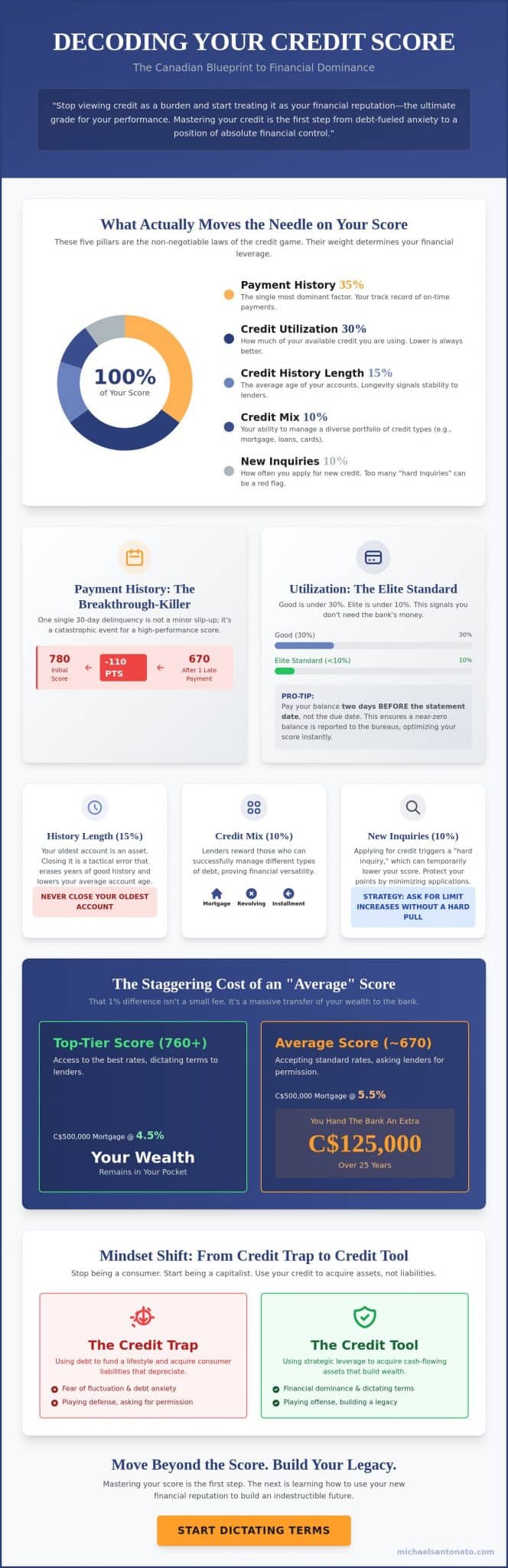
The Credit Trap vs. The Credit Tool: A Mindset Shift
Stop listening to the “debt is evil” choir. They’re teaching you how to stay small. If you want to be financially indestructible, you must stop viewing credit as a safety net for your failures and start seeing it as fuel for your growth. Most Canadians treat their credit and credit score like a fragile glass ornament. They’re too afraid to touch it, so they never use it. That’s a mistake that costs millions in lost opportunity over a lifetime.
The difference between a trap and a tool is the direction of the cash flow. Are you paying for a lifestyle you can’t afford, or are you funding an asset that pays you back? To master this, you need to understand what is a credit score? and how it acts as your financial reputation in the marketplace. It isn’t just a number; it’s your ability to command capital at will. The wealthy don’t work for money; they make their credit work for them.
Consumer Debt vs. Strategic Leverage
Toxic debt is the silent killer of Canadian legacies. It’s the C$15,000 balance on a retail card at 28% interest used for a vacation that lasted seven days. That isn’t leverage; it’s a parasite. Strategic Leverage is the use of OPM (Other People’s Money) to accelerate wealth. When you use a C$100,000 business line of credit to secure a cash-flowing property or scale a proven sales funnel, you aren’t “in debt.” You’re in position. Credit should be a bridge to liquidity, not a permanent crutch for poor cash management.
The Fear of the Check: Overcoming Inquiry Anxiety
I see it every day. Entrepreneurs are terrified of a “hard inquiry.” They treat a 5-point dip like a cardiac arrest. Get over it. In a high-stakes environment, your credit and credit score are meant to be used. Hard inquiries stay on your report for up to 36 months in Canada, but their impact on your score usually fades within 12 months. If you aren’t using your credit to expand, why do you even have it?
- Bundle your moves: Apply for related credit products within a 14 day window. Credit bureaus often treat these as a single event for scoring purposes.
- Know the difference: Soft inquiries for pre-approvals or personal checks don’t touch your score. Use them to scout the terrain before you strike.
- Focus on the prize: A C$50,000 increase in available capital is worth a temporary 10-point dip. Don’t step over dollars to pick up pennies.
Psychological resilience is the hallmark of the high-achiever. They don’t fear the bank; they partner with it. If you want to protect your family and build a fortress, you need to learn how to manage large lines of credit without flinching. Mastery over your finances starts with removing the emotional weight from the numbers. You can find more resources to protect your assets and align your credit strategy with the Financially Indestructible framework.
The Mastery Protocol: How to Repair and Optimize Your Score
Your credit and credit score represent more than a number; they are your financial reputation in the Canadian marketplace. If you aren’t auditing your reports from Equifax and TransUnion at least once every 12 months, you’re leaving your legacy to chance. A 2021 study by Consumer Reports found that 34% of consumers discovered at least one error on their credit reports. These mistakes are literally stealing your wealth by forcing you into higher interest rates. Stop letting the bureaus dictate your worth. Take control now.
- Step 1: Audit your report. Scrutinize every line for errors that drain your potential. Look for accounts you didn’t open or debts you’ve already cleared.
- Step 2: Execute the Rapid Re-score. Target high-utilization lines aggressively. If you’re carrying a C$5,000 balance on a C$10,000 limit, you’re at 50% utilization. Slice that to under 10% immediately to see a massive point jump within 30 days.
- Step 3: Dispute systematically. Don’t just click a button online. Be persistent. Force the bureaus to prove the accuracy of every negative mark.
- Step 4: Automate your discipline. Set every minimum payment to autopay. Your payment history accounts for 35% of your total score. One missed payment can tank a 750 score by 100 points instantly.
- Step 5: Diversify your portfolio. Show lenders you can handle different asset classes. Mix revolving credit with installment loans to demonstrate total mastery.
The Dispute Process: Fighting for Your Reputation
Identify common bureau blunders like double-reported debts, outdated balances, or identity mix-ups where a stranger’s failure is attached to your name. Don’t settle for digital dispute forms that limit your evidence. Use the “Certified Mail” strategy. Send a physical, documented letter to the bureau’s headquarters. It creates a legal paper trail they cannot ignore. This forces a 30-day investigation window under Canadian provincial consumer protection acts. Keep copies of every piece of correspondence. Your financial legacy depends on your ability to prove your excellence.
Rapid Optimization Tactics
Need a breakthrough fast? Use the “Authorized User” shortcut. Piggyback on a trusted partner’s long-standing account to instantly inherit their positive history. If you’re rebuilding from zero after a setback, a secured card is your high-octane fuel. Deposit C$500 and use it as a surgical tool for rapid reconstruction. For a deeper dive into the exact strategies that scale your net worth, get the book for a deeper dive into financial strategy. Mastery requires the right tools and a relentless mindset.
Ready to stop playing defense and start dominating your financial future? Book your strategy session today and let’s build your blueprint for indestructibility.
Beyond the Score: Building a Financially Indestructible Legacy
Most Canadians think hitting a 750 or 800 score is the finish line. They’re wrong. That number isn’t a trophy to hang on the wall; it’s a high-performance tool meant to be used. If you have a perfect credit and credit score but your net worth is stagnant, you’re failing to play the game. True financial mastery means moving beyond the vanity of the number and using your reputation to command capital at the lowest possible cost. It’s about transition from being a consumer to being a producer who controls their own financial ecosystem.
Credit and the Infinite Banking Concept
The Infinite Banking Concept (IBC) is the ultimate strategy for Canadians who want to take back control from the big banks. To do this effectively, you need specialized participating whole life insurance. Your credit score is the key that unlocks the best terms for any supplemental lending you might need to accelerate this system. When you have an elite credit and credit score, you can use credit as a secondary layer of liquidity. This allows you to keep your own capital compounding tax-free while using a bank’s money at prime rates to fund business acquisitions or real estate deals. You aren’t just borrowing; you’re scaling with purpose. You’re building a private banking system where every dollar does two jobs at once.
- Tier 1 Access: High scores ensure you get the absolute lowest interest rates from Canadian lenders, maximizing your arbitrage.
- Strategic Liquidity: Use credit lines to bridge gaps without interrupting the compounding growth of your core assets.
- Wealth Craft: Move from simple saving to sophisticated wealth engineering.
The Path to Financial Indestructibility
Financial indestructibility requires a holistic pursuit of excellence. It’s not just about one account or one score. It’s about how you integrate your credit profile into a broader plan for business growth and asset protection. In Canada, nearly 50 percent of small businesses struggle with cash flow. Don’t let that be you. Use your credit to build a fortress around your family’s future. Your financial legacy isn’t something that happens by accident ten years from now. It’s the direct result of the aggressive actions you take today. Stop watching from the sidelines. Stop being a spectator in your own life. It’s time to master your craft and secure your destiny.
Are you ready to stop playing small and start building a legacy that lasts for generations? The window of opportunity is open, but it won’t stay that way forever. Take the lead and commit to your growth right now. Join the Financially Indestructible Coaching Program and get the blueprint for total financial dominance.
Stop Spectating and Start Building Your Legacy
You’ve seen the blueprint. Mastering your credit and credit score isn’t about playing defense; it’s about weaponizing your capital to build a Canadian legacy that survives any market shift. We’ve decoded the 2026 scoring updates and mapped out the mastery protocol. Now, you face a critical choice. You can keep reacting to bank statements, or you can start dictating the terms of your own success. Don’t let another year slip by in a cycle of financial mediocrity.
I’ve spent over 10 years mentoring high-performing entrepreneurs and implementing the Infinite Banking Concept to create bulletproof wealth. As the founder of the Financially Indestructible Framework, I know that theory doesn’t pay the bills. Results do. It’s time to stop guessing and start executing with the precision of a professional. Your financial future isn’t a game of luck. It’s a game of strategy, and the board is set in your favour if you know the moves.
Master your financial destiny with the Financially Indestructible Coaching Program
Your breakthrough is waiting on the other side of this decision. Let’s build something indestructible together.
Frequently Asked Questions
How often should I check my credit report and credit score?
Check your credit and credit score at least once every 30 days to maintain total financial situational awareness. Under Canadian law, you’re entitled to free reports from Equifax and TransUnion. Why wait for a lender to tell you there’s a problem? Regular monitoring allows you to spot identity theft or reporting errors; do it before they sabotage your next big deal. Mastery requires constant vigilance, not occasional glances.
Can I really get my credit score to 850, and does it actually matter?
You can reach 850, but chasing that specific number in Canada is often a vanity project. While the Canadian scoring ceiling is actually 900, any score above the 760 or 800 threshold already unlocks the best interest rates available. Why stress over a few points that won’t change your borrowing power? Focus on maintaining a solid foundation rather than obsessing over a perfect number that offers no extra ROI.
What happens if I find an error on my Equifax or TransUnion report?
File a formal dispute with the credit bureau immediately to protect your financial legacy. According to Consumer Reports, 25% of credit reports contain errors that can lower your score. You must submit your evidence through the bureau’s online portal or via registered mail. Take command of your data. If the bureau can’t verify the accuracy of the item within 30 days, they’re legally required to remove it.
How long do late payments stay on my credit report in Canada and the US?
Late payments haunt your Canadian credit file for six years from the date of the first delinquency. In the United States, that window extends to seven years. This isn’t just a minor setback; it’s a long-term anchor on your financial momentum. You must act with discipline today because your current slip-ups will dictate your borrowing capacity until 2030. Are you willing to pay that high of a price for a mistake?
Will closing a credit card I don’t use hurt my credit score?
Closing an unused card usually hurts your score by reducing your total available credit and shortening your credit history. Length of history accounts for 15% of your score calculation. Killing a 10 year old account can cause an immediate 20 point drop. Keep the account open and put a small recurring charge on it. Don’t sabotage your hard-earned history just because you want a cleaner wallet.
How can I raise my credit score by 100 points in 30 days?
You can achieve a massive breakthrough by slashing your credit utilization below 10% or correcting major reporting blunders. Since utilization accounts for 35% of your credit and credit score calculation, paying down a C$4,000 balance on a C$5,000 limit can trigger an immediate surge. Don’t settle for slow growth. Execute a strategic debt paydown today and watch your numbers climb before the next billing cycle even ends.
Does my income or bank balance affect my credit score calculation?
Your income and bank balance have zero impact on your credit score calculation. Lenders care about your reliability and debt management, not the size of your savings account. A person with C$1,000,000 in the bank can have a 500 score if they miss payments. Focus on the mechanics of repayment and utilization. High performance in credit management is about how you handle what you owe, not what you earn.
Is credit monitoring worth the monthly subscription fee?
Credit monitoring is only worth the fee if you’re actively rebuilding from a bankruptcy or facing a high risk of identity fraud. Most Canadians already get free monitoring through major banks like RBC or Scotiabank. Paying C$20 monthly for a subscription is redundant for 80% of the population. Stop leaking cash on services your bank provides for free. Invest that money back into your own growth and business instead.