
You know what you should be doing with your money. You’ve read the articles, watched the videos, nodded along at the advice. Pay yourself first. Invest early. Let compound interest work its magic. And yet — here you are, six months later, twelve months later, maybe five years later — and you still haven’t started.
Let me ask you something uncomfortable: How long will you wait?
Not in the philosophical sense. I mean it literally. How many more months, years, decades are you going to let pass before your money starts working for you? Because here’s the truth nobody puts in the pretty graphics: every single day you wait, you’re not just losing time. You’re losing actual, quantifiable money that you will never get back.
This isn’t about guilt. It’s about math. And the math is brutal.
The Waiting Trap — Why “Someday” Never Arrives
There’s a reason most people never build real wealth. It’s not because they don’t earn enough. It’s not because they’re bad with money. It’s because they’re waiting for a day that doesn’t exist: the day when everything lines up perfectly, when they have enough saved up, when the market dips one more time, when they feel “ready.”
That day never comes.
I’ve worked with hundreds of Canadian business owners and professionals. The ones who build wealth don’t wait until they’re ready — they start while they’re still figuring it out. The ones who stay stuck? They’re still waiting. Three years later, five years later, ten years later, the same person, the same bank account, the same excuses.
In the Financial House framework, this is what we call a Destroyer — specifically, the Destroyer of Delay. It’s one of the seven forces that systematically dismantle your financial future, and unlike debt or overspending, it operates in total silence. You don’t feel it happening. You don’t get a statement showing the damage. One day you just look up and realize a decade disappeared while you were “getting ready.”
The Real Cost of Waiting — What You’re Actually Losing
Let’s make this concrete. Imagine two people — both 30 years old, both earning the same income, both planning to retire at 65.
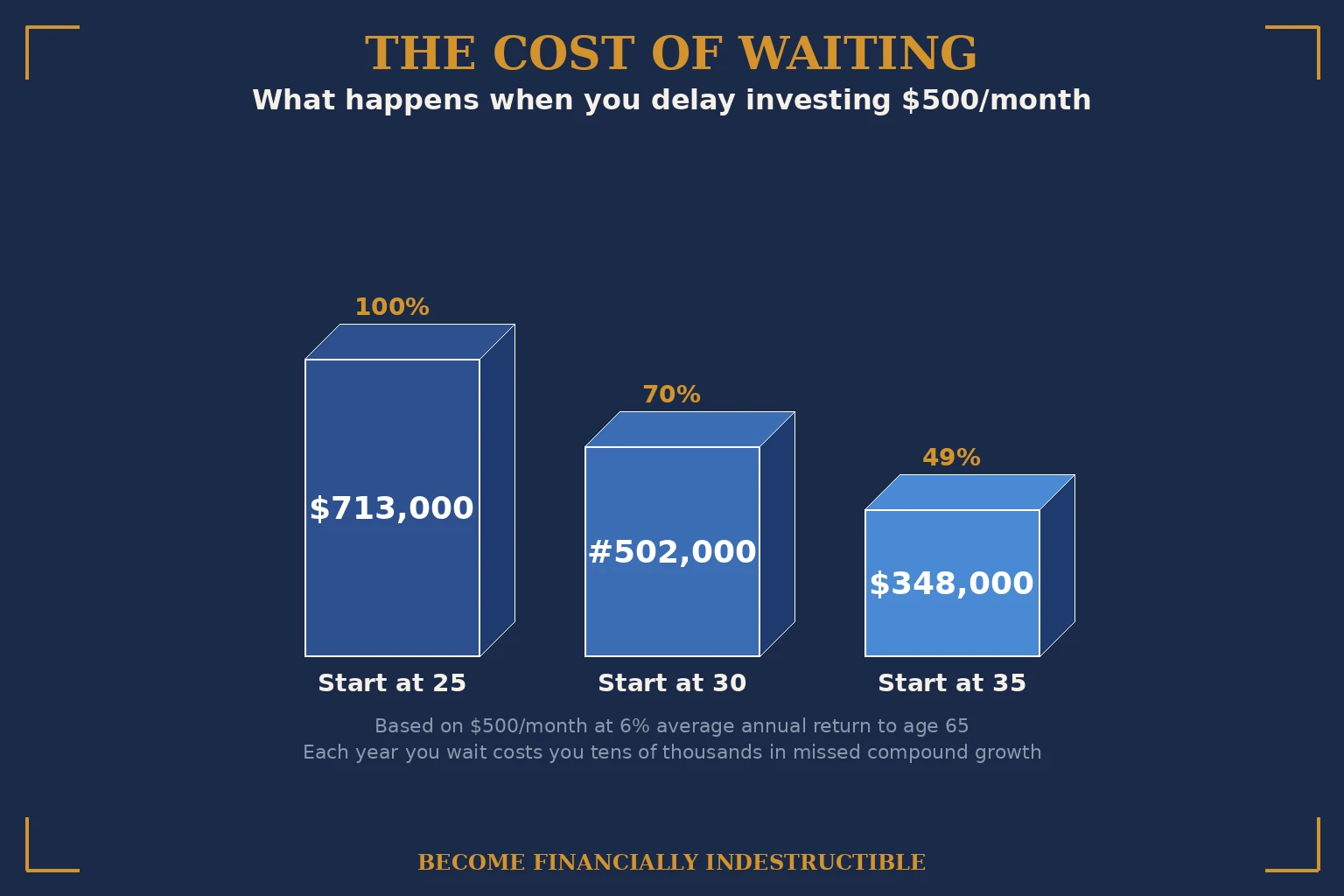
Person A starts investing $500 a month today. At a conservative 6% average annual return, they’ll have approximately $713,000 by age 65.
Person B decides to wait. “I’ll start next year,” they say. “Just need to get my business expenses sorted first.” They start at age 35 — just five years later — investing the same $500 a month at the same 6% return.
At age 65, Person B has approximately $502,000.
That five-year delay cost them $211,000. Not because they invested less — they invested the same $500 a month. The difference is entirely the compound growth that never happened because the money wasn’t in the market during those five critical years.
Now imagine Person B waits ten years. Starting at 40 with the same $500/month at 6%: approximately $348,000 by 65. That ten-year wait cost them $365,000 — more than the total they actually contributed.
This is the part they don’t teach you in school. Waiting doesn’t just delay your finish line. It fundamentally changes what kind of finish line is even possible.
Why Your Brain Is Designed to Procrastinate on Wealth
Here’s what makes this so insidious: your brain is wired to prioritize the present over the future. It’s called hyperbolic discounting — the tendency to choose a smaller, immediate reward over a larger, delayed one. Evolutionarily, it made sense. When you’re hunting for food, the berry in your hand is worth more than the promise of a feast next week.
But your financial life doesn’t run on hunter-gatherer timelines. It runs on decades. And your brain’s default setting — “deal with it later” — is the single biggest obstacle between you and financial freedom.
This is why the Earn pillar of the Financial House is so important. Not just earning more money — but earning the right to have your money work for you. Every dollar you earn and deploy into the Grow pillar (investing) today is a soldier sent into battle on your behalf. Every dollar you leave sitting in a chequing account earning 0.01% is a soldier sitting in a trench waiting for a war that never comes.
The Only Two Things That Matter: Time and Consistency
The two most powerful forces in wealth-building are completely free and available to everyone: time and consistency.
You don’t need to pick the perfect stock. You don’t need to time the market. You don’t need a six-figure income. What you need is to start — and then keep going.
Let me show you what happens when you combine time with consistency, even with modest amounts:
- $200/month for 30 years at 6%: ~$200,000
- $500/month for 30 years at 6%: ~$502,000
- $1,000/month for 30 years at 6%: ~$1,004,000
Notice the pattern. It’s not magic. It’s math. The more time you give your money, the harder it works. The more consistently you feed the machine, the bigger the result.
But here’s the catch: you have to start. Not next month. Not when your business is more stable. Not when the market crashes and you can “buy the dip.” Today. With whatever you have. Because the person who invests $100 a month starting at 25 will have more at 65 than the person who invests $500 a month starting at 40. The math doesn’t care about your excuses.
How to Break the Waiting Cycle — A Three-Step Start
If you’re reading this and recognizing yourself — the perpetual “I’ll start soon” — here’s your off-ramp. Three steps. Do them this week.
Step 1: Automate a tiny amount. Not what you think you “should” save. An amount so small it’s laughable. $50 a week. $100 a paycheque. Set up an automatic transfer from your chequing to a TFSA or an RRSP. The amount doesn’t matter as much as the act of starting. You can increase it later. You cannot get back the time you spent not starting.
Step 2: Pick one vehicle and commit. Don’t get paralyzed by choice. A low-cost diversified ETF in a TFSA is fine. Your company RRSP match is fine. A conservative balanced portfolio is fine. The perfect strategy executed six months from now is worse than a good strategy executed today. The 5 Methods — Real Estate, Insurance, Gold & Silver, Bitcoin, Business — are your long-term toolkit. For step one, pick the easiest one and start.
Step 3: Create accountability. Tell someone. Your spouse, your business partner, a mentor, a financial advisor. “I started investing $X a month starting this week.” The act of declaring it changes your psychology. You’re no longer someone who’s “thinking about it.” You’re someone who did it.
This is how you move from the Save pillar to the Grow pillar in the Financial House. Saving is parking your money. Growing is deploying it. They are not the same thing, and most people never make the transition because they never took Step 1.
What Happens After You Start
Here’s the part nobody warns you about: once you actually start, the waiting gets easier. Not because the process is fun (it’s actually quite boring), but because the anxiety of “should I start?” disappears. You’re no longer a spectator in your own financial life. You’re a participant.
You’ll check your account in six months and see a number that surprises you. Not because it’s huge — it won’t be — but because it’s yours. It’s proof that the math is working. And that momentum will carry you through the market dips, the economic uncertainty, the inevitable moments when you want to stop.
The Destroyer of Delay feeds on inertia. The moment you move, it loses its power.
So let me ask you one more time: How long will you wait?
Not forever, I hope. Because the best time to start was ten years ago. The second-best time is today. And the worst possible time — the one you’ll regret most — is tomorrow. Again.
Not sure where you stand? Take the 2-minute Financial House Assessment and get your personalized report — free.
Want to go deeper? Check out Essentials of Money ($50), The Wake Up Call ($50), or book a free discovery call.