
You’re running a profitable Canadian business. You max out your TFSA every January. You contribute to your RRSP like clockwork. You’ve got a corporate account earning 3.2% in a high-interest savings account, and maybe a rental property or two.
And you’re still leaving $127,000 on the table every decade — not because you’re doing anything wrong, but because you’re missing the 5th Method entirely.
Let me show you what I mean.

The 5 Methods — and the One Your Advisor Hopes You Never Ask About
In the Financial House framework, there are five ways to build wealth that actually work in the real world:
Method 1: Real Estate — rental properties, REITs, land.
Method 2: Insurance — whole life, universal life, critical illness.
Method 3: Gold & Silver — physical precious metals, ETFs.
Method 4: Business — your corporation, your practice, your side hustle.
Method 5: Bitcoin — the decentralized, non-sovereign, hard-money asset.
Most business owners I meet are using Methods 1 and 4. Some have dabbled in Method 2 or 3. Almost nobody — and I mean fewer than 1 in 10 — has seriously considered Method 5.
And that’s exactly where the $127,000 gap comes from.
The $127,000 Math — What Happens When You Add Bitcoin to the Portfolio
Let’s run the numbers for a Canadian business owner earning $180,000/year with $50,000 in annual surplus cash.
Scenario A: The “Safe” Portfolio
You put that $50,000 into your corporate investment account: 60% equities (Canadian dividend stocks + S&P 500), 30% bonds, 10% cash. Historical blended return: roughly 5-7% before corporate tax. After the 50.17% passive investment income tax on the first $50K of corporate investment income inside a CCPC, your effective net return drops to about 3.5-4%. Over 10 years: roughly $590,000 gross, $430,000 after tax drag.
Scenario B: The 80/10/10 Split
Same $50,000/year, but you allocate 10% — just $5,000 — to Bitcoin. The remaining $45,000 goes into the same traditional portfolio. The $45,000 at 4% nets you about $387,000 over 10 years. The $5,000/year into Bitcoin, even at a conservative 25% average annual growth (half of Bitcoin’s 14-year average), grows to roughly $170,000 over 10 years.
Total: $557,000 — that’s $127,000 more than Scenario A, with only 10% of your capital allocated differently.
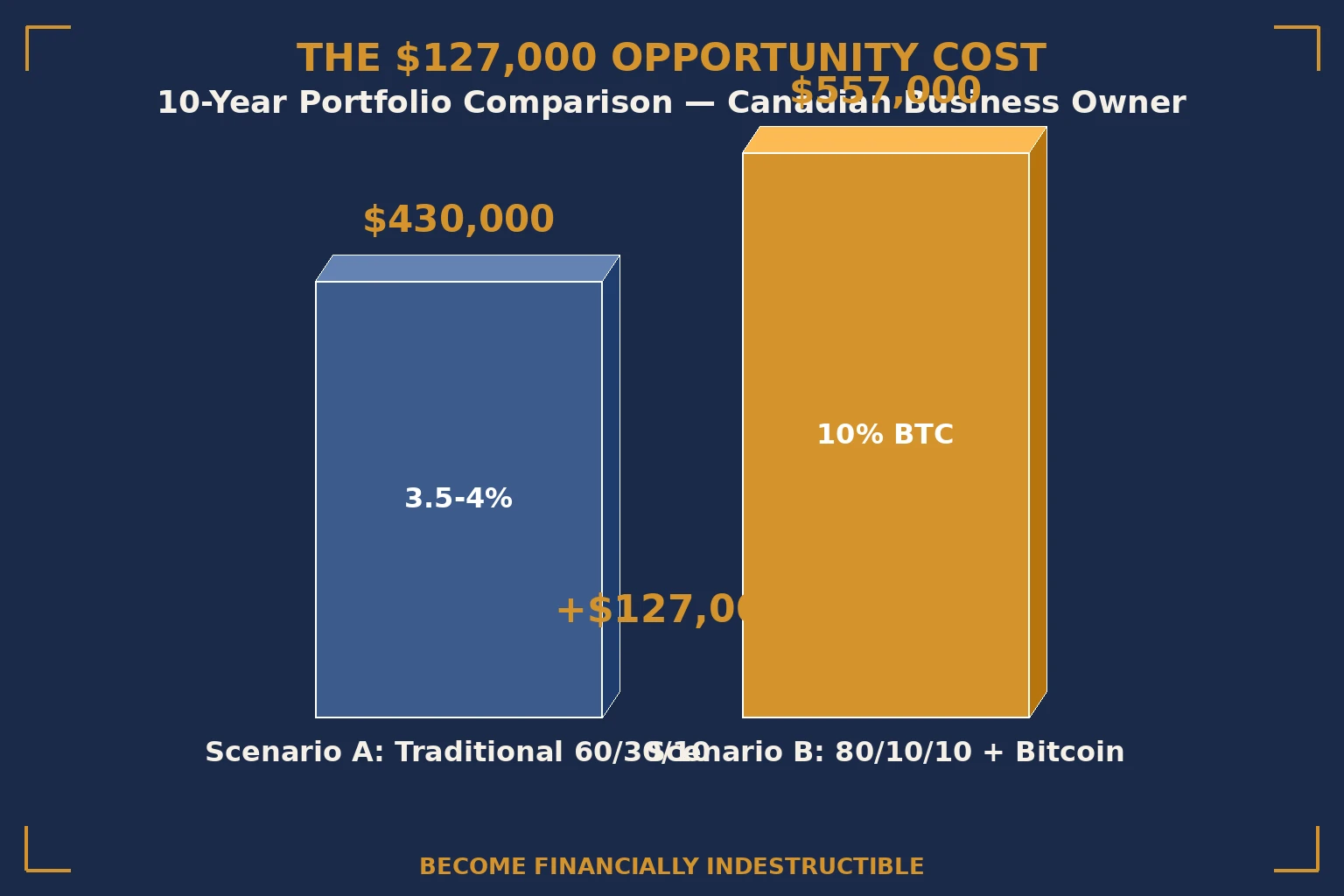
That’s the opportunity cost of ignoring Method 5. And I haven’t even factored in the tax advantage yet.
The Tax Advantage Nobody Talks About
Here’s where it gets interesting for Canadian business owners.
When you hold Bitcoin inside your corporation, the CRA treats it as capital property — just like stocks or real estate. You pay capital gains tax (50% inclusion rate) only when you sell. If you never sell? You never pay tax. And Bitcoin doesn’t generate dividends, interest, or rental income — so there’s no passive income surtax eating your returns every year.
Compare that to a corporate bond ETF paying 4.5% interest: that interest is taxed as passive income at ~50% inside a CCPC, every single year. A corporate GIC? Same story. The CRA takes half your growth annually, year after year.
Bitcoin flips that. You buy it with after-tax corporate dollars, it grows tax-deferred, and you only trigger tax when you decide to sell — ideally in a year when your business has losses or your personal income is low.
That’s not a loophole. That’s just how capital property works. But it’s a structural advantage that most business owners never use because nobody told them it exists.
The Objections I Hear Every Time — and Why They Don’t Hold Up
“Bitcoin is too volatile for a business owner.”
It’s volatile in the short term. Over any 4-year rolling period in its history, Bitcoin has been positive. The people who got wrecked were leveraged speculators, not patient savers allocating 10% of surplus capital. A 10% allocation in a diversified portfolio actually reduces overall volatility while increasing returns — this isn’t opinion, it’s portfolio theory backed by every major asset management firm’s research since 2020.
“What if the CRA comes after me?”
The CRA has clear guidelines on crypto. You report capital gains when you sell or trade. You keep records of acquisition cost and proceeds. That’s it. There’s nothing mysterious or illegal about a business owner buying Bitcoin through a regulated Canadian exchange like Shakepay, Newton, or Bull Bitcoin. You get a tax receipt and everything.
“I’ll just wait until it’s more stable.”
Bitcoin has a fixed supply of 21 million coins. The Canadian dollar supply has increased by 40% since 2020. Waiting for Bitcoin to become “stable” while the purchasing power of your cash erodes at 3-6% per year means you’re betting against the math. Every year you wait, you’re losing ground.
The 7 Destroyers — and How Bitcoin Neutralizes Three of Them
The 7 Destroyers of Wealth are the forces that quietly dismantle your financial house. Bitcoin is uniquely positioned to defend against three of them:
Destroyer #1: Inflation — The Bank of Canada’s 2% target means your cash loses half its purchasing power every 35 years. In reality, the money supply growth has averaged 8-12% annually since 2008. Bitcoin’s fixed supply of 21 million makes it the only asset that mathematically cannot be inflated away.
Destroyer #4: Taxation — As we covered above, Bitcoin held long-term inside a corporation avoids the annual passive income tax drag that eats bond and GIC returns alive.
Destroyer #6: Complacency — The biggest destroyer of all. Doing nothing because “what I’m doing is working fine.” The $127,000 gap above is what complacency costs. A small allocation to Method 5 is the opposite of complacency — it’s a deliberate hedge against the very system that’s designed to slowly bleed you dry.
How to Start — The $100/Week Plan for Business Owners
You don’t need to make a dramatic all-in bet. Here’s the exact plan I recommend to business owners who want to add Bitcoin to their Financial House without losing sleep:
Step 1: Set up an account with a Canadian-regulated exchange (Newton or Shakepay). Both support corporate accounts with EFT funding.
Step 2: Fund $100-500 per week from your corporate account — whatever 5-10% of your surplus cash flow works out to.
Step 3: Buy Bitcoin on every single funding day. No timing the market, no watching charts, no “waiting for a dip.” This is dollar-cost averaging, and it smooths out volatility automatically.
Step 4: Withdraw to a self-custody hardware wallet once your balance exceeds $5,000. Not your keys, not your coins.
Step 5: Don’t sell for at least 4 years. Let the tax-deferred compounding do its work.
That’s it. Five steps, 30 minutes to set up, 5 minutes per week to maintain. The same operational simplicity that makes your business run is what makes this work — small, consistent actions compound into massive results over time.
The Bottom Line
You’ve already built the first four floors of your Financial House. You earn well, you save diligently, you’ve got real estate and a business that generates real cash flow. But there’s a 5th Method that the traditional financial industry has every incentive to keep you ignorant about.
The $127,000 gap isn’t theoretical. It’s the measurable difference between using all five methods and stopping at four. And every year you wait, that number grows.
You don’t need to become a crypto bro. You don’t need to watch charts at 2 AM. You just need to allocate 10% of your surplus capital to the hardest money humanity has ever created — and then do nothing for four years.
That’s not speculation. That’s strategy.
Not sure where you stand? Take the 2-minute Financial House Assessment and get your personalized report — free.
Want to go deeper? Check out Essentials of Money ($50), The Wake Up Call ($50), or book a free discovery call.