
90% of Canadians who say they want to start a business this year will not have made a single dollar of outside income by December 31. They’ll buy a domain, draft a logo, watch six hours of YouTube tutorials, and call it “research.” Meanwhile, the 10% who actually take action will quietly earn their first $500 before the 90-day mark — not because they’re smarter or more talented, but because they understand one simple truth that the other 90% refuse to accept.
Your first $500 doesn’t come from a business plan. It comes from a transaction.
That’s the whole game in one sentence. You don’t need a website, an LLC, a logo, or a bank account with a business number. You need one person to hand you $500 in exchange for something they want more than the $500 in their pocket. That’s it. Everything else — the branding, the systems, the scale — comes after that first transaction confirms you’re building something people actually want.
Let me walk you through exactly how to get there, why most people never do, and what changes when you finally break through the $500 barrier.
The $500 Wall: Why 9 Out of 10 People Never Cross It
The gap between “thinking about it” and “doing it” is not a knowledge gap. It’s a tolerance gap. You already know how to make $500 — mow lawns, shovel driveways, freelance a skill, flip something on Marketplace, consult on a problem you’ve already solved. The information is not the bottleneck.
The bottleneck is that your brain treats the first $500 as if it doesn’t count. It’s not your salary. It’s not your business yet. It’s just… a weird little puddle of money that doesn’t fit into any of your existing financial categories. So you hesitate. You “research” more. You wait for the perfect moment. And the moment never comes.
Here’s what’s actually happening: your brain is protecting you from rejection. If you never try, you never fail. And $500 feels too small to risk embarrassment over. But that $500 is not about the money. It’s about proving to yourself that you can create value outside the structure of a job. That is the single most important financial threshold you will ever cross.
The Earn Pillar: Why Your First $500 Changes Everything About Your Financial House
In the Financial House framework, the first pillar is Earn. Before you can Save, Grow, or Protect, you have to bring money in the door. Most people think of “Earn” as their day job — and they’re right, in the short term. But the day job only has one engine. If that engine stalls, the entire house goes dark.
Your first $500 from an outside source does something far more valuable than the money itself: it installs a second engine. Suddenly you are not one-paycheque dependent. You are a person who has demonstrated the ability to generate revenue without a boss, a schedule, or a guaranteed direct deposit. That psychological shift is worth more than $500,000 in future earnings, because it unlocks every other step in the journey.
Business owners who have made their first $500 from a side venture approach their primary business differently. They stop treating their salary as the ceiling and start treating it as the floor. They negotiate harder. They invest more aggressively. They build the other four pillars — Save, Grow, Protect, and the 5 Methods (Real Estate, Insurance, Gold & Silver, Bitcoin, Business) — because they know they can always rebuild from the Earn pillar if one of the others cracks.
The 90-Day Blueprint: How to Make Your First $500
Here is a dead-simple system that works regardless of your skill set, industry, or location. It does not require a following, a budget, or any upfront investment beyond your time.
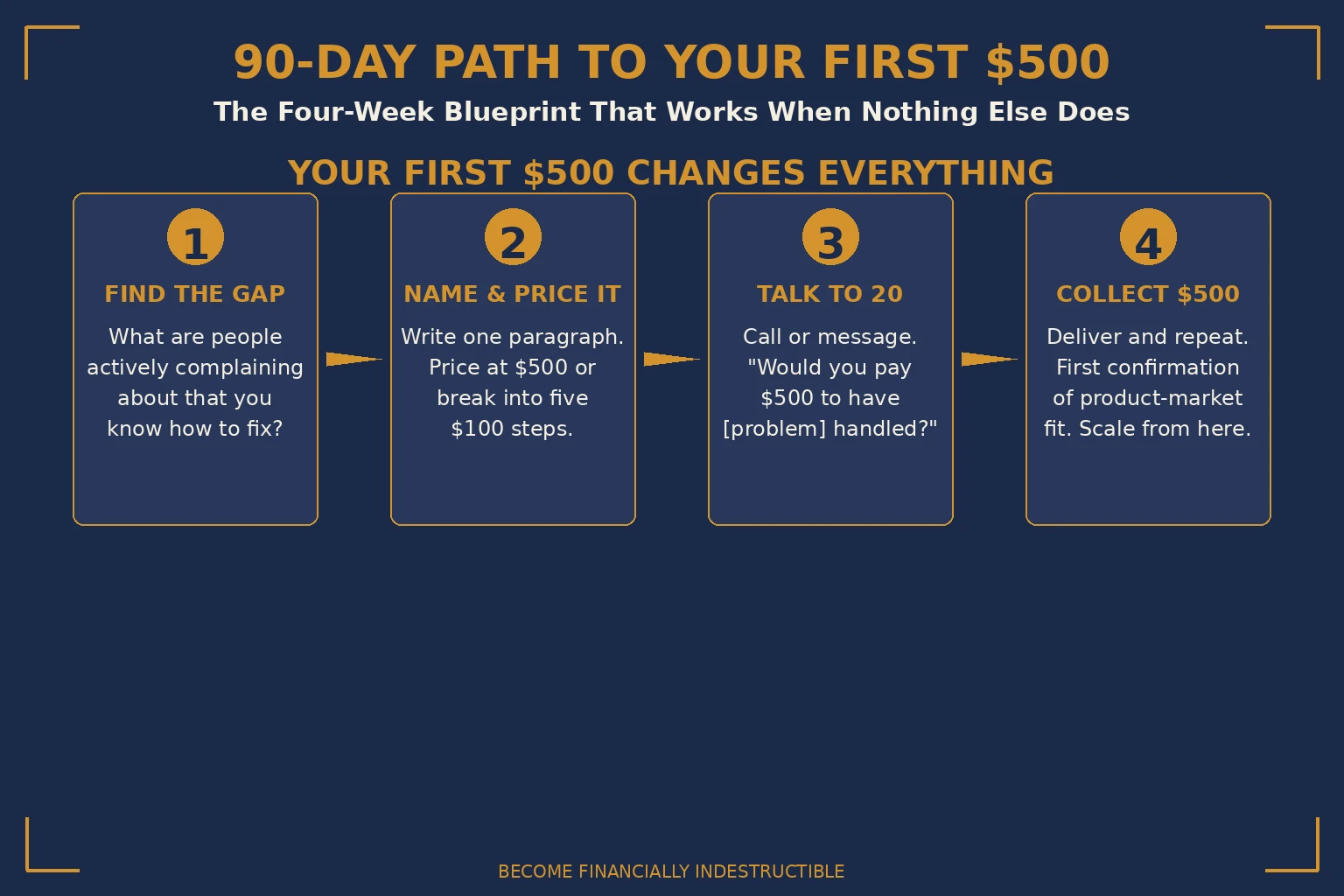
Week 1-2: Find the gap. Look at your existing skills and ask one question: “What do people around me regularly complain about that I know how to fix?” Not what they’d like to fix. What they’re actively complaining about. The gap is always there — a small business owner drowning in bookkeeping, a neighbour whose basement flooded and doesn’t know how to drywall, a friend who keeps buying the wrong investment products because nobody explained MERs to them. Pick one problem.
Week 3-4: Name it and price it. Write one paragraph about what you do and how it solves that problem. Price at $500 or break it into five $100 steps. The specific number matters less than that it’s a real number, not a “starting from” placeholder. Real prices attract real buyers. Lowball prices attract tire-kickers.
Week 5-8: Talk to 20 people. Not “market to.” Talk to. Call, message, or show up in person and say: “I’m working on solving [problem]. Would you pay $500 to have it handled?” Ninety percent will say no. That’s fine. The two who say yes are your first customers. Deliver for them like your reputation depends on it — because it does.
Week 9-12: Collect the $500 and repeat. Your first transaction confirms product-market fit. Now raise the price for the next round, or productize what you built and sell it while you sleep. The second $500 comes faster than the first.
Why $500 Matters More Than $50,000
I’ve watched entrepreneurs raise $50,000 in funding and fail within six months because they never proved anyone would pay for what they were building. And I’ve watched people start with $500 from a single client and build seven-figure businesses. The difference is not the size of the starting capital — it’s the evidence that the market actually wants what you’re selling.
$500 is the smallest amount of money that still feels real. It’s not pocket change. It’s not a gift. It’s earned, exchanged, and valued by both parties. That first $500 carries more information about your future success than any business plan, any market research report, or any mentorship call ever will. It is the market’s way of saying: “Yes, keep going.”
Canadian business owners in particular have an advantage here. Our tax system — with the $30,000 small supplier threshold for HST, the ability to deduct legitimate business expenses against side income, and access to programs like the Canada Business Banking account — makes it easier to test an idea without immediately drowning in compliance. You can earn your first $500, set aside 20% for taxes, and still walk away ahead — with a clear picture of whether this idea deserves more of your time.
The Destroyer That Kills More Ideas Than Anything Else
The 7 Destroyers of Wealth each target a different stage of the financial journey. But the one that kills more potential business owners than any other is Lifestyle Creep applied backward — the belief that you need a certain income level before you can start. You tell yourself: “I’ll start the side business when I have more time. I’ll invest when I have more money. I’ll build the second stream when the first one is stable.”
That’s not prudence. That’s procrastination dressed up as responsibility. The Destroyer convinces you that your current lifestyle — comfortable, predictable, safe — is worth protecting at the expense of your future wealth. And it works, because $500 feels small compared to a lifetime of comfortable salaries. But that $500 is the seed. And no tree ever grew from a seed that was never planted.
What Changes After Your First $500
Once you’ve crossed the $500 threshold, you will never see money the same way again. Here’s what shifts:
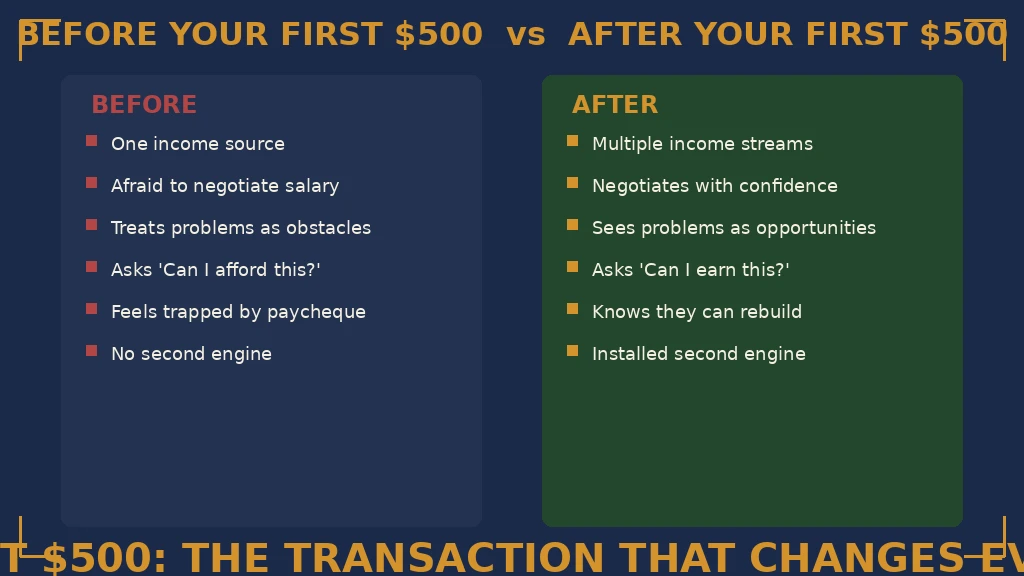
- You stop asking “Can I afford this?” and start asking “Can I earn this?” — a fundamentally different question with a fundamentally different answer.
- You see problems as opportunities instead of obstacles. Every complaint you overhear becomes a potential $500 transaction waiting to happen.
- You understand the Earn pillar of the Financial House viscerally, not just intellectually. You know what it feels like to create value from nothing but your own skills and effort.
- You can honestly tell yourself that you are no longer dependent on any single source of income. That peace of mind is worth more than the $500 itself.
The second $500 takes half the time. The third takes a week. And somewhere around the tenth $500, you stop counting — because you’re no longer measuring income. You’re building the rest of your Financial House, one pillar at a time.
Not sure where you stand? Take the 2-minute Financial House Assessment and get your personalized report — free.
Want to go deeper? Check out Essentials of Money ($50), The Wake Up Call ($50), or book a free discovery call.