
If you’re a Canadian business owner carrying debt right now — and let’s be honest, most of you are — there’s roughly a 70% chance you’re paying more interest than you need to. Not by a little. By thousands of dollars a month. The kind of money that could fund your RRSP, pay your kids’ school fees, or cover that HST remittance that keeps you up at night.
The problem isn’t that you have debt. The problem is that you’re using the wrong kind of debt — and the banks are counting on you not knowing the difference.
Debt is one of the 7 Destroyers of Wealth in the Financial House framework, but here’s what most people get wrong: not all debt destroys. Some debt builds. The difference comes down to three things — the rate, the structure, and the purpose. And right now, 7 out of 10 Canadian business owners are getting all three wrong.
The Debt Tax You Didn’t Know You Were Paying
Here’s a number that should make your stomach drop: the average Canadian small business carries about $200,000 in debt at any given time. Between credit card balances, operating lines of credit, equipment financing, and the occasional term loan, that number adds up fast.
Now here’s the part nobody talks about. Most business owners are carrying that debt on instruments with interest rates between 12% and 22%. Credit cards alone average 19.99% in Canada. Unsecured lines of credit run prime-plus-4-to-8%, which in today’s rate environment means 10% to 15%. Equipment financing through the dealer? Often 12% to 18%.
But here’s what’s sitting right there, completely accessible: secured borrowing at 6% to 8%. The difference between 15.5% (the blended rate most business owners are paying) and 7.5% (what you could be paying with the right structure) is $16,000 a year on $200,000 of debt. Over three years, that’s $48,000 — straight out of your pocket and into the bank’s.
That’s the debt tax. And you’re paying it every single month without realizing it.
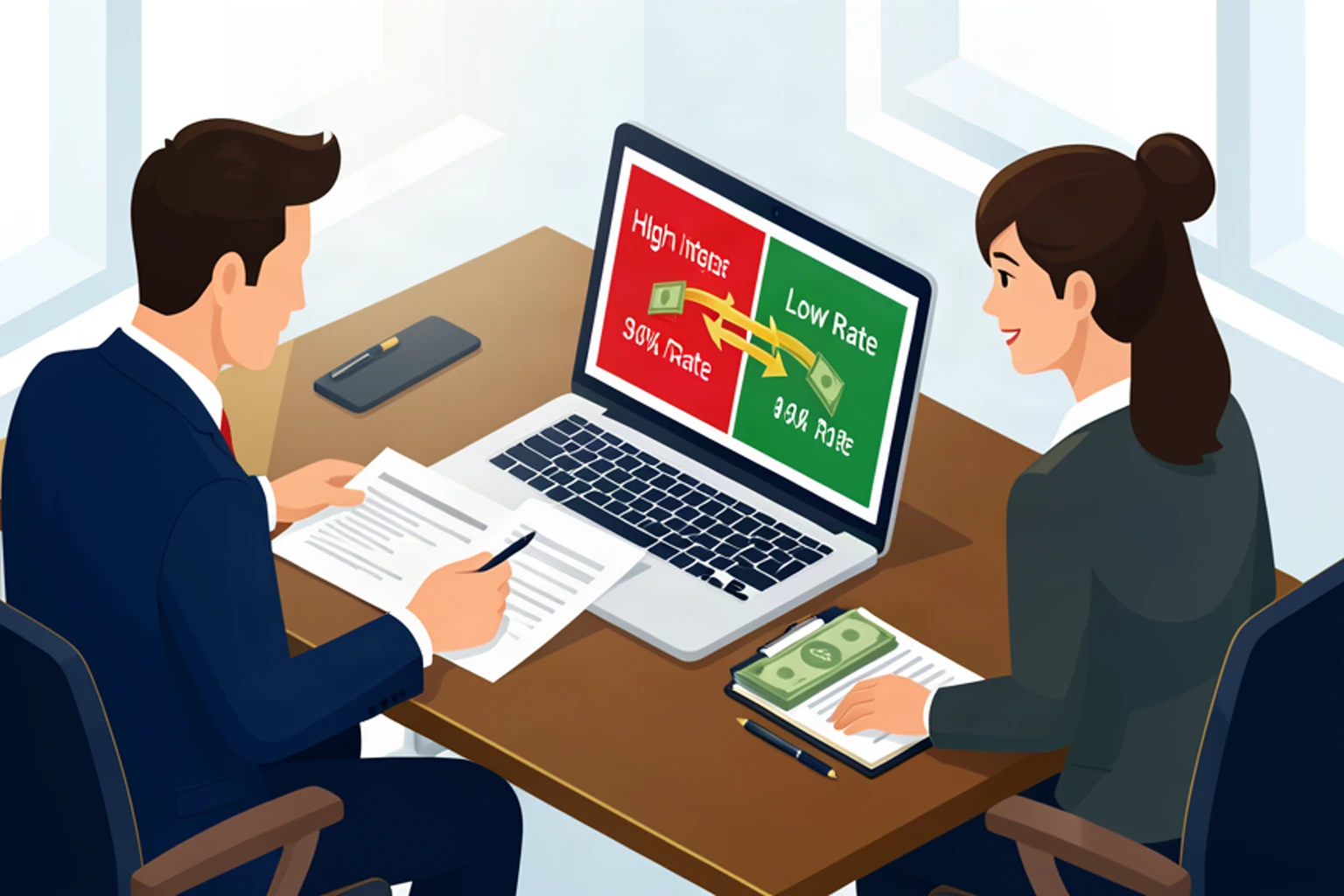
Why 7 Out of 10 Business Owners Are Stuck in the Wrong Debt
It’s not because business owners are careless with money. Most of the entrepreneurs I work with in Guelph and across the GTA are sharp operators who track every dollar in their business. The issue is structural.
When you first start a business, you don’t qualify for secured lending. You don’t have the assets, the track record, or the credit history. So you open a credit card. Maybe you get an unsecured line of credit from your bank. You use what’s available.
Then your business grows. You build equity in your home, your business assets appreciate, you establish a solid revenue history. But here’s the trap — nobody calls you to tell you your borrowing options have improved. The bank doesn’t phone and say, “Congratulations, you now qualify for 6.8% secured financing instead of 19.99% on your credit card.” In fact, the bank makes a lot more money when you stay on the high-interest products.
This is the loyalty tax — and it’s costing Canadian business owners billions every year.
In the Financial House framework, this is what we call the Earn pillar breaking down. You’re earning revenue, but your cost of capital is silently eating your margins. The money you worked so hard to earn is leaking out before it ever reaches your bottom line.
The 3 Types of Business Debt (and Which One Is Burning Your Cash Flow)
Not all debt is created equal. In fact, there are really only three categories, and understanding the difference is worth tens of thousands of dollars to your business.
Type 1: Unsecured Personal Debt (18%–22%)
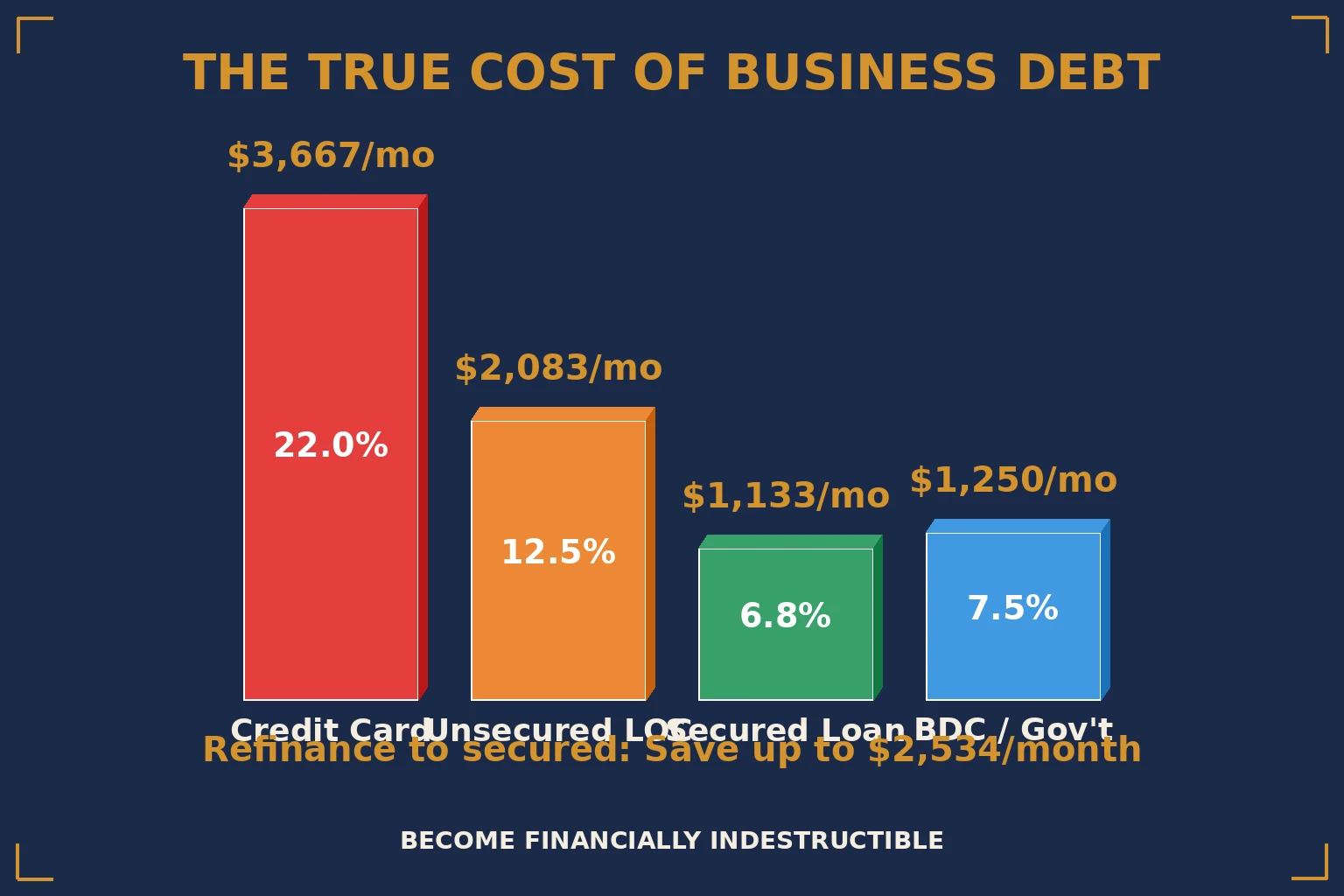
This is your business credit card and any personal borrowing you’re using for the business. It’s convenient, it’s fast, and it’s financially catastrophic if you carry a balance. A $50,000 credit card balance at 19.99% costs you nearly $10,000 a year in interest alone. If you’re making minimum payments, it’ll take you 22 years to pay off and cost you more than $95,000 in total interest. This isn’t debt — this is a wealth destroyer in its purest form.
Type 2: Unsecured Business Credit (10%–15%)
Your unsecured business line of credit. Better than credit cards, but still expensive. In today’s prime rate environment (which is roughly 5.7% as of late 2026), an unsecured LOC at prime-plus-5 puts you at 10.7%. On a $100,000 draw, that’s $10,700 a year in interest — compared to $7,000 if you had the same amount secured.
Type 3: Secured Business Debt (6%–8%)
A secured line of credit against your home equity, business assets, or a government-backed BDC loan. This is the Grow pillar in action — debt that serves your wealth instead of destroying it. At 6.8% on the same $100,000, you’re paying $6,800 a year. That’s $3,900 less than the unsecured option, every single year.
If you’re carrying all three types (and most established business owners are), your blended rate is probably around 13% to 15%. Restructuring everything into secured debt drops your blended rate to 7% to 8%. That’s the math behind the $48,000 number.
The 3-Step Restructuring That Saves You $48,000
Fixing this isn’t complicated — but it does require action. Here’s the exact playbook I walk my clients through.
Step 1: Audit your existing debt
Pull the last 12 months of statements for every credit card, LOC, and loan your business uses. Write down the balance, the interest rate, and the monthly payment. Don’t guess — actually look at the statements. Most business owners discover at least one account they forgot about, carrying a balance they didn’t realize.
Step 2: Calculate your debt tax
For each account, calculate what the interest would be if that balance were at 7.5% instead. The difference is your personal debt tax. A $50,000 credit card balance at 19.99% vs. 7.5% = $6,245 a year in unnecessary interest. A $100,000 unsecured LOC at 12% vs. 7.5% = $4,500 a year. Add it up across every account. That’s what you’re leaving on the table every twelve months.
Step 3: Consolidate and refinance
Here’s the order of operations. First, talk to your existing bank about converting your unsecured LOC to a secured LOC against your business assets or home equity. Most banks will do this if you have at least 20% equity and clean financials. Second, apply for a BDC term loan or Canada Small Business Financing Program loan to pay off credit card balances — these are capped at prime-plus-3% (roughly 8.7% today) and have fixed payments that build your credit profile. Third, once the high-interest debt is retired, cut up the business credit cards or switch to a charge card that you pay off monthly.
This isn’t theory. I’ve seen business owners save between $12,000 and $38,000 in the first year alone by making these three moves. One client in Kitchener had been carrying $145,000 on an unsecured LOC at 14.5% for four years — he assumed that was just “the cost of borrowing.” After restructuring to a secured LOC at 7.2%, he redirected $10,585 a year into his RRSP and his child’s RESP.
When Debt Is Actually a Wealth-Building Tool
Let me be clear: I’m not anti-debt. In the Financial House framework, strategic borrowing is part of the Grow pillar. The 5 Methods of wealth-building — Real Estate, Insurance, Gold & Silver, Bitcoin, and Business — all use leverage at their most effective levels.
The question is whether your debt is working for you or against you. Debt that funds revenue-generating assets (equipment that increases capacity, inventory that turns over, marketing that drives sales) at a rate lower than your return on that capital is wealth-building debt. Debt that covers lifestyle spending, cash flow gaps from poor planning, or old losses is wealth-destroying debt.
The Destroyer here isn’t debt itself — it’s the wrong debt at the wrong rate for the wrong purpose.
If your business debt costs you 15.5% and your business generates a 12% return on capital, you’re running a negative spread of 3.5%. That’s like running on a treadmill that’s slowly pulling you backward. But if you restructure that debt to 7.5% and your business generates a 12% return, you now have a positive spread of 4.5% — which means the bank’s money is actually earning you a profit.
That’s the difference between being a slave to your debt and making your debt a servant to your wealth.
So here’s my challenge to you this week: pull your statements. Do the math. Find out exactly how much of the debt tax you’re paying.
You might discover that the path to an extra $48,000 doesn’t require earning more clients or working more hours — it just requires getting the right kind of borrowing.
Not sure where you stand? Take the 2-minute Financial House Assessment and get your personalized report — free.
Want to go deeper? Check out Essentials of Money ($50), The Wake Up Call ($50), or book a free discovery call.