
You’ve spent 15 years building a business that pays your mortgage, funds your lifestyle, and lets you call the shots. And you’ve convinced yourself that when the time comes, you’ll sell it for a pile of cash and sail into retirement. There’s just one problem with that plan: the math doesn’t work for 7 out of 10 business owners.
I see this every single week. A successful business owner — $300K, $500K, even $1M+ in annual revenue — sits down in my office and says, “I’m planning to sell the business in five years and retire.” Then we run the numbers, and the whole thing falls apart. Not because the business isn’t profitable. Because the retirement plan is the business itself — and that’s not a plan, it’s a gamble.
The 70% Statistic Nobody Talks About
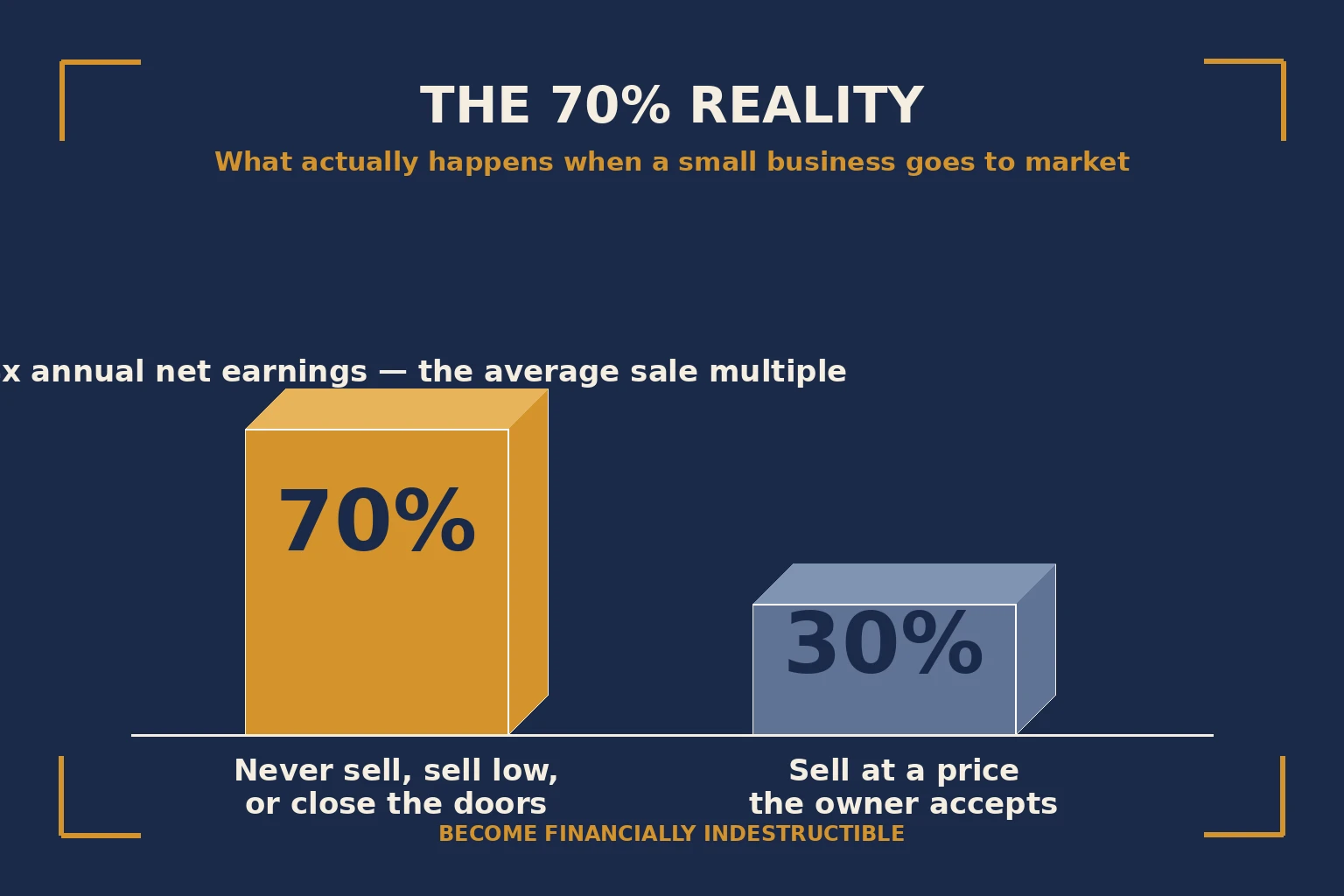
According to the Canadian Federation of Independent Business, roughly 70% of small businesses that go to market either never sell, sell for substantially less than the owner expected, or simply close their doors. Only about 30% actually find a buyer at a price the owner is willing to accept.
Think about that for a second. If your retirement plan is “sell the business,” you’re betting on a 30% outcome. Would you put your retirement savings into an investment that had a 70% chance of failing? Of course not. But that’s exactly what you’re doing when your business is both your income source and your retirement nest egg.
And here’s the kicker: even if you do sell, most business owners dramatically overestimate what their company is worth. The average Canadian small business sells for 2 to 4 times annual net earnings. If your business nets you $150,000 a year after expenses, you’re looking at $300,000 to $600,000. That’s not nothing — but it’s also not a retirement fund. Especially not when you factor in capital gains tax.
The Three Reasons Business Owners Can’t Sell
Why do 70% of businesses fail to sell? It’s not because they’re bad businesses. In my experience, it comes down to three things:
1. The owner is the business. If clients come to you personally, if the key relationships depend on your name and reputation, a buyer isn’t purchasing a business — they’re purchasing a job. And nobody pays 4x earnings for a job.
2. No systems. A business that runs on the owner’s brain — where the bookkeeping is a shoebox, the client onboarding is whatever feels right that day, and the marketing is “I’ll get to it” — has no transferable value. A buyer needs systems they can step into.
3. Unrealistic expectations. I’ve had owners tell me their business is worth $2 million because they “feel like it should be.” A business is worth what a buyer will pay. Period. Without a professional valuation, your number is a guess.

The Financial House Reality Check
Let me bring this back to the framework I use with every client: the Financial House. Four pillars: Earn, Save, Grow, Protect.
Most business owners are phenomenal at Earn. They’ve built a machine that generates real income. But they pour everything back into the business and neglect the other three pillars. The business becomes their savings account, their investment portfolio, and their insurance policy all at once.
The problem? A business is not a diversified asset. It’s a single point of failure. If your industry shifts, if a regulation changes, if your biggest client leaves — your retirement doesn’t just shrink. It evaporates.
Your business belongs in the Earn pillar. It’s your income engine. Your retirement needs a separate Grow strategy, a Save cushion, and a Protect safety net. When one asset serves all four roles, it’s not a strategy — it’s a house of cards.
The IPP: Your Business Owner Retirement Secret Weapon
If you’re a Canadian business owner over 40 and you don’t have an Individual Pension Plan (IPP), you’re leaving hundreds of thousands of dollars on the table. Here’s why.
An RRSP caps your contribution at 18% of earned income, up to about $32,000 per year. But an IPP — which is essentially a defined-benefit pension plan for incorporated business owners — lets you contribute based on what’s needed to fund a target retirement income. For a 45-year-old business owner, that can mean $40,000 to $60,000 in annual tax-deductible contributions.
And those contributions come from your corporation, not your personal account. They’re a corporate expense, reducing your taxable income at the corporate level. The funds grow tax-sheltered inside the IPP, just like an RRSP.
Over 20 years, the difference between maxing an RRSP and funding an IPP can exceed $500,000. That’s not a small edge — that’s the difference between a comfortable retirement and a constrained one.
The TFSA Leverage Play
Here’s another strategy most business owners never consider. Your TFSA contribution room is $7,000 per year (2026 rate), and the total cumulative room for someone who’s been eligible since 2009 is over $100,000. But most business owners have barely touched their TFSA because “all the money is in the corporation.”
The move: your corporation pays you a dividend. You pay personal tax on it. And then you invest the after-tax money in your TFSA. The growth is completely tax-free, and withdrawals are tax-free in retirement.
Why would you pay tax now just to invest in a TFSA? Because the alternative is worse. Money sitting inside your corporation earning passive investment income gets taxed at over 50% in most provinces thanks to the CRA’s passive income rules (the ones that grind down your small business deduction). A TFSA grows at 0% tax. The long-term math overwhelmingly favours the TFSA, even with the upfront tax hit.
It’s not about avoiding tax today. It’s about paying less tax over your lifetime. And the TFSA is the most tax-efficient account a Canadian can own.
The 5 Methods: Your Retirement Diversification Playbook
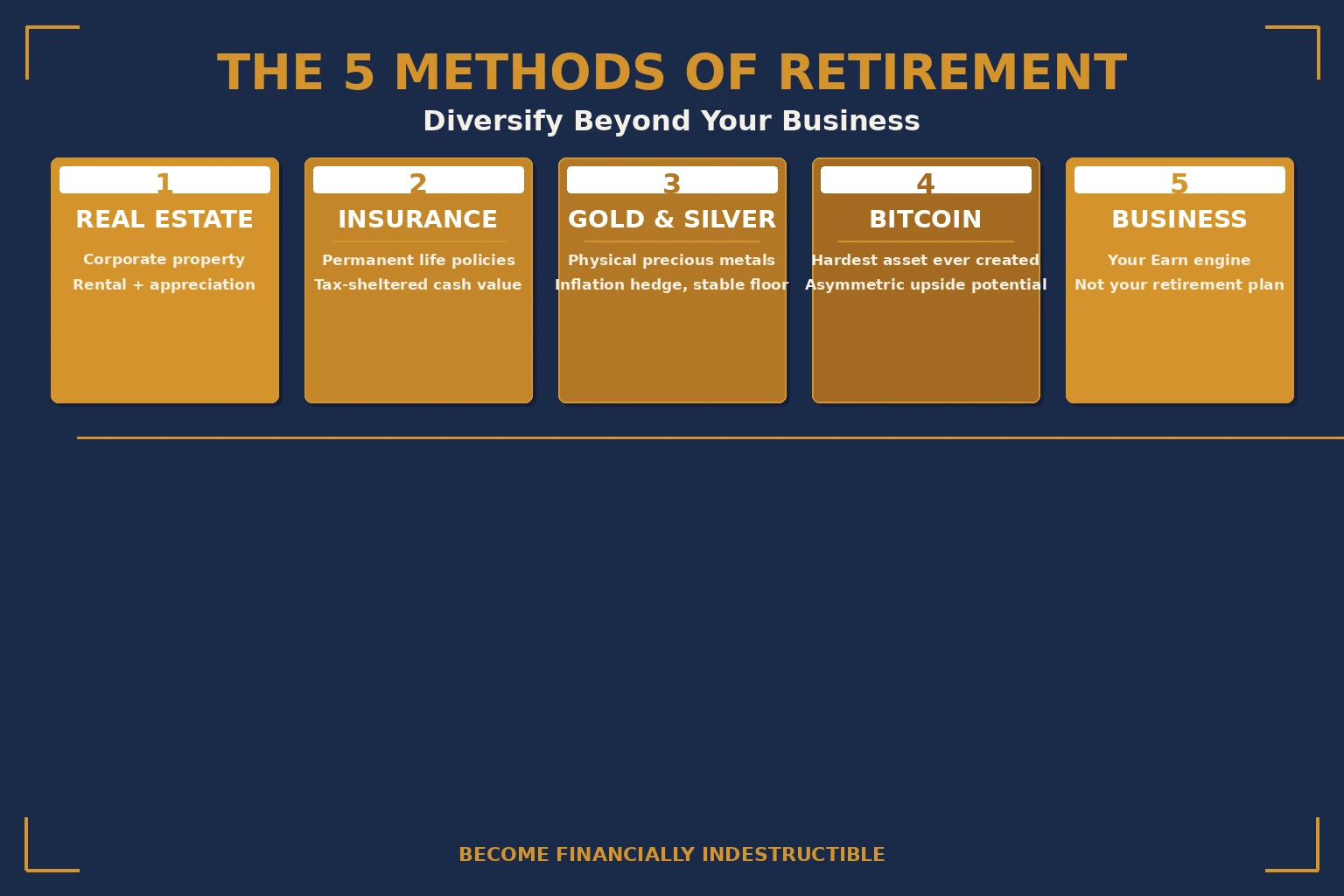
The 5 Methods of wealth building — Real Estate, Insurance, Gold & Silver, Bitcoin, and Business — give you a framework for diversifying your retirement assets beyond the corporate bank account.
Your business is already Method #5. That’s one out of five. If your net worth is 90%+ tied up in your company, you’re not diversified at all. Here’s how the other four methods fit into a retirement strategy:
Real Estate: Your corporation can own real estate directly — either commercial property for your business operations or residential investment property. The tax treatment is favourable, and real estate provides both income (rent) and appreciation. Many business owners buy their own building and pay rent to their corporation, building equity inside the company tax-efficiently.
Insurance: A permanent life insurance policy (whole life or universal life) held inside your corporation can serve as both a death benefit for your family and a tax-sheltered investment vehicle. The cash value grows tax-deferred, and with proper structuring, the death benefit can be paid out to your beneficiaries tax-free through the capital dividend account (CDA).
Gold & Silver: Precious metals are the ultimate hedge against currency devaluation and market crashes. Even 5% of your portfolio in physical gold or silver creates a floor that stocks and bonds can’t provide. Your corporation can hold precious metals directly.
Bitcoin: The hardest asset ever created. Bitcoin is still in its early adoption phase, but Canadian businesses are increasingly adding it to their corporate treasuries as a long-term store of value. The key is treating it as a long-term hold — not a trading vehicle. Even a 2-5% allocation creates asymmetric upside potential that no other asset class offers.
Your 90-Day Action Plan
If your retirement plan currently consists of “I’ll sell the business and figure it out,” here’s what I want you to do before the end of this quarter:
Step 1: Get a professional business valuation. Not what you think it’s worth — what an actual third-party valuator says. This is your retirement reality check. You can’t plan around a number you guessed.
Step 2: Calculate your retirement number. How much do you actually need to live on in retirement? Multiply your annual spending by 25 (the 4% rule). If that number is higher than your business valuation plus your other assets, you have a gap that needs filling — now, not at retirement age.
Step 3: Open an IPP if you’re over 40. It’s the single most powerful retirement tool available to incorporated business owners. The tax deduction alone makes it worth it.
Step 4: Fund your TFSA strategically. Pay the dividend, take the tax hit, and let that money grow tax-free forever. Every dollar in your TFSA is a dollar the CRA can never touch again.
Step 5: Diversify across the 5 Methods. Pick two methods you don’t currently use and start small. Even 5% of your net worth in Bitcoin, precious metals, or real estate creates diversification your business alone can’t provide.
Step 6: Build a 12-month personal emergency fund outside the business. If your business had a bad year, can you still pay your mortgage and feed your family? If not, you’re one downturn away from retirement disaster. This fund should be in your personal name, in a high-interest savings account or cashable GIC — not in the corporate account.
The Bottom Line
Your business is the most powerful wealth-building tool you’ll ever own. I’m not suggesting you sell it or stop investing in it. I’m saying: your business is your Earn engine. It is not your retirement plan.
The business funds the plan. The plan itself needs to be built on a foundation of diversified, tax-efficient assets that will be there whether your business sells for millions or closes its doors.
The owners who retire comfortably aren’t the ones who built the biggest businesses. They’re the ones who built the business and built a separate retirement strategy alongside it. The ones who understood that the business was a vehicle — not the destination.
You’ve already done the hard part. You built something real. Now give it a retirement plan that’s worthy of the work you put in.
Not sure where you stand? Take the 2-minute Financial House Assessment and get your personalized report — free.
Want to go deeper? Check out Essentials of Money ($50), The Wake Up Call ($50), or book a free discovery call.