

Are you tired of acting as a high-priced tenant for the big banks while your own financial legacy sits on the shelf? With total Canadian consumer debt hitting C$2.4 trillion in 2024, it’s clear that most professionals are just managing interest instead of building impact. You know the feeling of being trapped by 20% interest rates and the anxiety of multiple monthly payments. Leveraging debt consolidation canada is the first step to breaking this cycle of stagnation that drains your energy and kills your momentum.
It is time to stop playing defense. I’m going to show you how to move beyond basic relief and restructure your finances for permanent wealth. We aren’t just looking for a quick fix or a lower payment; we are talking about financial mastery and claiming your status as Financially Indestructible. This article breaks down the exact steps to collapse your debt into one manageable payment, slash your interest costs, and pivot that saved capital into wealth-building assets that last for generations.
Key Takeaways
- Stop playing the bank’s game and learn why most debt consolidation canada strategies are just expensive Band-Aids that keep you from reaching “Financially Indestructible” status.
- Stop the “tax time bomb” by understanding the brutal math: why destroying 19% credit card interest is a massive win over mediocre 6% RRSP returns.
- Audit your liabilities without flinching to eliminate the credit score errors that are siphoning thousands of C$ from your net worth.
- Transition from a debtor to a wealth-builder by using the Infinite Banking Concept to reclaim your interest and build a legacy asset.
What is Debt Consolidation in Canada and Why Does the ‘Bank Way’ Fail?
Most Canadians are stuck in a cycle of financial survival. You aren’t winning; you’re just treading water. Let’s get clear on the definition. What is Debt Consolidation? It is the strategic merging of high-interest liabilities into a single, lower-interest stream. It sounds simple. But the ‘Bank Way’ fails because it addresses the symptom, not the cause. Moving debt around without changing your underlying financial framework is a Band-Aid on a bullet wound.
Are you consolidating to survive, or are you consolidating to win? If you just move a C$15,000 balance from a credit card to a line of credit without a strategy for impact, you’ll be back in the same hole in 12 to 18 months. You must stop managing debt and start building a legacy. This requires a shift from a consumer mindset to a wealth-builder mindset. Real success isn’t about having a smaller monthly payment. It’s about how much capital you can recapture to fuel your future.
The Psychology of the Canadian Debt Trap
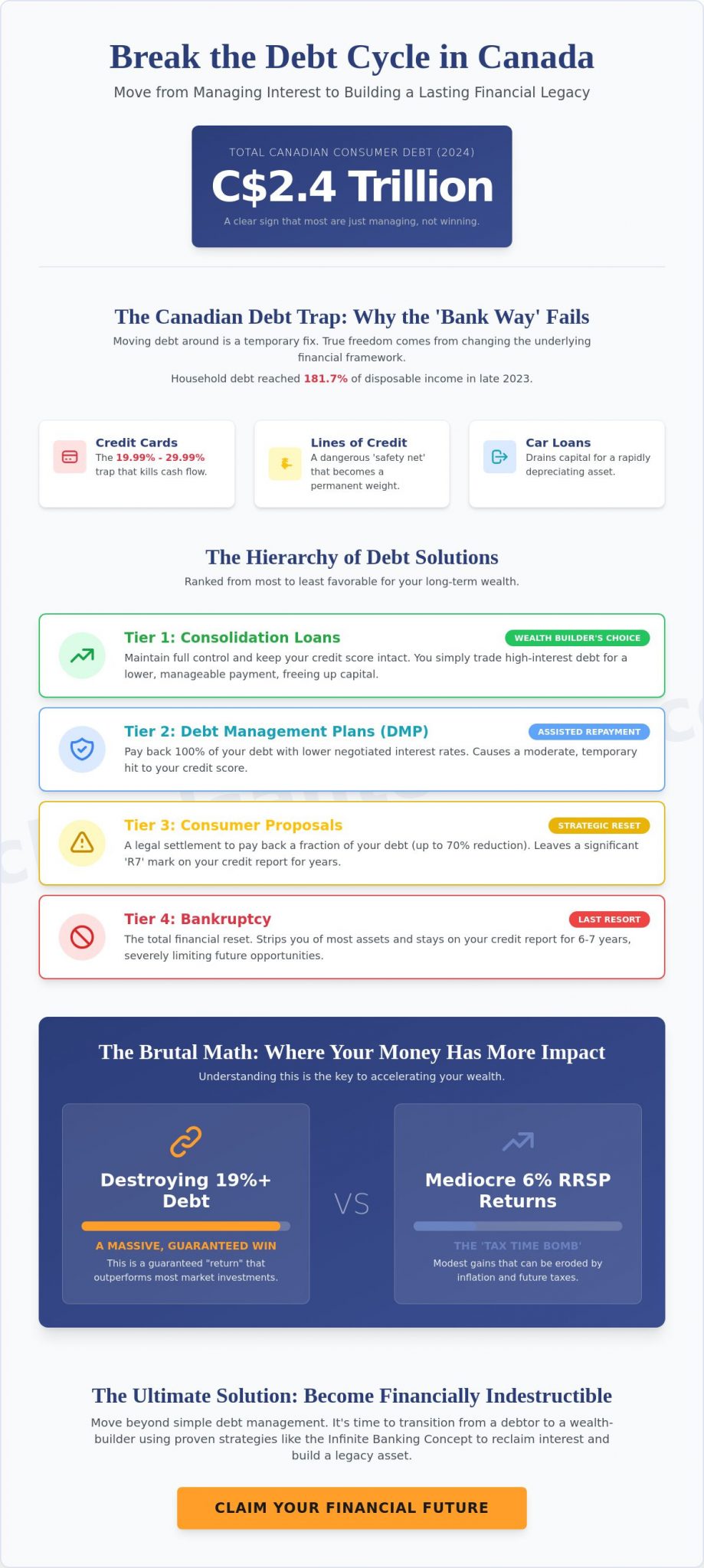
The ‘Big Five’ banks profit from your stagnation. They want you trapped in a perpetual loop of interest payments. Statistics Canada reported that household debt reached 181.7% of disposable income in late 2023. This isn’t an accident. It’s a business model designed to keep you paying. You must understand the difference between ‘bad’ debt, which fuels consumption, and ‘good’ debt, which acts as leverage for your growth. Debt consolidation is a tool for capital recapture, not just a lower payment.
- Credit Cards: The 19.99% to 29.99% trap that kills your monthly cash flow.
- Lines of Credit: The dangerous ‘safety net’ that often becomes a permanent weight on your balance sheet.
- High-Interest Car Loans: Depreciating assets that drain your ability to invest in assets that actually grow.
Common Consolidation Products: Loans vs. Lines of Credit
Traditional unsecured loans provide a fixed end date. This is helpful for discipline, but they often lack the flexibility needed for a true financial breakthrough. Using a HELOC for debt consolidation canada is a double-edged sword. You access lower rates near the prime rate, but you put your home at risk. One market shift could compromise your entire foundation. Balance transfers are another common trap. These ‘low-interest’ offers often include 3% transfer fees and skyrocket to 25% interest if you miss a single payment deadline. You need a better plan. If you’re ready for a real shift, it’s time for The Wake Up Call.
Deep Dive: Comparing the Top Debt Solutions for Canadians
Debt isn’t just a financial burden; it’s a leak in your legacy. If you want to move from surviving to thriving, you must choose a path that protects your ability to build wealth. Not all debt consolidation canada strategies are created equal. Some save your cash flow but destroy your future borrowing power. Others require more discipline but keep your financial reputation pristine. You need to view these options through the lens of being “Financially Indestructible.” This means choosing the solution that best protects your assets while eliminating high-interest liabilities.
The hierarchy of debt solutions, ranked from most to least favorable for wealth building, looks like this:
- Tier 1: Consolidation Loans. You maintain control, keep your credit intact, and simply trade high-interest debt for lower-interest debt.
- Tier 2: Debt Management Plans (DMP). You pay back 100% of what you owe, but credit counselors negotiate lower interest rates. Your credit takes a moderate, temporary hit.
- Tier 3: Consumer Proposals. A legal settlement where you pay back a fraction of the debt. It stops interest but leaves a significant mark on your record for years.
- Tier 4: Bankruptcy. The total reset. This is the last resort because it strips you of most assets and stays on your credit report for six to seven years.
The Consumer Proposal: A Last Resort or a Strategic Reset?
A Consumer Proposal is a formal process governed by the Bankruptcy and Insolvency Act. It allows you to offer creditors a percentage of what you owe. While it can slash your principal by up to 70%, it’s not a free lunch. For high-income earners, this “easy out” is dangerous. Under Canadian law, if your income exceeds a certain threshold, you may be forced into “surplus income” payments, making the proposal far more expensive than anticipated. Most importantly, a proposal makes it nearly impossible to implement Private Money Maximization strategies. Lenders see an R7 rating on your credit report and shut the door. You’re effectively sidelined from major investment opportunities for three years after you complete the payments.
Consolidation Loans: Taking Control of the Interest Game
This is where the pros play. A consolidation loan allows you to wrap multiple high-interest debts into one manageable monthly payment. In the 2026 economic environment, lenders are prioritizing borrowers with stable employment and a clear plan. To win here, you must opt for fixed rates. Variable rates are for gamblers; fixed rates are for builders who value predictability. If you can move C$40,000 from 19.9% credit card interest to a 7.5% personal loan, you’ve just bought yourself a massive head start on wealth creation. However, a loan only works if you fix the behavior that caused the debt. Most people clear the cards and then max them out again within 18 months. Don’t be a statistic. You need a mindset shift to ensure this is the last time you ever deal with consumer debt. Start that transformation by checking out The Wake Up Call course to master the psychology of money.
Choosing the right path requires an honest look at your balance sheet and your long-term goals. If you’re ready to stop guessing and start executing a high-performance plan, let’s have a direct conversation about your specific situation.
Why Your RRSP is a ‘Tax Time Bomb’ in Your Debt Strategy
You’ve been told that maximizing your RRSP is the ultimate path to financial freedom. That’s a lie. It’s a dangerous distraction when you’re carrying high-interest consumer debt. Why would you fight for an uncertain 6% return in the markets while handing over a guaranteed 19.99% to a credit card company? You aren’t building wealth; you’re subsidizing the bank’s record profits. This is the math of a losing game. To win, you must stop the bleeding first.
Many Canadians fall into the ‘tax trap’ by withdrawing from their RRSP to pay off debt. This is financial suicide. When you pull money out, the government takes up to 30% in immediate withholding tax. You also lose that contribution room forever. You’re trading your future for a temporary fix. Instead, debt consolidation canada strategies allow you to protect your assets while killing the debt with efficient cash flow. Consolidating is your first step toward Tax-Free Wealth Planning, moving you from a defensive posture to an offensive one.
Recapturing Lost Interest
Stop being a renter of capital. Every time you pay interest to an external lender, you’re experiencing a massive opportunity cost. If you pay C$500 a month in interest, that isn’t just C$6,000 a year gone. It’s the hundreds of thousands of dollars that money would have earned if it stayed in your control for the next 30 years. You must become the owner of the process. Every dollar sent to a bank is a dollar stolen from your legacy.
The RRSP vs. Debt Elimination Debate
It’s time for a hard truth: you need to pause your RRSP contributions. If your debt interest rate is higher than your expected investment return, you’re moving backward. Redirecting those C$500 or C$1,000 monthly contributions into a structured debt consolidation canada plan creates an immediate, tax-free return equal to the interest rate you stop paying. This isn’t just about math; it’s about momentum. Once the debt is gone, your ability to scale your wealth explodes because you own your income again.
Tax optimization is about more than just a refund check in April. It’s about freeing up the cash flow necessary to build a foundation that can’t be shaken. If you want to see how the elite truly manage their capital without relying on traditional bank traps, you need to understand Infinite Banking Canada: The 2026 Guide. Stop playing by the bank’s rules and start playing by yours. You can learn more about these advanced strategies at truefinancialeducation.com.
How to Prepare for a Financial Breakthrough: A 5-Step Checklist
Most Canadians drift through their finances. They hope for the best while paying the minimum. That ends today. If you want a real breakthrough, you need a tactical roadmap. This isn’t about saving pennies on coffee; it’s about restructuring your entire financial engine. You’re not just “paying bills” anymore. You’re engineering a legacy.
- Step 1: The Total Debt Audit. List every creditor, balance, and interest rate. If that C$15,000 balance is at 22.99%, face it. You can’t fix what you won’t measure.
- Step 2: Credit Score Optimization. Clean up the Equifax errors that are dragging you down. A 2024 report indicated that roughly 20% of credit reports contain errors. These mistakes cost you thousands in higher interest.
- Step 3: Cash Flow Engineering. Find the leaks in your budget. If money is disappearing without a clear purpose, you’re losing the war. Every dollar needs a specific job.
- Step 4: Professional Strategy Session. Stop taking advice from a bank teller who’s just trying to hit a monthly sales quota. A coach looks at your wealth mechanics; a teller looks at their commission.
- Step 5: Execution. Lock in your debt consolidation canada plan. Close the high-interest traps. Stop the bleeding and start the building.
Mastering Your Credit Score
You can check your credit score for free in Canada through platforms like Borrowell or your own banking app. It’s 2026; there’s no excuse for being in the dark about your standing. Aim for the 30% rule. If your credit limit is C$10,000, keep your balance under C$3,000. This utilization ratio is a massive factor in securing the best debt consolidation canada rates. Never close your oldest accounts. Even if you don’t use that card, its history accounts for 15% of your total score. Keep it alive to keep your score high.
Building a Budget That Actually Works
Stop using complex spreadsheets that you’ll abandon in a week. Use a staccato approach. Ruthlessly prioritize your wealth building and cut the fluff. Simplified Banking is about automation. Set your systems so your debt disappears while you sleep. You need a structure that works when you’re tired or distracted. For a deeper dive into the mechanics of high-performance wealth, read Michael’s book.
The Ultimate Solution: Moving from Debt to Infinite Banking
Most people think debt consolidation in Canada is the finish line. They are wrong. It is just the starting block. If your only goal is to hit a zero balance, you are still playing a losing game. Why settle for being “debt-free” when you can be wealthy? You need to stop managing your liabilities and start mastering your cash flow. This is where the Infinite Banking Concept (IBC) changes everything. It is the ultimate breakthrough for anyone tired of the traditional banking cycle.
Why are you handing your hard-earned C$1,000 monthly payments to a faceless institution? Every dollar you pay in interest to a big bank is a dollar that stops working for you forever. That is a legacy killer. IBC allows you to pay off those high-interest credit cards while simultaneously building a liquid asset that grows every single day. You aren’t just clearing the slate; you are building a foundation that makes you Financially Indestructible.
How IBC Restructures Your Financial DNA
Traditional bank loans are a one-way street. You borrow their money, you pay them back, and they keep the profit. When you implement IBC, you adopt the Banker mindset. You use a specially designed, dividend-paying whole life insurance policy to finance your own life. Instead of begging a lender for a break, you take a policy loan against your own collateral. The mechanics are simple but profound:
- Uninterrupted Compounding: Your total cash value continues to grow as if you never touched a cent, even while you use a policy loan to wipe out C$25,000 in high-interest debt.
- Control: You set the repayment terms. You are the lender and the borrower.
- Recaptured Interest: The interest that used to disappear into a bank’s vault now stays within your financial ecosystem.
This is the secret the wealthy use to manage liabilities without sacrificing their growth. It turns a draining monthly bill into a powerful monthly investment that fuels your future.
Your Path to Financial Indestructibility
Mastery does not happen by accident. It requires a radical shift in how you view every dollar that passes through your hands. You need a mentor who understands the Canadian landscape and the specific regulations that allow these strategies to thrive. By structuring your finances this way, you create a fortress. You protect your capital from unnecessary taxes and shield it from creditors simultaneously. In Canada, the right insurance structure offers a level of asset protection that most professionals completely overlook.
Don’t settle for mediocrity. Don’t just survive the month. It is time to take control and scale your life with purpose. You have the tools to turn your debt into a springboard for generational wealth. Stop playing small and start building a legacy that lasts. Join the Financially Indestructible Coaching Program and claim your financial freedom today.
Claim Your Financial Sovereignty Today
Managing debt is a losing game that keeps your wealth in someone else’s vault. You now understand why the standard bank model fails and why your RRSP could be a massive tax liability waiting to explode. True debt consolidation canada isn’t about moving numbers around; it’s about reclaiming your cash flow through the Infinite Banking Concept. You’ve been playing by the banks’ rules for too long. It’s time to become the bank.
As the founder of the Financially Indestructible framework, I’ve spent 12 years coaching Canadian professionals to achieve total wealth mastery. We eliminate the noise and focus on high-performance results that create a lasting legacy. Stop settling for “getting by” when you can build an unbreakable financial foundation. The tools are in your hands, but knowledge without action is just a distraction. You’re ready for a breakthrough. Let’s make it happen.
Ready to stop the debt cycle? Book your Financially Indestructible Strategy Session now.
Your future self will thank you for the courage you show today. Let’s build something that lasts.
Frequently Asked Questions
Is debt consolidation a good idea in Canada for 2026?
Yes, debt consolidation is a strategic move for 2026 if you want to lock in a fixed rate and stop the bleeding from high-interest credit cards. With the Bank of Canada maintaining strict inflationary targets, borrowing costs remain a critical factor for your personal cash flow. Why continue paying 19.99 percent or 29.99 percent interest when you can consolidate? It’s about taking control of your financial legacy right now.
How much will debt consolidation lower my monthly payments?
You can typically reduce your monthly obligations by 30 to 50 percent depending on your current interest rates and the term of your new loan. If you’re juggling five different payments totaling C$1,500 monthly, a single consolidated payment could drop that to C$800 or less. This isn’t just about lower numbers; it’s about freeing up capital to fuel your wealth-building engine. How much faster could you scale if you had an extra C$700 every month?
Will debt consolidation hurt my credit score?
Your credit score will likely see a temporary dip of 5 to 10 points due to the hard inquiry, but it will rebound quickly as your utilization ratio drops. Paying off high-interest revolving debt is the fastest way to signal financial mastery to credit bureaus like Equifax and TransUnion. Within 6 to 12 months of consistent payments, most Canadians see an upward trajectory in their score. Stop fearing a minor dip and focus on the long-term breakthrough.
What is the difference between a debt consolidation loan and a consumer proposal?
A debt consolidation loan is a private agreement where you borrow funds to pay off creditors in full, whereas a consumer proposal is a legal process under the Bankruptcy and Insolvency Act to pay back a percentage of what you owe. Loans protect your credit rating and maintain your professional standing. Proposals stay on your record for 3 years after completion. Choose the loan if you want to preserve your ability to scale and build future impact.
Can I consolidate my student loans in Canada?
You can consolidate private student loans immediately, but consolidating federal loans means forfeiting government interest subsidies and repayment assistance programs. If your Canada Student Loan interest rate is higher than a private consolidation offer, the move makes sense. However, you must weigh the C$0 payment options provided by the government against the speed of private repayment. Are you playing for safety or playing for total financial freedom?
Do I need a co-signer for a debt consolidation loan?
You will likely need a co-signer if your credit score sits below the 650 mark or if your debt-to-income ratio exceeds 40 percent. Lenders need certainty that their capital is safe. If you don’t meet the criteria alone, a co-signer with strong credit provides the leverage you need to secure a lower rate. It’s a partnership built on trust. Use that leverage to fix your foundation so you never need a co-signer again.
How does the Infinite Banking Concept help with debt?
The Infinite Banking Concept allows you to use the cash value of a participating whole life insurance policy to pay down high-interest debt while your capital continues to grow inside the policy. You become your own banker. Instead of giving your interest to a Big Five bank, you flow that money back into your own ecosystem. This is how high-performers achieve debt consolidation canada and build a lasting legacy simultaneously. It’s about efficiency and total control.
What happens if I get denied for a debt consolidation loan?
If a bank says no, you must immediately pivot to alternative lenders or explore asset-backed options like a Home Equity Line of Credit (HELOC). Denial isn’t a dead end; it’s a signal that your current strategy needs a mid-course correction. Review your credit report for errors and focus on reducing your debt-to-income ratio for 90 days before reapplying. Success requires persistence and the willingness to find another path to the top.