

Are you tired of feeling like a tax slave to the very business you built? You didn’t spend years mastering your craft just to watch the CRA claw back your small business rate. It’s time to stop playing defense. Implementing the right tax strategies for incorporated professionals is the difference between surviving tax season and building a breakthrough legacy. Since the 2018 passive income tax changes shifted the landscape for 100% of Canadian professional corporations, many high earners feel stuck. You aren’t alone in your frustration, but you don’t have to stay there.
You deserve to keep more of what you earn. I’m going to show you how to transform your corporation from a simple tax shelter into an indestructible wealth-building engine. We’ll dive into reclaiming your capital so you can become your own banker and secure a tax-efficient retirement. This isn’t about mere compliance; it’s about total financial mastery and creating a generational impact that lasts forever. Let’s move from theory to action right now.
Key Takeaways
- Stop letting the “Passive Income Trap” bleed your Small Business Deduction dry by mastering the critical $50,000 threshold.
- Optimize your total compensation by choosing the right mix of salary, dividends, and IPPs to maintain your Lifetime Capital Gains Exemption.
- Implement advanced tax strategies for incorporated professionals that utilize the Infinite Banking Concept to create a self-funding wealth engine.
- Take immediate action with a 90-day corporate audit to transition from defensive tax shielding to offensive legacy building for 2026.
The Incorporated Professional’s Tax Trap: Why You Are Overpaying
Your professional corporation is a double-edged sword. While it acts as a powerful shield against immediate personal tax hits, it can quickly transform into a cage for your hard-earned capital. Most high-earning professionals incorporate because their accountant promised tax deferral. That’s a fine start, but deferral is not the same as permanent wealth creation. Are you working for your corporation, or is it working for you? If you’re simply stockpiling cash and hoping for the best, you’re missing the core purpose of advanced tax strategies for incorporated professionals. You need to move from defensive shielding to offensive legacy building.
The $500,000 Threshold: Protect Your Small Business Rate
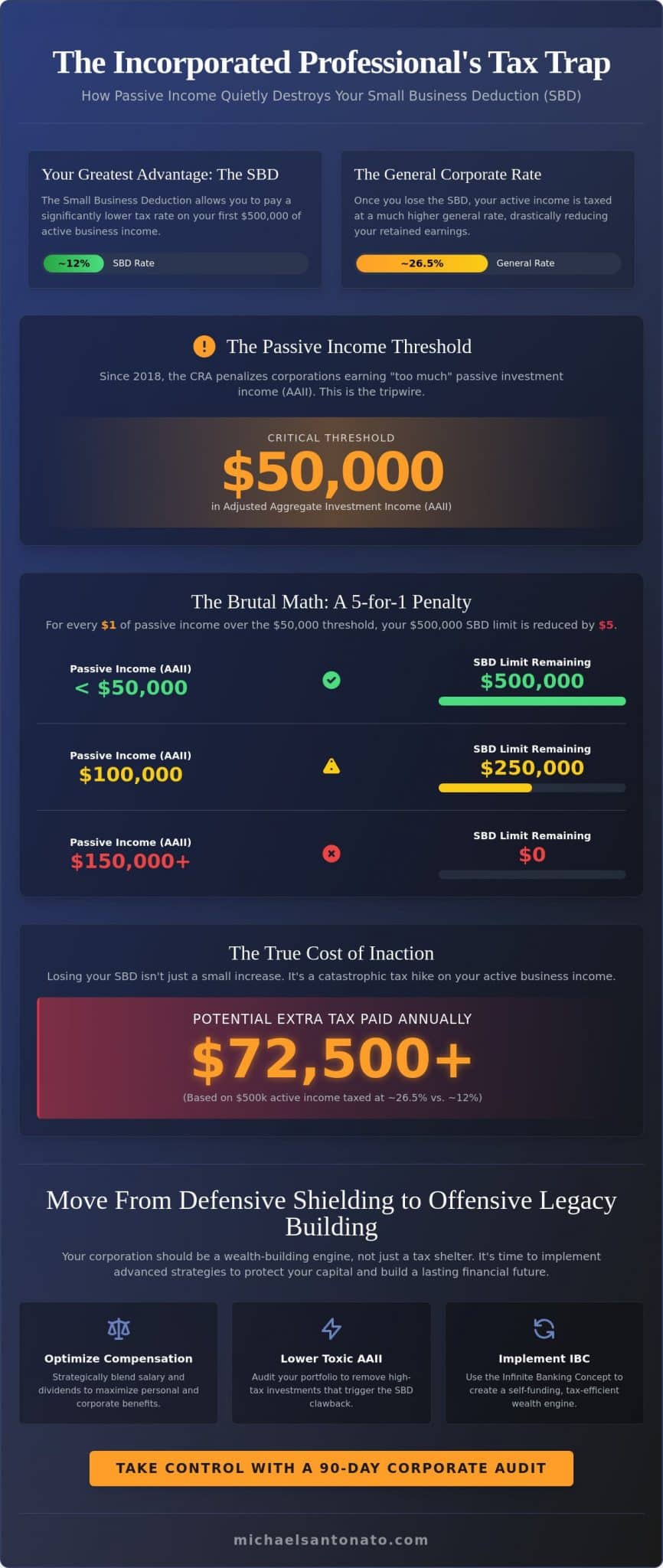
The Small Business Deduction (SBD) is the most critical component of Corporate tax in Canada. It allows you to pay a federal and provincial combined rate of roughly 9% to 12% on your first $500,000 of active business income. That is a massive advantage compared to the 53.5% top personal marginal rate in provinces like Ontario. However, that $500,000 limit is a target. If you have associated corporations sharing this limit, you’re diluting your primary benefit. Hitting this ceiling triggers a jump to the general corporate rate of approximately 26.5% or higher. You must proactively manage your corporate structure to ensure you aren’t accidentally disqualified from these lower rates by crossing technical thresholds without a plan.
Stop viewing the “Salary vs. Dividend” debate as a binary choice. It isn’t about which one is “better” in a vacuum; it’s about capital velocity. Salaries create RRSP room and CPP contributions, while dividends can be more flexible. The real mastery lies in how you flow that capital out of the corporation to build assets you control personally or through a trust. If your money is sitting still, it is losing its power.
The Hidden Cost of Doing Nothing
Doing nothing is the most expensive financial decision you can make. Leaving stagnant cash in your corporate account is a slow-motion disaster for your net worth. Consider these factors:
- Inflation Erosion: With inflation effectively reducing purchasing power by 3% or more annually, your retained earnings are shrinking every day they aren’t deployed.
- Passive Income Grinds: Once your corporation earns more than $50,000 in passive investment income, the CRA begins clawing back your SBD, effectively taxing your active income at a much higher rate.
- Opportunity Cost: Every dollar sitting in a low-interest corporate account is a dollar that isn’t being used to fund your own “bank” or secure a private money deal.
In 2026, the tax drag on professional corporations is the silent killer of generational wealth, acting as a compounding penalty on every dollar you fail to move into a tax-efficient, high-growth environment. You didn’t build a successful practice just to let 50% of your investment gains disappear into the government’s coffers. It’s time to take control and demand more from your corporate structure.
Mastering the Passive Income Rules: Protecting Your SBD
The CRA changed the game in 2018. If you’re still playing by 2015 rules, you’re losing money every single day. The “Passive Income Trap” is a predatory tax mechanism designed to penalize professionals who build wealth inside their corporations. It’s a direct hit on your ambition. To win, you must understand the difference between your Active Business Income and your Adjusted Aggregate Investment Income (AAII). While active income is taxed at that beautiful low rate we discussed, AAII is the trigger for a massive tax hike. Traditional mutual funds are often a recipe for disaster here because they spit out taxable interest and dividends that push you over the edge. You need a structure that prioritizes growth without triggering a penalty.
The SBD Clawback Mechanism
Here is the brutal math: for every $1 of passive investment income your corporation earns above $50,000, your Small Business Deduction (SBD) limit is reduced by $5. It is a 5-for-1 penalty. If your portfolio generates $150,000 in passive income, your $500,000 SBD limit vanishes completely. Suddenly, your active earnings are taxed at the general corporate rate, which is roughly 15% higher than the small business rate in most provinces. You aren’t just paying more tax on your investments; you’re paying significantly more on your actual work. You must audit your portfolio for toxic passive income sources such as interest from GICs, foreign dividends, and high-turnover mutual funds that trigger constant capital gains.
Strategies to Lower Your AAII
You don’t have to accept this clawback as the cost of doing business. High-performance tax strategies for incorporated professionals focus on moving capital out of the passive bucket and into tax-sheltered environments. One powerful tool is the Individual Pension Plan (IPP). By shifting corporate dollars into an IPP, you reduce your retained earnings and lower your AAII while building a massive retirement nest egg. Another breakthrough strategy is Corporate Owned Life Insurance. Growth inside these policies is tax-exempt and does not count toward the $50,000 AAII limit, allowing you to scale your wealth without losing your tax advantages.
If you want to stop the bleeding and identify where your corporation is leaking capital, my Wake Up Call course provides the exact roadmap to audit your structure for 2026. You’ve worked too hard to let a lack of planning destroy your legacy. Mastery requires action, and the first step is knowing where you stand. If you’re ready to stop guessing and start scaling, it might be time to book a strategy alignment call to review your current trajectory. Don’t wait for the CRA to send you a bill to realize you’ve been overpaying for years.
Roundup: Advanced Tax Optimization Strategies for 2026
Most accountants act like historians. They tell you what you owed last year, but they rarely tell you how to win next year. To build a legacy, you must move beyond basic filing. You need to master the “Big Four” tax strategies for incorporated professionals: Salary, Dividends, IPPs, and Holding Companies. This isn’t about picking one; it’s about orchestrating them to create a fortress. If your current advisor isn’t talking about “purifying” your corporation, they are leaving your money on the table. In 2024, the Lifetime Capital Gains Exemption (LCGE) is worth $1,016,836. If more than 10% of your corporate assets are non-active, you risk losing this million dollar tax break. You must keep your corporation clean to stay eligible.
The Individual Pension Plan (IPP) vs. RRSP
If you’re over age 40, the RRSP is a toy. The IPP is a professional power tool. It allows for contribution limits that are often 35% higher than a standard RRSP, and every dollar comes directly off your corporate top line. Unlike an RRSP, an IPP allows your corporation to deduct “past service costs.” This means you can make massive, one-time contributions to catch up on years when you weren’t maximizing your savings. At retirement, the “terminal funding” advantage lets you inject even more tax-deductible cash to ensure your pension is fully indexed. It’s the ultimate upgrade for high-performance professionals who demand more than the bare minimum.
Holding Companies: The Vault Strategy
Think of a Holding Company (HoldCo) as your financial vault. It separates your accumulated wealth from the daily professional liability of your practice. If a lawsuit hits your professional corporation, the assets inside your HoldCo remain protected. You can move surplus cash from your operating company to your HoldCo using tax-free intercorporate dividends. This allows you to reinvest that capital without a personal tax hit. 2026 is the year to finalize this structure. Legislative environments are shifting, and waiting to restructure is a gamble you can’t afford to take. You need to lock in your gains and protect your family’s future now.
Eventually, every successful professional must consider an “Estate Freeze.” This maneuver locks in the current value of your corporation for you, while allowing all future growth to accrue to your heirs. It stops the clock on your personal tax bill and starts the clock on your legacy. Why wait for a crisis to plan? Start demanding indestructible growth today. If you aren’t actively managing these levers, you’re just another high-earner waiting for a tax bill. Take command of your capital and build something that lasts.
The Indestructible Roadmap: Integrating IBC into Your Corp
Stop playing small. Most professionals use their corporation as a simple piggy bank; the elite use it as a private bank. Integrating the Infinite Banking Concept into your corporate structure is the ultimate evolution of tax strategies for incorporated professionals. Instead of letting retained earnings sit in a low-yield account where the CRA can tax the growth at nearly 50%, you move that capital into a high-cash-value life insurance policy. This isn’t just “insurance.” It is a warehouse for your wealth that provides liquidity, growth, and protection simultaneously.
This creates what I call the “Double Play.” Your corporate dollars grow inside the policy tax-deferred, completely bypassing the passive income clawback we discussed in previous sections. Because the growth within the policy isn’t classified as Adjusted Aggregate Investment Income (AAII), you protect your Small Business Deduction. Simultaneously, you can leverage that cash value through policy loans to fund practice expansions, purchase medical equipment, or invest in private money deals. Your money is working in two places at once. You earn dividends on the full value of the policy even while you use the borrowed funds to scale your business. This is how you reclaim the interest you used to give to third-party lenders.
Becoming Your Own Banker
When you need capital for a new clinic or a buy-sell agreement, don’t go to the bank on your knees. Become the bank. By using policy loans, you eliminate the need for traditional financing and the high interest rates that come with it. You set the terms. You pay the interest back to your own corporate legacy rather than a bank’s bottom line. This shift in capital flow is the foundation of financial independence. I break down this entire framework in detail in my guide; you can Get the Book to see the exact mechanics of this transition. It’s about total control and capital velocity.
Tax-Free Death Benefit and the CDA
The real magic happens with the Capital Dividend Account (CDA). This is the “holy grail” of corporate tax planning. When the insured passes away, the death benefit proceeds flow into the corporation. A significant portion of this payout credits the CDA, allowing you to extract those funds from the corporation completely tax-free. It’s the most efficient way to move massive amounts of wealth to the next generation without the 50% tax hit of a typical corporate liquidation. IBC creates a self-completing estate plan that ensures your family is protected while your business remains indestructible.
You’ve spent years building your reputation. Now, spend an hour securing it. If you’re ready to stop being a “tax slave” and start acting like a banker, book your strategy alignment call today. Let’s build a roadmap that actually serves your vision, not the government’s budget.
Executing the Breakthrough: Your Next Steps to Mastery
Stop settling for “safe” accounting. Most professionals are coached to play small, stay quiet, and pay their dues. But you didn’t build a high-performance practice to be average. You built it to be a powerhouse. If your current tax plan is just a defensive shield, you’re leaving your flank wide open. True tax strategies for incorporated professionals require a shift from passive compliance to aggressive wealth multiplication. It’s time to stop looking in the rearview mirror at what you owed in 2024 and start looking at where you’re going in 2026. You need a 90-day audit of your entire corporate structure to identify the leaks before they become floods.
Execution is where the winners separate themselves from the dreamers. You’ve seen how the Passive Income Trap can destroy your Small Business Deduction. You’ve seen how the Infinite Banking Concept can turn your corporation into a private vault. Now, you must decide if you’re going to keep reading or start leading. A spreadsheet won’t build your legacy; decisive action will. Mastery requires mentorship and a commitment to high-level performance that most “standard” advisors simply cannot provide because they don’t think like entrepreneurs.
The Mastery Mindset
There is a massive difference between a “Tax Minimizer” and a “Wealth Multiplier.” A minimizer looks for ways to pay less today. A multiplier looks for ways to control more forever. You must integrate your personal values into your corporate structure so that every dollar earned serves your ultimate vision for your family. I know what you’re thinking. This sounds too good to be true. That’s the “employee mindset” trying to protect you from growth. It’s not magic; it’s the strategic application of the Canadian tax code and the mechanics of capital velocity. If you don’t take control of your banking and tax flow, the government will happily do it for you.
Join the Indestructible Community
Success leaves clues, and it thrives in community. You don’t have to navigate these complex shifts alone. To stay ahead of the legislative changes coming in 2026 and beyond, you need tactical updates that cut through the noise. I invite you to subscribe via SendFox for weekly insights on how to keep your corporation lean, mean, and tax-efficient. This is where we distill high-level strategies into actionable breakthroughs you can use immediately.
Your legacy is being written today. Every decision you make or avoid determines whether your wealth will be a shield for you or an engine for the next three generations. Don’t let your hard work be eroded by “safe” advice that keeps you stuck. If you’re ready to audit your current corporate tax plan and move toward a financially indestructible future, book your strategy session today. Let’s make your legacy bulletproof. The clock is ticking; let’s get to work.
Take Command of Your Corporate Wealth
You’ve seen the math. You’ve seen the traps. Now you have a choice. You can continue letting the passive income clawback erode your growth, or you can implement tax strategies for incorporated professionals that actually work. We’ve covered how to neutralize the $50,000 threshold and why the Infinite Banking Concept is the ultimate tool for capital velocity. This isn’t just about saving a few dollars on your tax return; it’s about building a legacy that remains indestructible for generations.
I didn’t develop the Financially Indestructible Framework or write “The Wake Up Call” to help people play small. As a specialist in Infinite Banking for Canadian professionals, I’ve seen what happens when you stop being a tax slave and start being a banker. You have the tools. You have the roadmap. Now, you need the execution. Don’t let another year pass where your hard-earned dollars are used to fund someone else’s budget instead of your own family’s future.
Ready to build an indestructible legacy? Book your strategy session with Michael Santonato today. You’ve worked hard to build your practice; let’s make sure you actually get to keep the rewards. Your breakthrough is waiting.
Mastering Your Corporate Structure: Frequently Asked Questions
Is an Individual Pension Plan (IPP) better than an RRSP for an incorporated professional?
An Individual Pension Plan is superior to an RRSP for professionals over age 40 who want to maximize their corporate deductions. It allows for contribution limits that are roughly 35% higher than a standard RRSP. Every contribution is a direct corporate expense, lowering your taxable income while building a guaranteed pension. It’s a power move for those who are done playing with retail-level savings accounts and want to scale their retirement security.
What is the passive income limit for Canadian corporations in 2026?
The passive income threshold remains $50,000 for Canadian corporations in 2026. This limit applies to your Adjusted Aggregate Investment Income (AAII). Once your investment income crosses this line, the CRA begins clawing back your Small Business Deduction. You must use advanced tax strategies for incorporated professionals to ensure your investment growth doesn’t trigger a massive tax hike on your active earnings. Don’t let your success become a penalty.
Can I use Infinite Banking inside my professional corporation?
You can absolutely implement the Infinite Banking Concept inside your professional corporation to reclaim your banking functions. By using corporate dollars to fund a high-cash-value policy, you create a liquid reserve that grows tax-deferred. You then leverage policy loans to buy equipment or fund practice operations. This keeps your capital moving and growing in two places at once. It’s the ultimate strategy for maintaining capital velocity and total control.
How does a Holding Company protect my professional assets from creditors?
A Holding Company protects your assets by legally separating your accumulated wealth from the professional risks of your operating company. You move surplus cash into the HoldCo via tax-free intercorporate dividends. If your professional corporation faces a lawsuit or creditor claim, the assets in your HoldCo are generally out of reach. It’s the difference between leaving your vault door open and locking it tight. Secure your legacy by separating your risk.
What happens to my Small Business Deduction if my passive income exceeds $150,000?
Your Small Business Deduction is completely eliminated once your passive income hits $150,000. The CRA applies a 5-for-1 reduction rule for every dollar of passive income over the $50,000 threshold. Since the SBD applies to the first $500,000 of active income, a $100,000 overage wipes out the entire benefit. This forces you to pay the much higher general corporate tax rate on every dollar your business earns. It’s a brutal wealth destroyer.
How can I pay myself a tax-free dividend from my corporation?
You pay yourself a tax-free dividend by utilizing the Capital Dividend Account (CDA). The CDA is a special corporate account that tracks non-taxable portions of capital gains and life insurance proceeds. When you have a credit in this account, you can file an election to pay out a dividend that is 100% tax-free to the shareholder. It is the most efficient way to extract wealth from your business without giving half to the government.
Is the Lifetime Capital Gains Exemption (LCGE) available for professional corporations?
The Lifetime Capital Gains Exemption is available to professional corporations provided the shares meet the Qualified Small Business Corporation (QSBC) criteria. In 2024, this exemption covers $1,016,836 in gains. To qualify, at least 90% of your corporate assets must be used in active business at the time of sale. You must purify your corporation by moving passive assets into a Holding Company to ensure you don’t lose this million-dollar tax break.
Why should I use corporate-owned life insurance for tax planning?
Corporate-owned life insurance is a premier tool because the growth inside the policy doesn’t count towards the $50,000 passive income limit. This allows you to accumulate significant wealth without triggering the SBD clawback. Additionally, the death benefit flows through the Capital Dividend Account, allowing your heirs to receive the proceeds tax-free. It’s a foundational piece of high-performance tax strategies for incorporated professionals that prioritizes long-term impact and generational wealth.