

You did the hard part. You built a business that actually makes money, you kept it alive through the rough years, and now there’s finally some real money moving through your accounts. And that’s exactly when the questions start.
“Should I put money in my RRSP or my TFSA?” It’s one of the most common questions I get from Canadian business owners, and it’s also one of the most badly answered. Most of the advice out there treats it like a one-size-fits-all math problem, written for salaried employees with steady paycheques and predictable pensions. That’s not you. You have irregular income, you have a corporation, and you have financial decisions that a paycheque person never has to think about.
So let’s settle this properly. Not with jargon. Not with a rule of thumb that ignores your situation. With a clear way to think about both accounts, so you can decide where your next dollar belongs — and stop losing money to confusion and delay.

The question every business owner eventually asks
Here’s the scene I see over and over. A business owner finally gets their cash flow under control. They’ve built a reserve, they’re paying themselves consistently, and now they have money left over that needs a home. So they ask their accountant, they ask their friends, they read a few articles — and they get three different answers, all delivered with total confidence.
One person says RRSP, no question, because of the tax refund. Another says TFSA, because “tax-free growth” sounds better. A third says it depends, and then never actually explains on what. Meanwhile, the money sits in a savings account earning nothing, slowly losing to inflation. That inaction is itself a wealth destroyer — not one of the dramatic seven, but a quiet one.
The truth is that the TFSA and the RRSP aren’t competing against each other. They’re two different tools for two different jobs, and a business owner who understands the difference can use both to build serious wealth. Let me show you what they actually are.
The TFSA and RRSP aren’t really rivals
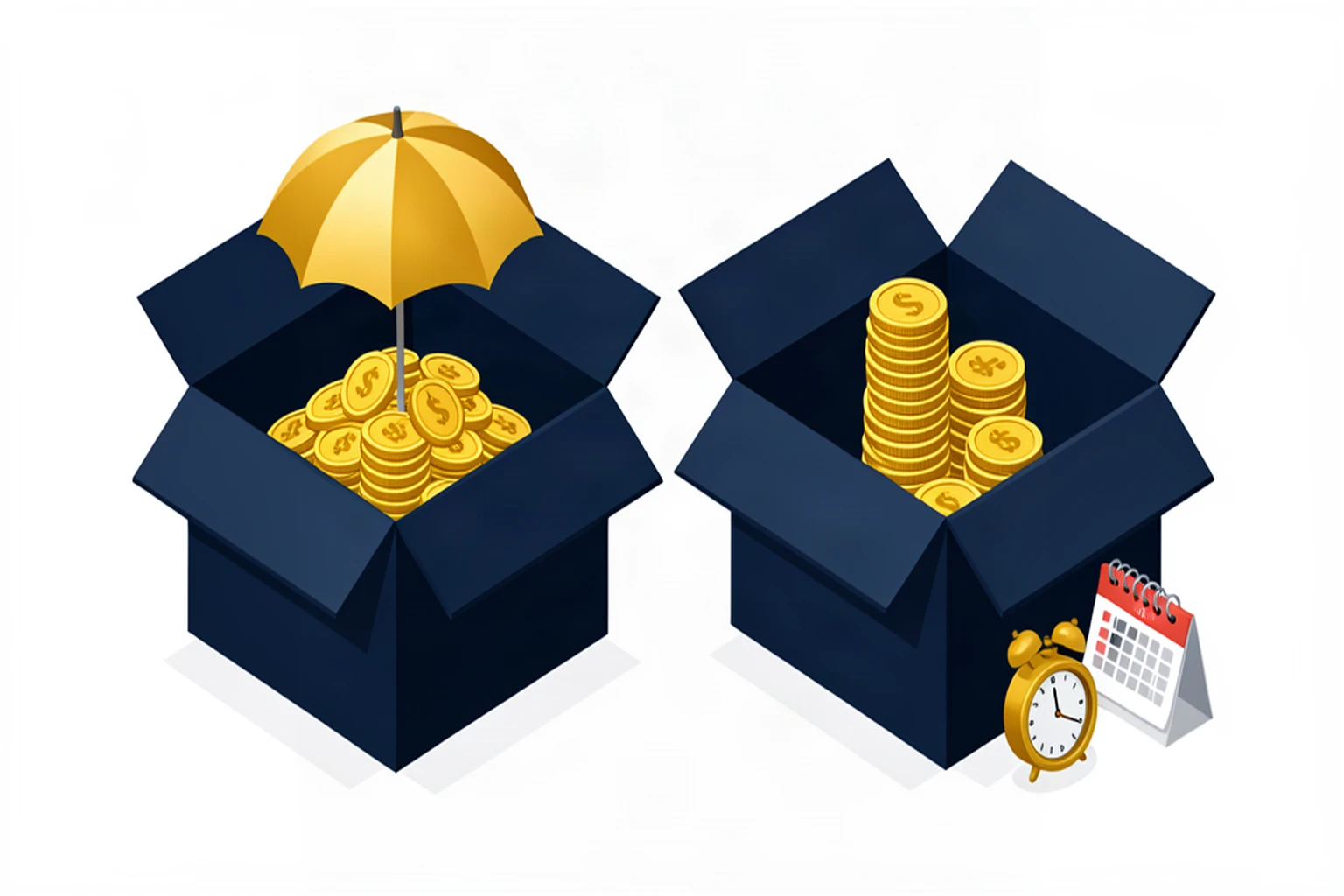
The easiest way to understand both accounts is to stop thinking of them as investments. They’re not. An RRSP is not an investment, and neither is a TFSA. They’re containers — boxes you put investments inside. You can hold GICs, stocks, ETFs, mutual funds, or bonds inside either one. The box itself is what has the tax rules, not what’s inside it.
Think of it like this. You’re moving into a new house, and you have two storage rooms. One room is labelled “Pay the tax later.” The other is labelled “Pay the tax now.” Both rooms keep your stuff safe and let it grow, but the tax bill arrives at different times depending on which room you use. That timing difference is the entire game.
The RRSP: the tax break now, the tax bill later
The RRSP is the “pay the tax later” room. You put money in, and you get a deduction that lowers your taxable income this year. For a business owner in a high-income year, that deduction can mean a big refund — real money that you can reinvest or use to build your business.
But here’s what most people gloss over: you don’t get the tax break for free. When you eventually take money out of an RRSP, every single dollar you withdraw is taxed as regular income — at whatever rate you’re paying in that year. The account grows tax-deferred, not tax-free. You’re simply delaying the tax bill to a year when, ideally, you’re in a lower tax bracket.
There are a few other things to know. RRSP withdrawals can trigger withholding tax, and they count as income, which means they can claw back government benefits like OAS and GIS in retirement. You can also withdraw money for a first home or education, but that’s a loan to yourself you have to pay back, not free money. None of this makes the RRSP bad. It just means you should only use it when the math genuinely favours you.
The TFSA: pay the tax now, keep everything later
The TFSA is the “pay the tax now” room. You contribute after-tax dollars — no deduction, no refund. But from that point on, every bit of growth is tax-free, and every withdrawal is tax-free, forever. No withholding tax, no clawback of benefits, no surprise bill in retirement.
That sounds strictly better, so why would anyone ever use an RRSP? Because the upfront deduction has real value in a high-income year, and a TFSA’s contribution room grows in a fixed, limited way each year. The TFSA gives you freedom and flexibility; the RRSP gives you a powerful tax break when you need it most. They serve different moments in your financial life.
What’s different when you’re a business owner
Most of the standard advice assumes you have a stable salary. You don’t. Your income swings from year to year — a banner year followed by a lean one, a big contract that changes everything, a year where you pay yourself more or less depending on what the business needs. That changes the whole TFSA vs. RRSP calculation.
Here’s the principle that matters more than any single number: you want your tax deduction in your high-income years and your tax-free withdrawals in your lower-income years. That’s the whole art of it.
In a high-income year, an RRSP contribution can save you thousands — you’re deducting at your top marginal rate. In a lean year, you should skip the RRSP entirely and instead lean on your TFSA, where contributions don’t hinge on your tax bracket and withdrawals are completely flexible if the business needs the cash back. Your corporate structure matters too: how you pay yourself — salary vs. dividends — affects how much RRSP contribution room you even have, since only earned income (salary) creates RRSP room. If you pay yourself mostly in dividends, your RRSP room is limited, which makes the TFSA even more important for you. This is one of those places where getting the structure right pays off for decades. If you’re not sure how your current pay structure affects your room, my post on salary vs. dividends walks through the whole decision.

A simple way to choose
Forget the complicated calculators for a moment. Here’s the practical decision rule I use with my own clients, and you can apply it in about thirty seconds:
- Are you in a high-income year? Contribute to your RRSP to capture the deduction at your top rate, then invest the refund.
- Is your income variable or unpredictable? Use your TFSA first. You keep total flexibility, and you never lock yourself into a future tax bill.
- Do you think you’ll be in a lower tax bracket in retirement than you are now? The RRSP shines. You deduct high, you withdraw low.
- Do you think you’ll be in a similar or higher bracket later? The TFSA wins. You’re paying tax now at today’s (lower or equal) rate instead of a future one.
- Might you need this money before retirement? TFSA, no contest. Withdrawals are free and penalty-free, and you get the room back the following year.
This isn’t about being perfect. It’s about making a clear decision with the information you have, instead of letting the money sit idle while you wait for certainty that never comes.
Use both, in the right order
Here’s the honest answer: for most business owners, it’s not really an either/or. It’s a sequence. Build your emergency reserve first (inside a TFSA if you can), then use your RRSP strategically in your strongest years, and keep topping up the TFSA with whatever room you have left.
This is exactly where the Save room of the Financial House comes in. Your house needs all four rooms — Earn, Save, Grow, Protect — and the Save room is where the TFSA and RRSP live. If you’re not sure how these accounts fit into the bigger picture of building wealth, my guide to the 5 Methods of Wealth Building is a great place to see how saving, investing, and asset ownership fit together.
The goal isn’t to pick the “right” account forever. It’s to make sure every dollar you’ve worked for has a job, a home, and a tax plan — instead of sitting in a low-interest account, quietly losing ground. That’s a decision you can make today. And when you do, you’ll be surprised how much lighter the whole thing feels.
This article provides general information and is not personalized financial advice. Speak with a licensed advisor about your specific situation before making changes to your retirement strategy.
Not sure where you stand? Take the 2-minute Financial House Assessment and get your personalized report — free.
Want to go deeper? Check out
Essentials of Money ($50),
The Wake Up Call ($50), or
book a free discovery call.