
You are losing money right now. Not on bad investments, not on high interest rates, not on a slow month. You’re losing it by doing nothing at all — by letting your corporate cash sit in the same chequing account where your receivables land, earning exactly 0.05% while inflation silently carves 3.2% out of its purchasing power every year.
I sat down with a client last week — a Guelph contractor who’d just finished his best year ever. $347,000 in retained earnings sitting in his business chequing account. When I asked what he was doing with it, he shrugged. “It’s my safety net. I need it liquid.” He was proud of having that cushion. And he should be — until you do the math.
That $347,000 is losing $11,104 in purchasing power every single year. Every. Single. Year. And he’s been doing this for four years. That’s not a safety net — that’s a slow-motion wealth fire, and the smoke is invisible because the dollar balance never drops.
The $3,800-a-Year Comfort Tax Every Business Owner Is Paying
Here’s what nobody tells you about business bank accounts: the bank is using your cash to lend out at 6.99%, and they’re paying you 0.05% for the privilege. That’s a 6.94% spread — on your money. The bank is making $24,078 a year off that $347,000 while you get $173.50 in interest. Let that sink in for a second.
I’m not saying you shouldn’t have a cash reserve. Every business needs one. The question is: how much, and where is it living?
In my Financial House framework, this falls squarely under Grow — but most business owners treat corporate cash like it belongs in Save. They park it in a chequing account (the Save zone) when it should be working in the Grow zone. The distinction matters because the Financial House has walls for a reason: money in the wrong room doesn’t just underperform — it rots.
The Three-Bucket System for Corporate Cash
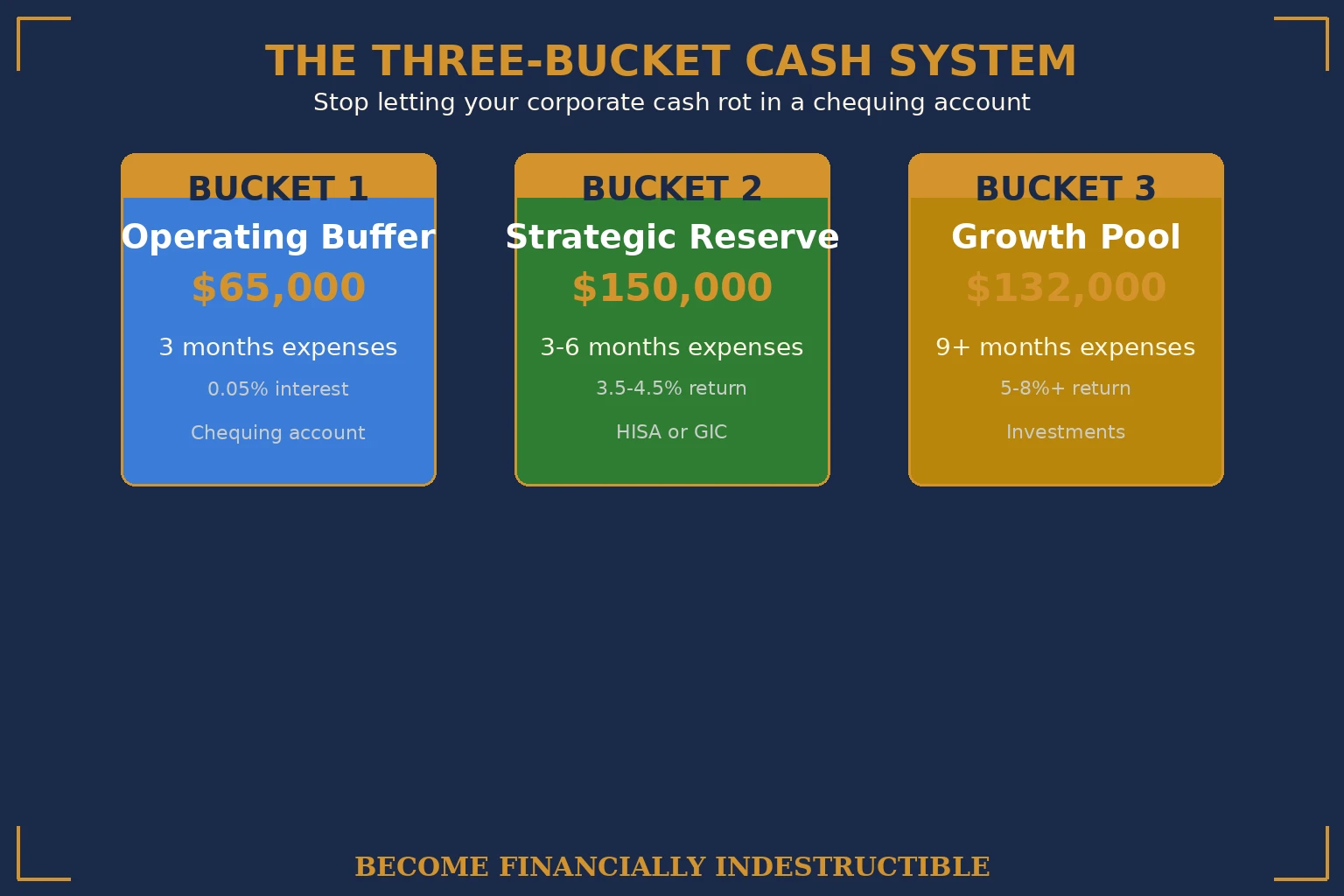
The fix is simple, and it doesn’t require you to lock everything up in risky investments. Here’s the three-bucket system I walk every business owner through:
Bucket 1: The Operating Buffer (3 months of expenses)
This stays in your chequing account. It covers payroll, rent, supplies, and the surprise HST instalment that always seems to land on the same week as your insurance renewal. For our contractor above, that’s roughly $65,000 — about 19% of his retained earnings. This money earns nothing, and that’s fine. It’s insurance, not investment.
Bucket 2: The Strategic Reserve (3-6 months of expenses)
This is where the magic starts. Move this into a high-interest savings account or a one-year GIC ladder. As of November 2026, you can get 3.5-4.5% on business savings accounts and GICs. On $150,000, that’s $5,250 to $6,750 a year — compared to the $75 you’re making in your chequing account. Same cash, different room in the Financial House.
Bucket 3: The Growth Pool (everything above 9 months)
This is money that doesn’t need to be liquid — and it shouldn’t be. For our contractor, that’s about $132,000. This capital can go into corporate investments: a diversified portfolio of ETFs held inside the corporation, real estate through a holding company, or even Bitcoin as a corporate treasury asset (one of my 5 Methods). The gains are partially tax-sheltered through the corporation’s small business deduction limits, and you control the timing of when you distribute them personally.
The $83,000 Cost of Playing It Safe
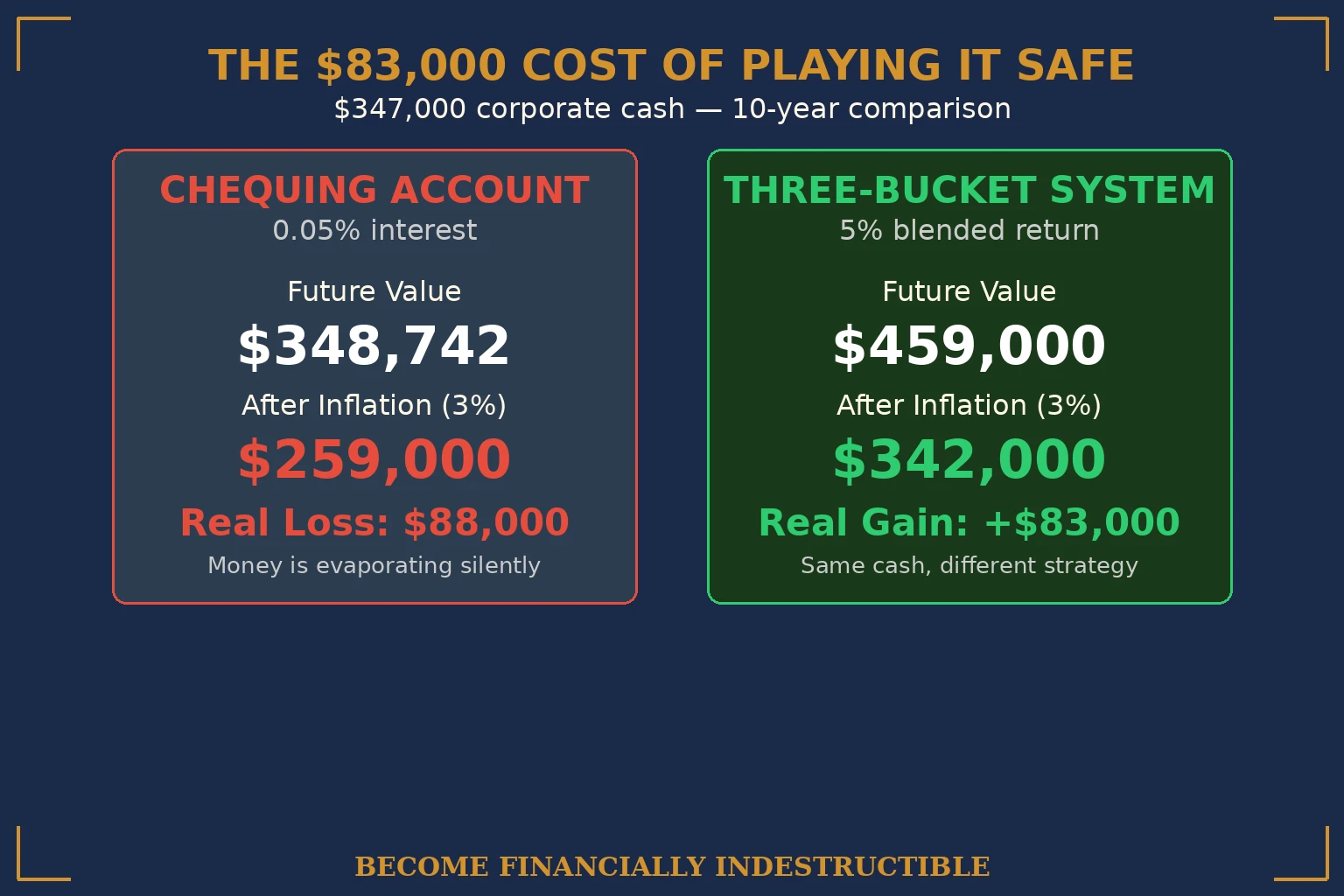
Let me show you what our contractor is actually giving up. Over 10 years, that $347,000 sitting in a chequing account at 0.05% — even assuming he adds nothing — grows to $348,742. Adjusted for 3% inflation, its real purchasing power drops to $259,000. He lost $88,000 in real terms by playing it “safe.”
Now take that same $347,000, put $65,000 in the operating buffer, and deploy the remaining $282,000 across Buckets 2 and 3 at a conservative blended return of 5%. In 10 years, that’s $459,000 — and even adjusted for inflation, it’s worth $342,000 in today’s dollars. He didn’t take more risk; he took smarter risk. The difference: $83,000 in preserved and grown wealth.
The Destroyer Nobody Talks About
The 7 Destroyers of Wealth usually get attention for the dramatic ones: Debt, Procrastination, Greed. But the quietest Destroyer is Complacency — the belief that because your bank balance isn’t dropping, your financial health isn’t declining. It’s the frog-in-boiling-water Destroyer, and it hits business owners harder than anyone because your corporate account balance looks fine on the surface.
I’ve seen business owners who would never dream of leaving $100,000 in their personal chequing account do exactly that inside their corporation — because “it’s the business account, it’s different.” It’s not different. It’s your money. Your future retirement. Your family’s security. And it’s slowly evaporating while you’re busy running your business.
Three Steps to Take This Week
Here’s what I want you to do — and I mean this week, not next quarter:
1. Calculate your burn rate. Add up every dollar your business spends in a typical month. Multiply by three. That’s your Bucket 1 number. Everything above that is eligible to work harder.
2. Open a business high-interest savings account. Most Canadian banks offer them — EQ Bank, Tangerine, or your existing bank’s business savings product. Move Bucket 2 there. It takes 15 minutes online.
3. Book a 30-minute conversation with a financial advisor who understands corporate cash. Not your bank’s “wealth manager” who wants to sell you mutual funds with a 2.5% MER. Someone who understands the Financial House framework and can help you build a corporate investment policy statement that matches your risk tolerance and liquidity needs.
Your business generates cash so that cash can generate freedom. But cash that isn’t deployed isn’t freedom — it’s a slow leak in your Financial House’s foundation. Plug the leak. Move the money. Let it work.
Not sure where you stand? Take the 2-minute Financial House Assessment and get your personalized report — free.
Want to go deeper? Check out Essentials of Money ($50), The Wake Up Call ($50), or book a free discovery call.