
You just spent four hours on a Saturday afternoon sorting through a shoebox full of crumpled receipts, wondering if that coffee meeting with a client counts as a business expense (it does) and if you can claim that laptop you bought in July (you can, partially). Sound familiar?
If it does, you’re not alone. According to a 2025 Intuit Canada survey, 78% of Canadian small business owners admit their bookkeeping is “disorganized” or “a complete mess.” And that chaos is costing you real money — an average of $31,000 per year in missed deductions, penalties, and wasted time.
Here’s the hard truth: the CRA doesn’t care that you’re busy running your business. They expect you to have your records in order. And when they come knocking — which they do for roughly 1 in 30 Canadian businesses each year — your shoebox full of receipts won’t cut it.
But here’s the good news: fixing your bookkeeping doesn’t require an accounting degree, expensive software, or hours of your time. It requires a system. And you can build one in 90 minutes.
Why Your Bookkeeping Is Bleeding You Dry — the Three Hidden Costs
Most business owners think “messy bookkeeping” just means a headache at tax time. In reality, it’s a slow leak in your Financial House that touches every pillar — Earn, Save, Grow, and Protect.
Cost #1: Missed Deductions ($8,000–$15,000/year)
The average Canadian business owner leaves between $8,000 and $15,000 in legitimate deductions on the table every single year. Not because they’re trying to cheat the system — because they simply forgot or didn’t know what was deductible. Home office expenses, vehicle mileage, client meals, professional development, software subscriptions — the list goes on. Each one seems small. Together, they’re a second mortgage payment.
Cost #2: CRA Penalties and Interest ($1,500–$5,000/year)
Missing a filing deadline or misreporting income isn’t just stressful — it’s expensive. The CRA charges daily compound interest on late payments and can levy penalties of 5% + 1% per month on unpaid balances. One missed HST return can cost you thousands before you even realize you missed it.
Cost #3: The Time Tax ($5,000–$10,000/year in lost productivity)
How many hours have you spent hunting for receipts, reconciling bank statements, or explaining your scribbled notes to your accountant? At $100–$300 per hour of your time, those hours add up fast. The business owner who spends 40 hours a year on disorganized bookkeeping has effectively burned $8,000 of their own labour.
The 3-Step Bookkeeping Rescue System — 90 Minutes to Clarity
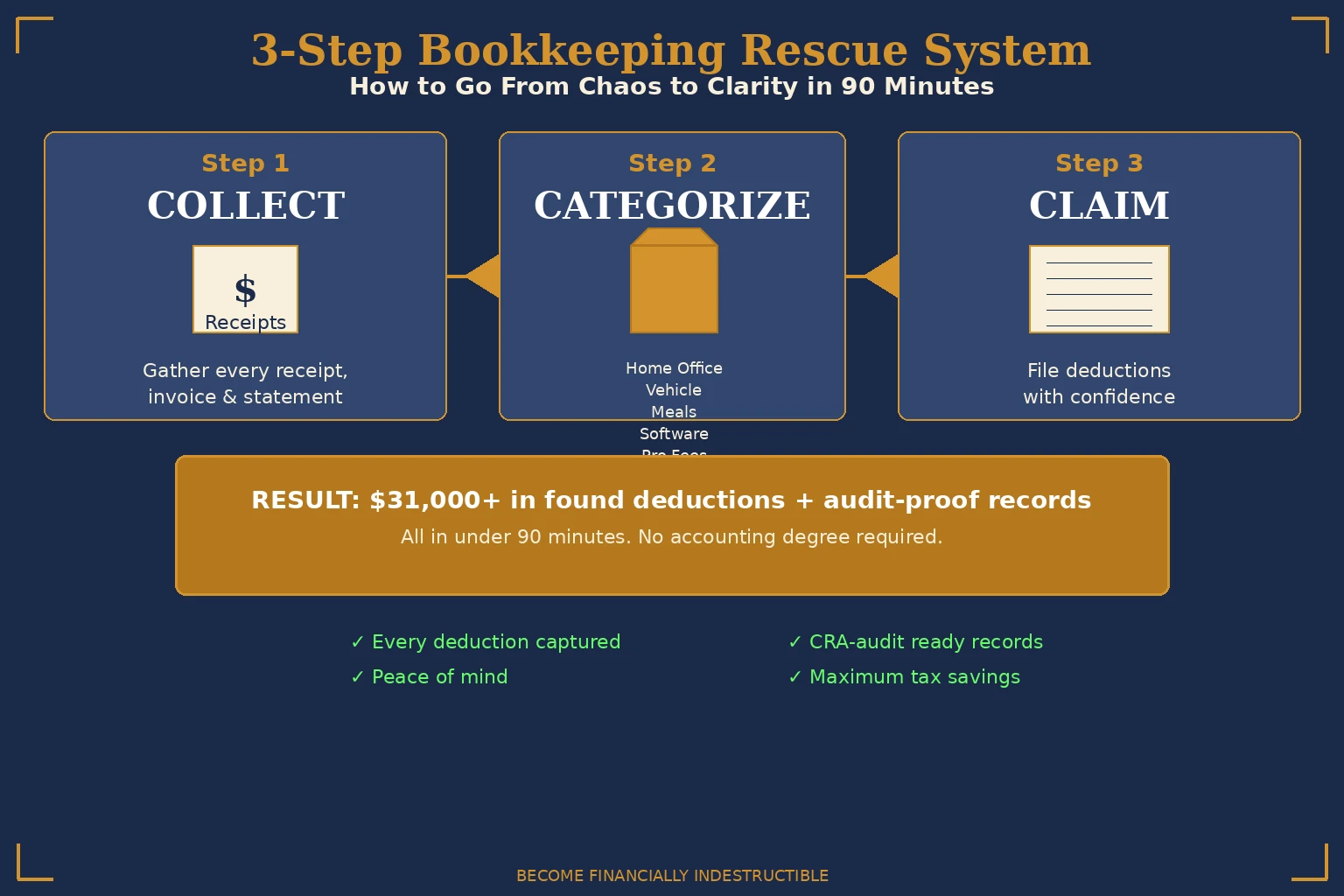
Here’s the system I teach every business owner who walks through my door. It takes 90 minutes to set up and saves you thousands every year. You don’t need QuickBooks. You don’t need a bookkeeper. You just need a Sunday afternoon and a commitment to stop leaving money on the table.
Step 1: Collect Everything (30 minutes)
Get a box, a folder, or a digital scanner. Gather every receipt, invoice, bank statement, and credit card statement from the past 12 months. Yes, all of them. The coffee receipts, the software subscriptions, the office supplies from Amazon, the parking receipts — everything. If you’re missing anything, request duplicates from your vendors or download them from your online accounts. Don’t skip this step. The CRA’s definition of “reasonable documentation” starts with having the paper.
Step 2: Categorize Like the CRA Expects (30 minutes)
Sort everything into the CRA’s standard deduction categories. The big ones for Canadian business owners are:
- Home office expenses — a portion of your mortgage interest, utilities, insurance, and maintenance based on the percentage of your home used for business
- Vehicle expenses — gas, insurance, maintenance, and lease costs proportional to business use
- Meals and entertainment — 50% of client meals, team lunches, and business-related entertaining
- Professional fees — your accountant, lawyer, and any consultants you hire
- Software and technology — your CRM, accounting software, website hosting, and phone plan
- Continuing education — courses, conferences, books, and certifications related to your field
Create a digital folder for each category (or use a simple spreadsheet with tabs). Drop each receipt into its folder. This single step will save you more money than any tax strategy I’ve ever seen.
Step 3: Claim with Confidence (30 minutes)
Now that everything is categorized, hand it to your accountant or plug it into your tax software. Because your records are organized, your accountant can actually find the deductions instead of guessing. And because you have the receipts to back every claim, you can sleep through a CRA audit.
Pro tip: most accounting software (Wave, QuickBooks, Xero) lets you snap a photo of a receipt with your phone and categorize it in 10 seconds. If you do it the day you spend the money, Step 1 and Step 2 become a five-minute weekly habit instead of a four-hour Saturday nightmare.
The Five Deductions Most Business Owners Miss (and How to Fix Them)
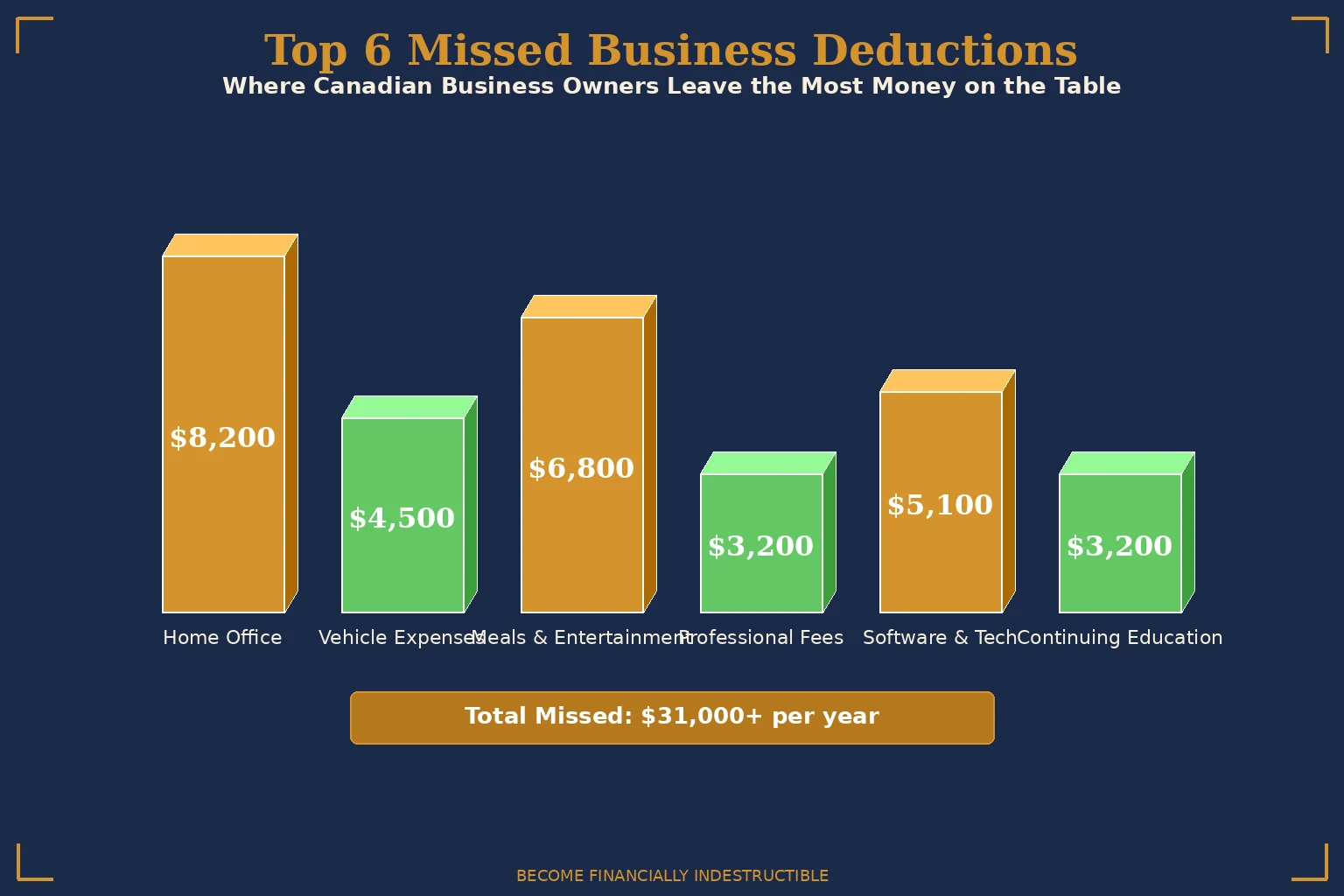
Even with a good system, most business owners miss these five deductions. Check your file before you file:
1. Home Office — Up to $8,200/year
If you work from home even part-time, you can claim a portion of your housing costs. The CRA lets you deduct based on the square footage of your workspace relative to your home. Many business owners skip this because it feels small — but $8,200 is not small.
2. Vehicle Expenses — Up to $4,500/year
If you drive to client meetings, the bank, or the supply store, track your mileage. The CRA allows 61 cents per kilometre for the first 5,000 km and 55 cents thereafter (2025 rates). A simple mileage log in your glove box can be worth thousands.
3. Meals & Entertainment — Up to $6,800/year
Client lunches, team celebrations, and industry networking events are 50% deductible. Keep the receipt and note who you met and what you discussed. The CRA wants to see a business purpose — a scribbled note on the back of the receipt is enough.
4. Professional Development — Up to $3,200/year
Courses, conferences, books, and certifications related to your industry are fully deductible. If you learned something that makes you better at your business, the CRA considers it an investment — not a personal expense.
5. Software & Technology — Up to $5,100/year
Your CRM, accounting software, website hosting, domain names, cloud storage, and even a portion of your cell phone plan are deductible. If you use your phone for business (and you do), you can claim a percentage of your bill.
The Audit-Proof Checklist
An organized bookkeeping system isn’t just about saving money — it’s about protecting what you’ve built. The Financial House’s “Protect” pillar demands that your records can survive scrutiny. Here’s your audit-proof checklist:
- Every receipt has a date, vendor, amount, and business purpose written on it
- Mileage is logged with date, destination, purpose, and distance
- Home office expenses are calculated using the square footage method with a diagram of your workspace
- Meal receipts include the names of attendees and the business discussion topic
- Vehicle logs separate business from personal use clearly
- All digital records are backed up (cloud + local)
- You have a dedicated business bank account and credit card (this alone makes bookkeeping 10x easier)
When your books look like this, a CRA auditor doesn’t just approve your deductions — they close your file and move on to someone who’s still using a shoebox.
The difference between a business owner who saves $31,000 a year and one who leaves it on the table isn’t income, industry, or intelligence. It’s a system. A simple, repeatable, 90-minute system that turns chaos into clarity and turns your financial house from a rental into a fortress.
Build yours this weekend. Your future self — and your accountant — will thank you.
Not sure where you stand? Take the 2-minute Financial House Assessment and get your personalized report — free.
Want to go deeper? Check out Essentials of Money ($50), The Wake Up Call ($50), or book a free discovery call.
Why Bookkeeping Is the Foundation of Your Financial House
Here’s something most financial advice won’t tell you: your entire Financial House rests on the quality of your bookkeeping. The Earn pillar — how much you keep from what you earn — is built on deduction accuracy. The Save pillar depends on knowing your true cash flow. The Grow pillar requires clean financials to qualify for financing. And the Protect pillar demands audit-ready records.
Think of bookkeeping as the concrete slab your house sits on. You can have beautiful walls and a gold-plated roof, but if the foundation is cracked, the whole structure is at risk. A 2025 study by the Canadian Federation of Independent Business found that 43% of small business owners who faced a CRA audit ended up paying additional taxes, penalties, or interest — not because they did anything wrong, but because they couldn’t produce the paperwork to prove they were right.
Your bookkeeping system isn’t an administrative chore. It’s the difference between building wealth on a solid foundation and building it on sand.
The Digital Upgrade: Why Your Phone Is Your Best Bookkeeping Tool
If the shoebox method sounds like you, here’s the fastest upgrade you can make: use your smartphone. Modern accounting apps like Wave (free for Canadians), QuickBooks Self-Employed, and Xero all include receipt scanning. Snap a photo of a receipt the moment you get it, and the app extracts the date, vendor, and amount. You just pick the category. Five seconds per receipt. Done.
The business owners who save $31,000 a year don’t have better accountants or more deductions available to them. They have a system that captures every single expense, categorized and ready to file, before the ink on the receipt dries. The technology is free. The discipline costs nothing. The only thing standing between you and $31,000 is a habit.
Start today. Grab that shoebox. Set a timer for 90 minutes. And watch your Financial House grow stronger with every receipt you file.