

Your fear of a routine credit check is the single biggest barrier between you and your financial legacy. While most Canadians treat their score like a fragile secret, high-achievers know it’s actually a high-performance diagnostic tool for wealth. You’ve likely felt that familiar anxiety when a lender pulls your report, worrying about a five point drop or a hidden error you missed. It’s a common frustration in a system that often feels rigged against the individual.
I’m here to tell you that the game has changed for 2026. You’re going to stop being a victim of the bureaus and start using your credit profile to unlock elite levels of capital. We’ll transform that anxiety into total clarity by mastering the mechanics of the Canadian lending landscape. You’ll learn how to leverage your standing for massive growth while insulating your assets against the C$569 million in fraud losses reported by the Canadian Anti-Fraud Centre in 2023. This is your roadmap to becoming financially indestructible and scaling your life with purpose.
Key Takeaways
- Stop playing defense and start using your financial data as a high-performance diagnostic to scale your wealth and secure your future.
- Demystify the impact of inquiries by learning how to perform a routine credit check on yourself with zero risk to your score.
- Transition from a passive observer to a strategic auditor by identifying security threats before they compromise your Canadian business or family legacy.
- Navigate the 2026 financial landscape with a step-by-step guide to accessing your data for free through Equifax and TransUnion Canada.
- Discover how the Infinite Banking Concept allows you to break free from traditional lending cycles and become your own source of capital.
Why a Credit Check is Your Most Vital Financial Diagnostic
Stop treating your financial health like a hobby. If you want to scale your wealth and secure a lasting legacy, you must face the numbers. A credit check isn’t just a routine administrative task. It’s a high-performance diagnostic tool that reveals your reliability and your potential for leverage in the Canadian market. It’s the difference between being a passenger and being the pilot of your own destiny.
Many Canadians fall into the trap of the “ignore it and it goes away” mindset. This is a dangerous delusion. You can’t hide from the data. In late 2023, Equifax Canada reported that total consumer debt reached C$2.4 trillion. If you aren’t looking at your profile, you’re flying blind. High-performers monitor their credit like a pilot monitors an altimeter. They know that a sudden drop in “altitude” can ground their biggest projects before they even start. This diagnostic is the foundation of the Financially Indestructible framework. Without it, your financial strategy is built on sand.
The Difference Between a Score and a Report
Think of your score as the grade on your final exam. It’s a quick reference for lenders to judge your risk level. However, the report is the actual textbook. It contains the raw data, the history, and the context of your entire financial life. To achieve true mastery, you must look at both. While What is a credit score? provides a numeric summary of your creditworthiness, the report tells the full story. A credit report is a historical record of financial commitments. You need this level of detail to spot trends and fix leaks in your wealth bucket before they drain your future.
Why Complacency is a Wealth Killer
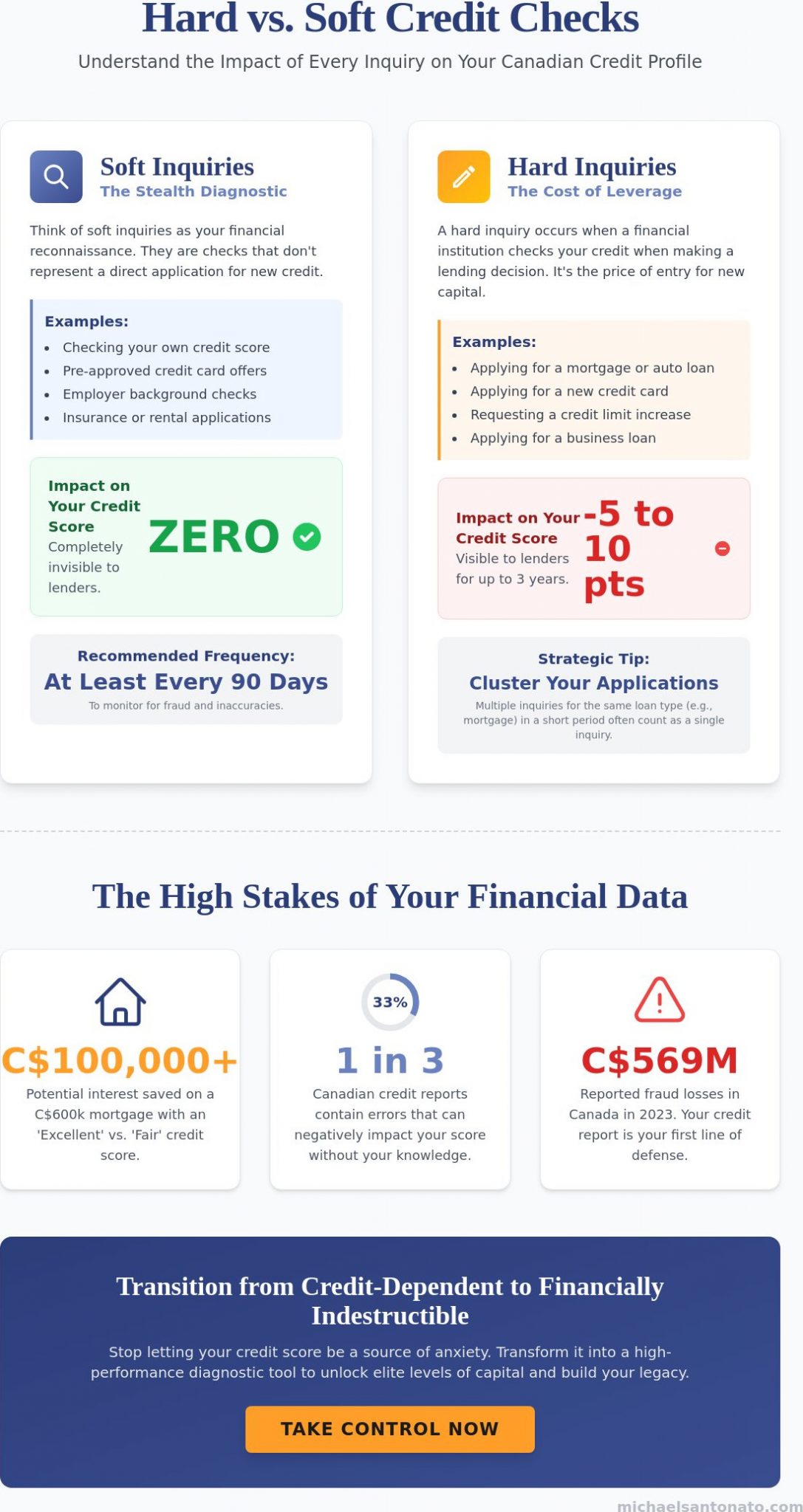
Settling for “good enough” credit is a choice to stay average. In the high-stakes world of Canadian real estate and business expansion, “average” is incredibly expensive. Consider a C$600,000 mortgage. The interest rate gap between a “fair” score and an “excellent” score can cost you over C$100,000 in interest over the life of the loan. That’s capital stolen from your future growth. Errors are also a silent threat to your impact. Statistics show that roughly 33% of credit reports contain inaccuracies that can drag down your score without your knowledge. If you haven’t performed a credit check recently, you’re likely paying a “lazy tax” that erodes your net worth. Stop being a spectator in your own life. It’s time to take ownership and drive your performance to the next level. If you’re ready to stop guessing and start growing, it’s time for The Wakeup Call.
Hard vs. Soft Credit Checks: Know the Impact on Your Score
Ambition requires data. You can’t scale a business or build a legacy on guesswork. Understanding how a credit check impacts your momentum is non-negotiable. Most people live in fear of “the check,” but high-performers treat it as a diagnostic tool. There are two distinct gears here: soft and hard. One builds your awareness; the other tests your leverage. Stop guessing and start measuring your progress with precision.
Soft Inquiries: The Stealth Diagnostic
Think of soft inquiries as your financial recon. These happen when you check your own score or when an employer runs a background check before a big promotion. They’re invisible to lenders. They don’t cost you a single point. In fact, pulling your own data is a sign of financial maturity. You should be running a personal credit check at least once every 90 days. It’s about maintaining a breakthrough mindset. If you aren’t tracking your numbers, you aren’t leading your life.
Knowledge is your primary asset in the Canadian market. You can learn more about the mechanics of how to get your free credit report to ensure your data is accurate and free from errors. For those ready to stop reacting and start dominating, The Wake Up Call course provides the specific mindset training to align your daily habits with your long-term wealth goals.
Hard Inquiries: The Cost of Doing Business
Hard inquiries are different. These occur when you apply for C$25,000 in business credit or a new mortgage. A lender digs deep into your history to assess risk. This usually triggers a temporary dip of 5 to 10 points on your score. It’s the price of entry for high-level leverage. Don’t fear the dip; manage it strategically. If you’re shopping for a major asset, cluster your applications. Canadian credit models typically treat multiple inquiries for the same type of loan within a 14 to 45 day window as a single event. This protects your score while you hunt for the best rates.
Stop being bait for retailers. That 10% discount at the checkout counter isn’t worth a hard pull on your file. It’s a low-level move that compromises your long-term borrowing power for a short-term win. Keep your hard inquiries to fewer than 3 per rolling 12-month period. This keeps your profile clean and your reputation elite. If you want to refine your strategy and protect your points, let’s book a brief strategy session to optimize your financial trajectory.
The Strategic Audit: Using Your Credit Report to Protect Your Legacy
Amateurs check their score to see if they can buy a new toy. Professionals audit their credit report to ensure their legacy remains bulletproof. You aren’t just looking for a number. You’re hunting for leaks. A single error can cost you thousands in C$ interest over a decade. It can even stall a business expansion or a critical real estate play. Treat this credit check as a high-performance diagnostic for your financial engine. Stop playing small and start looking at the raw data.
Identity theft isn’t just a headache; it’s a direct assault on your family’s security. In 2023, Canadian reports of identity fraud hit record highs, and the recovery process can take years. If you aren’t auditing your report, you’re leaving the door unlocked. You also need to watch for zombie debts. These are old, expired debts that collectors try to resurrect to drag down your wealth. Kill them immediately. Use your report as leverage. When you show up with a pristine profile, you have the power to renegotiate terms with your financial institutions. You dictate the terms, not them.
Spotting Red Flags and Errors
Research indicates that 1 in 4 credit reports contains a serious error that could result in a denied loan or higher interest rates. These aren’t just typos. They’re financial anchors. You need to be aggressive. Don’t wait for a bank to tell you no. Take the tough love approach: dispute every inaccuracy with Equifax and TransUnion the moment you find it. Check your report for these specific red flags:
- Incorrect home or business addresses that link your profile to strangers.
- Accounts you closed years ago that still show as open or active.
- Credit limits reported lower than they actually are, which spikes your utilization ratio.
- Duplicate entries for the same debt that artificially inflate your liabilities.
Leveraging Your Score for Better Terms
A top-tier score is more than a badge of honor. It’s the hammer you use in negotiations. When your credit check reveals a score north of 760, you stop asking for favors and start demanding results. Big banks want your business because you’re low risk. Use that. Call your current lenders. Demand a lower interest rate on your line of credit or a better spread on your mortgage. If they won’t budge, move your capital to a firm that values your performance.
Scaling with purpose requires access to cheap capital. You can’t build a legacy while paying retail interest rates. Understand the mechanics of Hard vs. Soft Credit Checks to protect your score while you shop for better terms. If you want to master these mechanics and build a truly indestructible foundation, you need to get the book and start implementing these high-performance strategies today. This is how you transition from being a consumer to being a master of your wealth.
How to Perform a Free Credit Check in 2026
Stop flying blind. Most people think a credit check costs money or requires a subscription. That is a lie. In 2026, transparency is your right, not a luxury. You need the raw data to build a legacy; you should not pay a cent for it. High performance requires precision, and you cannot be precise with your wealth if you are guessing about your standing.
Direct Access Through the Major Bureaus
Equifax Canada and TransUnion are the gatekeepers. To get your data without the “free trial” traps, look specifically for the “Consumer Disclosure.” This is not the flashy commercial score they try to sell you for C$19.95 a month. It is the full, unvarnished history of your financial conduct. For Equifax Canada, navigate to their “Free Credit Report” page and select the digital dashboard option. You will verify your identity through a few security questions and get instant access. TransUnion offers a similar portal called “Online Consumer Disclosure.”
If you want a physical audit of your assets, request a paper copy. You will need to mail a form with photocopies of two pieces of government ID. It takes about 10 business days to arrive; however, having a hard copy allows for a meticulous, line-by-line review of every account. The law entitles you to this information for free. Do not let corporate marketing convince you to pay for what you already own. Mastery starts with knowing the rules of the game.
Third-Party Apps and Bank Integrations
Apps like Borrowell or your RBC and BMO mobile banking portals are convenient for daily monitoring. They are great for a quick pulse check, but they have a massive flaw. These platforms often use “educational” scores that can vary by 35 to 55 points from the actual numbers lenders use. They are estimates, not the final word. If you are planning a major acquisition or a high-level investment move, relying on an estimate is a recipe for failure. You need the mastery of your full report to make moves that stick. To understand how these pieces fit into your total wealth strategy, you should Get the Book and stop playing small with your finances.
Establish a high-performance rhythm. Set a recurring calendar alert for every four months. Rotate between the bureaus. Check Equifax in January, TransUnion in May, and Equifax again in September. This 120-day cycle ensures you catch errors or identity theft before they compromise your momentum. Precision is the difference between a breakthrough and a breakdown. If you are ready to stop guessing and start scaling your impact, book a strategy session to optimize your financial performance today.
From Credit-Dependent to Financially Indestructible
Stop playing the bank’s game. Most Canadians spend decades obsessing over their score just to get a slightly better rate on a mortgage. That is small-time thinking. A credit check should be a formality, not a performance review that keeps you up at night. If you are still sweating over a three-digit number, you aren’t winning yet; you are just a well-behaved borrower. High-performers understand that credit is merely a tactical tool. The real objective is to reach a level where you no longer need the bank’s permission to move your own capital. You want to become the bank. This is about total control. It’s about moving from a position of weakness to a position of absolute power.
The Infinite Banking Shift
Mastering your own private bank changes your entire financial DNA. When you implement the Infinite Banking Concept, you use Canadian participating whole life insurance to build a pool of accessible cash value. This isn’t about hiding money; it’s about strategic liquidity. Why wait for a loan officer to approve your expansion when you can finance it yourself? In 2023, Canada’s big six banks reported over C$45 billion in combined profit. They earned that by using your deposits to lend to others at a premium. High-performers flip the script. They use traditional credit strategically while their internal cash value grows tax-advantaged. Are you building the bank’s legacy or your own? If you still rely on a standard credit check to fund your life or business, you are still a servant to the system. Break those chains. Your wealth should work for you, not the other way around.
Your Next Breakthrough Step
Success requires speed. You don’t have another year to waste on mediocre financial structures that leave you vulnerable to interest rate hikes. The Financially Indestructible movement is for those who demand more than “good enough.” It’s for the leaders who want to ensure their wealth survives market volatility and shifting bank policies. Take the decisive step today. You can continue being a line item on a bank’s balance sheet, or you can start building your own. The choice is yours, but the clock is ticking. Don’t let another month of interest payments drain your potential. To start your transformation, book a strategy session to restructure your personal finances and reclaim your power. It’s time to build a legacy that doesn’t require anyone’s permission.
Take Command of Your Financial Legacy
Your credit score isn’t just a number; it’s the pulse of your wealth. By 2026, the Canadian financial landscape will demand higher precision from every high-performer. You’ve learned that a routine credit check is your first line of defense against inefficiency and a vital diagnostic for your long-term stability. You now understand the tactical difference between soft and hard inquiries and how to leverage Equifax and TransUnion data to protect your family’s future. These aren’t just administrative tasks; they’re the mechanics of a breakthrough.
Knowledge without execution is a liability. It’s time to move beyond simple monitoring. You need a framework that turns your credit profile into a strategic asset for growth. I’ve spent over a decade coaching professionals to implement the Infinite Banking Concept and master their cash flow. As the founder of the Financially Indestructible framework, I’ve seen how a disciplined diagnostic approach can transform a legacy. Don’t leave your performance to chance. Stop reacting to the market and start dictating your terms.
Master your money and become Financially Indestructible today.
The path to mastery is open. You have the tools; now take the lead and build something that lasts.
Frequently Asked Questions
Does checking my own credit score lower it?
No, checking your own score has zero impact on your rating. This is classified as a soft inquiry, which never penalizes your financial standing. You need to monitor your data constantly to maintain mastery over your wealth trajectory. High achievers track their metrics weekly; don’t let a fear of a point drop stop you from auditing your performance.
How often should I perform a credit check on myself?
You should perform a credit check on yourself at least once a month to ensure total data accuracy. In the fast paced 2026 Canadian market, top tier performers audit their reports every 7 days using free tools like Borrowell or Credit Karma. This frequency allows you to spot errors or identity fraud before they compromise your legacy. Waiting for an annual report is a legacy mistake that costs you leverage.
What is the difference between a hard and soft credit check?
A hard check occurs when a lender evaluates you for new debt, which can drop your score by 5 to 10 points instantly. Soft checks happen during background reviews or personal audits and leave your score untouched. You must guard your report against unnecessary hard inquiries. Only authorize a hard credit check when the potential ROI on that capital justifies the temporary dip in your numbers.
Can an employer do a credit check without my permission?
No, Canadian employers must obtain your written consent before accessing your credit file. Under provincial laws like the Ontario Consumer Reporting Act, unauthorized access is a direct violation of your privacy rights. Many firms in the financial sector require this for 100 percent of new hires to verify integrity and fiscal responsibility. Always read the fine print in your employment contract to know exactly what you’re signing.
How long do negative marks stay on my credit report in 2026?
Negative marks typically haunt your Equifax or TransUnion report for 6 years in Canada. Bankruptcies can linger for up to 7 years depending on your province and whether it’s a first time filing. You can’t outrun your past mistakes; you have to outwork them. Focus on building new, positive history today to dilute the impact of those 72 months of baggage.
Will a credit check show all of my bank accounts and balances?
A credit report does not show your chequing or savings account balances. It tracks your debt obligations, such as credit cards, mortgages, and car loans. Lenders care about your reliability in repaying 100 percent of what you owe, not the cash sitting in your daily account. To prove liquidity for high level moves, you’ll need to provide separate bank statements showing your C$50,000 or C$100,000 cash reserves.
What is a good credit score for Infinite Banking implementation?
You need a credit score of at least 700 to implement Infinite Banking with maximum efficiency. While you can start lower, a score above 750 secures the best terms for the policy loans that fuel your wealth engine. This isn’t just a number; it’s your reputation in the financial arena. High performance banking requires a rock solid foundation, so aim for the 800 club to eliminate all friction.
How do I dispute an error on my credit report for free?
Submit a dispute directly through the Equifax Canada or TransUnion Canada online portals at zero cost. You must provide concrete evidence, such as a digital receipt or a formal letter from a creditor, to prove the 100 percent inaccuracy of the data. These bureaus are legally required to investigate and respond to your claim within 30 to 60 days. Don’t outsource this task; take personal responsibility for the integrity of your financial identity.