
Let’s do the one exercise every financial advisor dreads and every business owner avoids. Close your eyes for ten seconds and imagine this: you don’t retire. You die. Tonight. Not at seventy-five with a folder full of neatly organized plans — tonight. Your company still in your name. Your RRSP parked exactly where you left it. And your will… well, the one you keep meaning to write.
Here’s what nobody tells you. The day your heart stops, the CRA doesn’t pause to grieve. By law, it pretends you sold everything you own that morning — your business shares, your equipment, your rental property, your investments. Then it sends your family a bill for the tax on that imaginary sale. Before your spouse can change the garage door code, the government gets paid ahead of everyone you love.
I’ve watched brilliant owner-operators fuss over a $200 tax receipt and hand the CRA a six-figure cheque by dying without a plan. That’s not sad. It’s expensive. And it’s fixable before lunch on Tuesday.
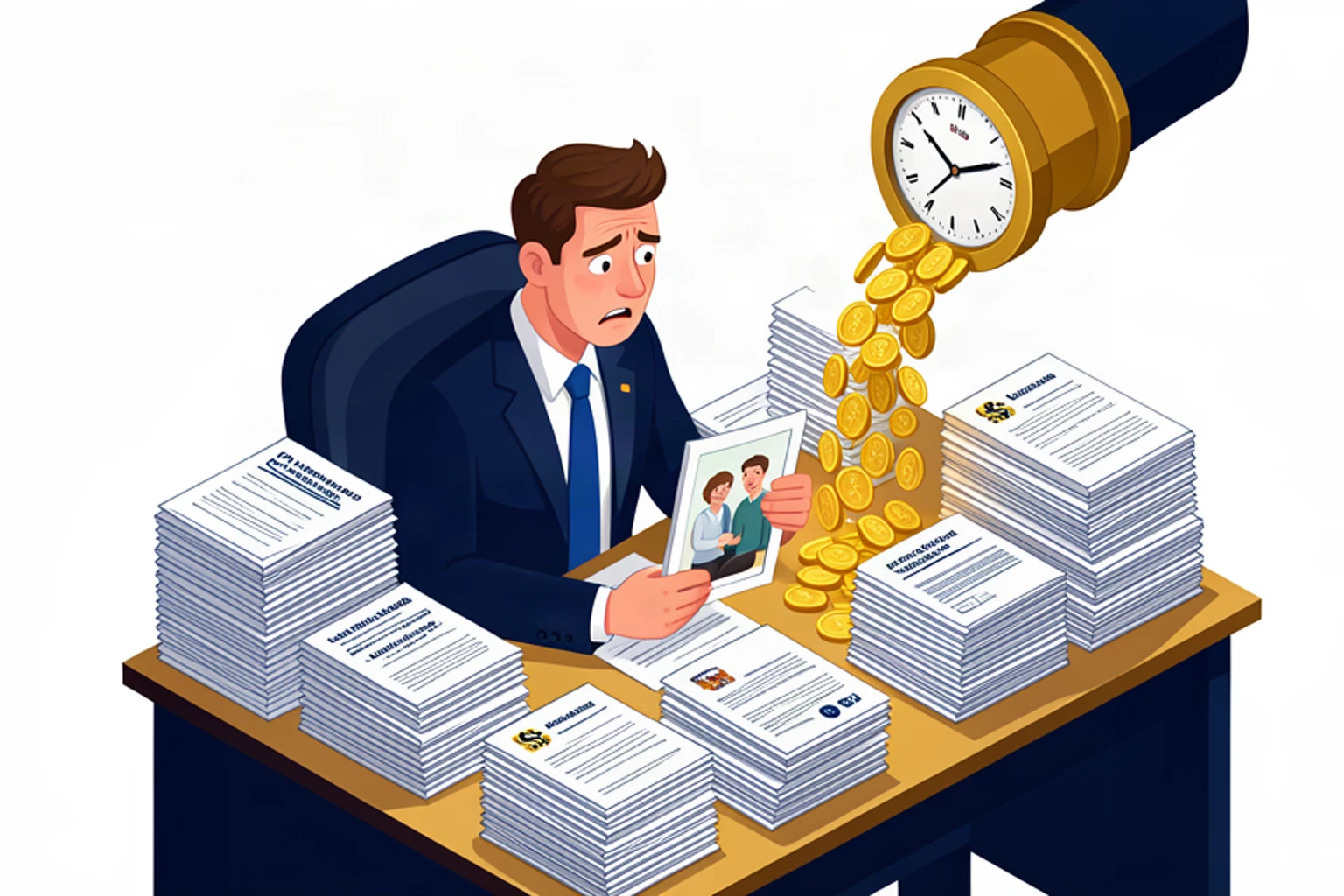
The phantom sale: why the CRA taxes you the day you die
Canada doesn’t have a “death tax” in the American sense. What we have is sneakier — and just as expensive. It’s called a deemed disposition.
On death, your estate is treated as if it sold every capital asset at fair market value the moment you passed. Business shares you bought for $50,000 that are now worth $1.4 million? Deemed sold for $1.4 million. The capital gain gets taxed on your final return. Rental properties, commercial land, a portfolio of stocks — all the same story.
And with registered money it gets worse. The full value of your RRSP is added to your final year’s income unless it rolls over to a spouse or a financially dependent child. The whole thing. At your top marginal rate. Roughly half of it gone to tax is entirely possible — no deductions, no negotiation, no “but I was going to spend it on the grandkids.”
Most owners go their entire careers never seeing this number written down. Meanwhile, the tax system was designed around it. There is a reason “estate planning” is a growth industry, and it’s not because Canadians are great at paperwork.
The real math: what your family actually keeps
Let’s make this concrete. A completely ordinary Guelph business owner — let’s call her Maria. Incorporated 18 years ago, $100,000 of share capital that’s now a company worth $1.5 million. Another $400,000 sitting in an RRSP. A house that’s paid off. No life insurance. No will update since the kids were born. No buy-sell — she’s the sole owner, so there’s no partner to force the issue.
Maria dies in a car accident at 54. Here’s the bill:
- The RRSP: $400,000 added to her final return. At Ontario’s top marginal rate (roughly 53%), that’s about $214,000 of tax — paid out of the estate before anyone sees a dime.
- The shares: $1.4 million of capital gain. Without the small-business shares exemption kicking in, the tax is roughly $350,000–$470,000 depending on the year and how the inclusion rate applies.
- The house: passes to her spouse tax-free — but it’s tied up in probate, and probate fees in Ontario are charged on the entire estate value, which nobody budgets for.
Add it up: north of half a million dollars in tax, before medical bills, before the funeral, before a single dollar of the business’s value reaches her kids. Maria spent 18 years building a $1.5 million company and unknowingly wrote the CRA into her will as the majority shareholder.

Here’s the cruelest part: the tax is due before the assets are sold. The estate can’t say “we’ll pay you when we find a buyer.” So your executor — usually your spouse or your oldest kid — is forced to sell the business fast, to whoever will take it, at whatever price, just to cover the CRA’s bill. The fire sale is often more expensive than the tax. That’s how families end up with a fraction of what you built, and a resentment of the business that made it.
The $1.25 million gift most owners never claim
Now for the part that should make you angry. Because it’s not all bad news — the law has a huge favour for business owners. Most of you will never use it.
The Lifetime Capital Gains Exemption (LCGE) lets you shelter more than a million dollars of capital gains on qualified small business corporation (QSBC) shares — completely tax-free. It stood at $1.25 million and is indexed upward with inflation every year, so the number keeps climbing on its own.
On death, your estate can claim the LCGE against the deemed disposition of your business shares. In Maria’s case, if her company is a proper QSBC, the exemption wipes out the $350,000–$470,000 share tax almost entirely. The difference between “estate in shambles” and “kids inherit a business outright” is often just this one rule.
But the rules to qualify are strict, and two structural mistakes quietly kill the exemption:
- Too much passive money in the company. For the shares to stay “qualified,” a large portion of the corporation’s assets must be used in an active business. Pile up investments inside the company and you can fail the test before you die — and the exemption evaporates at the exact moment your estate needs it. (If you’ve got dead cash building up, this connects directly to what corporate savings do to your tax plan.)
- Shares held in the wrong place. The LCGE only attaches to shares held by individuals (with family trusts and specific structures as exceptions). If your shares sit inside a holding company instead of in your name, the exemption can be lost permanently.
Both are fixable — but only while you’re alive. Nobody restructures a corporation from the executor’s chair. And the same rules that govern your deathbed exit govern your retirement sale: if you’re ever planning to sell, the structure either unlocks the exemption or torches it. If you’re approaching either event, structure now or pay later — the holding company decision and the exit plan are two sides of the same coin.
The four documents that decide who gets paid first
Estate planning isn’t a product you buy. It’s four decisions, in writing. Here’s the whole stack:
1. A real will — not a napkin, not a holograph. Roughly half of Canadians die without a valid will, and business owners aren’t better — they’re usually worse, because their estates are more complicated. No will means the provincial rules decide who gets what. The province does not know your kids hate the business. The province does not care.
2. Beneficiary designations on everything that has one. RRSP, TFSA, life insurance, pension. These pass directly to the named person — outside the will, outside probate, and (if the spouse is the beneficiary) with a tax-free rollover of the RRSP. Name them, and Maria’s $214,000 RRSP tax disappears. Leave them blank, and the money funnels into the estate, gets probated, gets taxed, gets slow.
3. Powers of attorney — and here’s the uncomfortable stat. You are statistically more likely to become incapacitated before you die than to die quickly. A car accident, a stroke, a bad anaesthetic reaction. Without a power of attorney for property and a personal care directive, your family can spend months and thousands of dollars in court just to pay your company’s bills. That’s not estate planning — that’s an emergency loan to the legal system.
4. A buy-sell agreement, if you have partners. This is the one owners skip because it feels like a partnership fight. It isn’t. A buy-sell simply pre-arranges: if you die, your partners’ life insurance pays out, and the proceeds buy your shares from your estate at a fair, agreed price. Your family gets cash — clean, immediate, no forced partnership with people they don’t know. Meanwhile the insurance death benefit lands in the corporation’s Capital Dividend Account, which lets that money flow to your heirs tax-free. Everyone wins, including the surviving business, which now has clean ownership instead of a grieving widow as a 50% partner.

Where insurance is a wealth tool, not a commission
Estate planning is the fourth pillar of the Financial House — Protect — and it’s the pillar most business owners skip, because it deals with what might happen instead of what’s happening. Earn, Save, Grow: all fun. Protect: feels like paying for nothing. That’s exactly why it’s worth the most.
Used deliberately, life insurance is the cheapest liquidity your estate will ever own. A term policy covering your estimated tax bill means your family is never forced to fire-sale the business — the insurance pays the CRA, the business stays whole, the kids keep the company. That’s the whole job of a corporate-owned policy: the death benefit lands in the Capital Dividend Account tax-free, ready to be passed to your heirs at tax-free rates.
For most owners this is genuinely a better purchase than a second rental property or another market deposit — it’s the only asset that’s guaranteed to pay exactly when you die. If you want the full sweep of where protection fits, this is the deeper dive on business-owner insurance.
The most expensive destroyer is the one you never talk about
There are seven destroyers of wealth, and they usually get airtime: debt, comparison, fear, greed, procrastination, lifestyle creep. But the one that actually wrecks owner families is the one no one wants to name: avoidance.
You run a business that exists to solve problems other people refuse to face. You’ll sit in a room and tell an employee their job is gone. You’ll argue with a supplier over $3,000. But scheduling ninety minutes to answer “what happens to my family if I’m gone?” — that’s the meeting that never happens. For a decade. Until it’s too late.
You wouldn’t leave $200,000 on the table in a supplier negotiation. You’re leaving six figures to the CRA by not booking one meeting. That’s not a tax problem. That’s a you problem, and it’s the only kind you can actually fix.
So here’s the assignment, and it’s smaller than you think. This week, do two things: write down (or update) your beneficiary designations — that’s twenty minutes on the bank’s website — and book one conversation with a professional who understands corporate structure, insurance, and the LCGE. Not a product pitch. A plan. You don’t have to solve it all this week. You just have to stop being the majority shareholder the CRA never had to earn.
You can’t take it with you. But you can decide exactly who gets it — and how much of it actually arrives.
Not sure where you stand? Take the 2-minute Financial House Assessment and get your personalized report — free.
Want to go deeper? Check out Essentials of Money ($50), The Wake Up Call ($50), or book a free discovery call.