
Walk into any room of Canadian business owners and ask one question: “What are you doing with the money your business generates?”
Nine out of ten will give you the same answer: “It stays in the business.” Or worse: “It sits in the bank.”
Here’s what nobody tells you: that answer is costing you a seven-figure retirement.
You’ve built a machine that prints money. But if every dollar that machine produces goes back into the same machine — or sits in a savings account earning 1.2% — you haven’t built wealth. You’ve built a very expensive job.

The Financial House framework has four pillars: Earn, Save, Grow, and Protect. Most business owners crush the first two. They earn like crazy and they save aggressively. But when it comes to Grow — actually multiplying that money — they freeze. They default to what’s familiar: more business, more real estate, or more cash.
That’s like owning a Ferrari and only driving it to the grocery store.
The Grow pillar of the Financial House rests on five distinct methods of wealth creation. Each one behaves differently in different economic environments. Each one has a different tax profile, liquidity profile, and risk profile. And the business owners who actually retire wealthy — the ones who don’t have to sell their company at 68 to afford their lifestyle — are the ones who learn to use all five.
Here they are.
Real Estate — The Inflation Hedge That Eats Other People’s Money
This is the one most Canadian business owners already understand. You buy a property, you rent it out, tenants pay down your mortgage, and over 25 years the thing doubles in value. Simple. Boring. Effective.
Real estate works because it does three things at once: it generates cash flow (rent covers the mortgage), it appreciates (the asset goes up over time), and it creates tax advantages (depreciation, mortgage interest deductibility, capital gains deferral through the principal residence exemption).
For Canadian business owners, real estate also offers a unique advantage: you can use your corporation to buy it. Corporate-owned real estate lets you invest pre-tax dollars — money that would have been taxed at 13-50% depending on your province and income level — and put it to work in an asset that grows tax-deferred.
The catch? Real estate is illiquid, expensive to enter, geographically concentrated, and vulnerable to interest rate shocks. If you bought a rental property in 2021 at 1.8% and it’s renewing at 4.5% in 2026, your cash flow just evaporated. If you own everything within 20 kilometres of your home, a local economic downturn takes your entire portfolio with it.
Real estate is one of the five methods. It is not the only method.
Insurance Products — The Boring Money That Never Sleeps
I know what you’re thinking: “Insurance is a cost, not an investment.”
That’s what the industry wants you to believe — because they make more money selling you term insurance you’ll never use than they do showing you how permanent insurance actually works.
Whole life insurance, participating life insurance, and universal life policies aren’t just death benefits. They’re tax-sheltered investment vehicles that grow at 3-7% annually, completely tax-deferred, and can be accessed tax-free through policy loans during your lifetime.
For Canadian business owners, the math gets even better. Your corporation can own the policy, pay the premiums with pre-tax corporate dollars, and receive the death benefit tax-free through the capital dividend account (CDA). The policy’s cash value grows without triggering the passive income rules that punish corporate investment accounts above $50,000.
The Wall Street Journal recently reported that institutional investors now allocate 15-25% of their portfolios to insurance-linked assets. If the world’s smartest money is using insurance as a growth vehicle, maybe it’s time to rethink the “insurance is a cost” assumption.
Is it exciting? No. Does it generate 40% returns? Absolutely not. But it generates consistent, predictable, tax-sheltered growth in any market condition — and that’s exactly what you need in the “Protect” layer of your portfolio.
Gold & Silver — The Wealth Insurance Nobody Talks About
Gold has been money for 5,000 years. The Canadian dollar has been money for 150 years. One of these has a longer track record than the other.
I’m not saying sell everything and buy bullion. I’m saying that every diversified portfolio needs an asset that exists entirely outside the banking system. When banks freeze, when currencies devalue, when governments print money at unprecedented rates — gold and silver don’t care. They’re the only financial asset that isn’t simultaneously someone else’s liability.
For Canadian business owners, precious metals offer a specific advantage: they can be held inside your corporation or your RRSP/TFSA through exchange-traded funds like CGL.C (gold) or ZSL (silver). You get the diversification without the storage hassle. And during the inflationary spike of 2021-2023, gold outperformed the TSX composite by a wide margin.
The key insight: gold and silver aren’t “growth” assets in the traditional sense. They’re preservation assets that happen to grow when everything else is shrinking. You don’t buy them for their upside. You buy them because they have no downside correlation with your business, your real estate, or your stocks.
Bitcoin — The Digital Asset That’s Eating the World
I can already hear the objections: “It’s volatile.” “It’s speculative.” “It’s not backed by anything.”
Let me ask you something: what backs the Canadian dollar?
Government debt. That’s it. The Canadian dollar is worth what it is because the government says it is, and because you pay your taxes in it. That’s not “backing.” That’s a collective agreement.
Bitcoin is the same thing — except instead of being backed by a government that printed 30% of its money supply in two years, it’s backed by 200 million lines of code that make it mathematically impossible to print more than 21 million coins. Ever.
For Canadian business owners, Bitcoin offers something no other asset class provides: a completely uncorrelated store of value that can be held inside your corporate treasury, accessed 24/7/365, and transferred anywhere in the world for pennies. In 2024, MicroStrategy’s stock outperformed nearly every S&P 500 company — not because their software business exploded, but because they converted their corporate treasury into Bitcoin.
Is Bitcoin volatile? Yes. A 30% drawdown is a regular Tuesday. But the trajectory over any four-year period has been decisively upward. The question isn’t “Is Bitcoin risky?” — it’s “Is holding 100% of your net worth in assets that are correlated with each other riskier?”
Your Business — The One You Already Have
This is the method every business owner is already using — and the one most are using exclusively.
Your business is an asset. It generates cash flow. It has value. It can be sold. In many cases, it’s the single largest asset you’ll ever own. The problem is that business owners treat it as an ATM, not as an investment vehicle.
The 5 Methods framework doesn’t say “stop investing in your business.” It says “stop betting 100% of your financial future on your business.”
Here’s the brutal truth: 70% of businesses don’t sell for what the owner thinks they’re worth. Buyers discount for customer concentration, owner dependency, industry risk, and a dozen other factors. If your retirement plan is “I’ll sell my business for $2 million,” there’s a 70% chance you’re going to be disappointed.
That’s not pessimism. That’s the data. And it’s exactly why the Financial House framework insists on multiple methods of growth.
How the 5 Methods Work Together
Here’s the mistake most business owners make: they pick one method and go all in. Real estate guy buys six properties in the same city using the same bank. Crypto guy puts everything in one coin. Business owner reinvests every dollar into growth.
That’s not diversification. That’s concentration with extra steps.
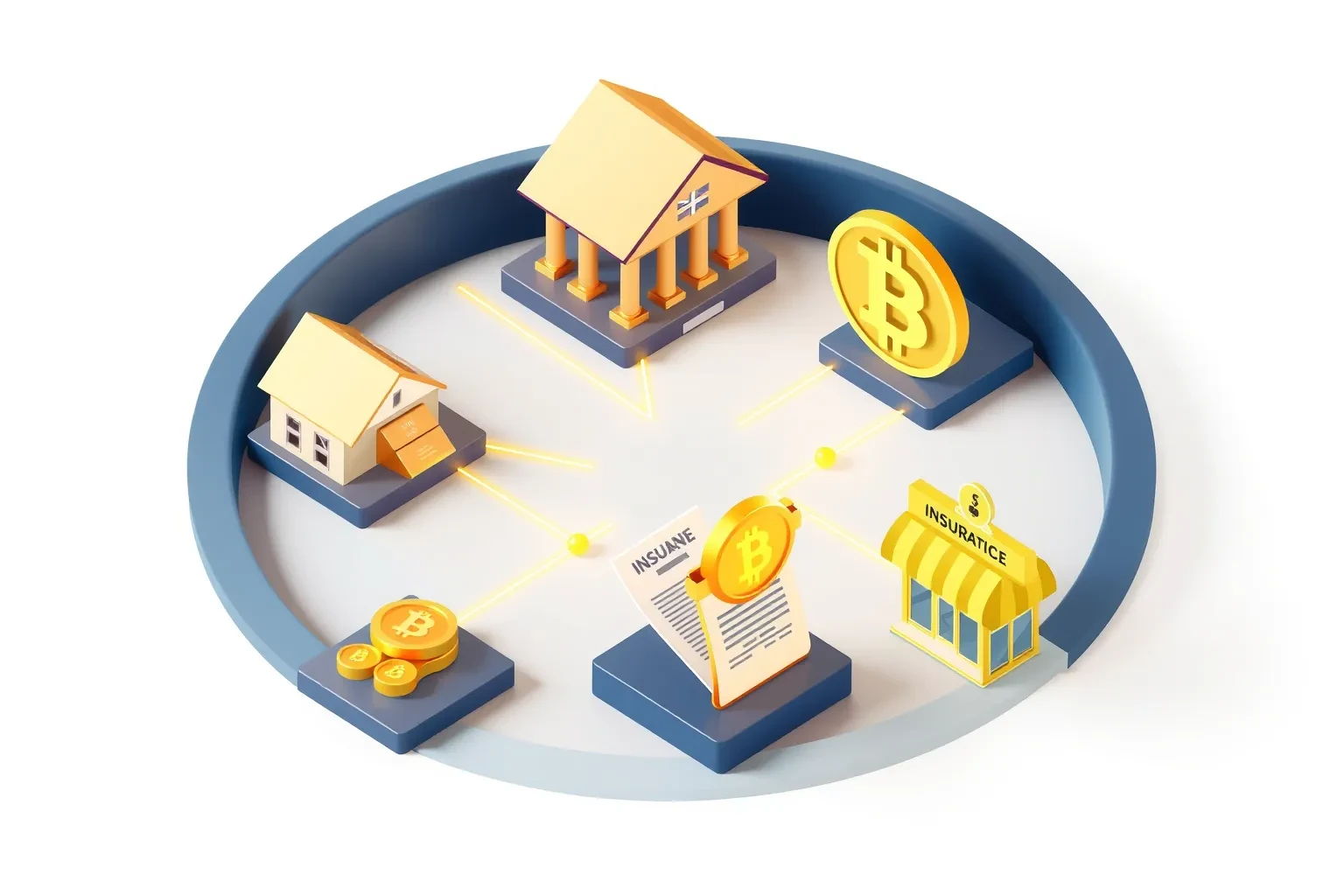
Proper diversification across the 5 Methods looks like this:
- Your business generates the cash flow (Method #5).
- Real estate (Method #1) absorbs the first layer of excess cash, giving you inflation-protected, tax-advantaged growth.
- Insurance products (Method #2) provide the tax-sheltered foundation that compounds quietly regardless of markets.
- Gold and silver (Method #3) act as the emergency brake — the asset that holds value when everything else drops.
- Bitcoin (Method #4) gives you asymmetric upside: a small allocation (3-10% of investable assets) that can dramatically change your net worth trajectory if the trend continues.
Notice what’s missing: cash sitting in a bank account earning less than inflation. That’s not a “conservative” strategy. That’s a guaranteed loss of purchasing power. At 3% inflation, $100,000 in the bank loses $3,000 of buying power every year. Over 10 years, that’s nearly $35,000 gone — and you didn’t spend a dime.
The Destroyer That’s Quietly Eating Your Wealth
Of the 7 Destroyers of Wealth — Debt, Procrastination, Comparison, Ego, Distraction, Greed, and Comfort — the one most relevant here is Comfort.
Comfort is the destroyer that convinces you the way you’ve always done things is the right way. Comfort tells you that a savings account is “safe.” Comfort tells you that you don’t need to understand gold, Bitcoin, or insurance products because they seem complicated or unfamiliar. Comfort whispers: “You’ve done fine so far. Why change now?”
Because “fine so far” isn’t a strategy. It’s a eulogy for the wealth you could have built.
The business owners who retire wealthy aren’t the ones who picked the perfect investment. They’re the ones who refused to pick just one.
They learned all five methods. They allocated across all five methods. And they rebalanced every year, selling what had run up and buying what had fallen — the same discipline that every pension fund in the world uses.
You don’t need to master all five methods today. You need to know they exist, and start exploring the ones you’ve been ignoring.
If you own real estate, learn about Bitcoin. If you’re all-in on crypto, learn about insurance products. If your entire net worth is in your business, learn about real estate and precious metals.
The goal isn’t to be an expert in everything. The goal is to never be at the mercy of one thing.
Not sure where you stand? Take the 2-minute Financial House Assessment and get your personalized report — free.
Want to go deeper? Check out Essentials of Money ($50), The Wake Up Call ($50), or book a free discovery call.