
There’s a $50,000 line in the Income Tax Act that could cost you 13¢ on every dollar your business earns — and most accountants won’t mention it until it’s too late.
If you have money sitting inside your corporation — retained earnings, a savings account, GICs, even a corporate investment portfolio — this post is the most important thing you’ll read this year. Not because I’m trying to scare you. Because the Canada Revenue Agency quietly changed the rules in 2019, and the full impact is just now landing on Canadian business owners who didn’t see it coming.
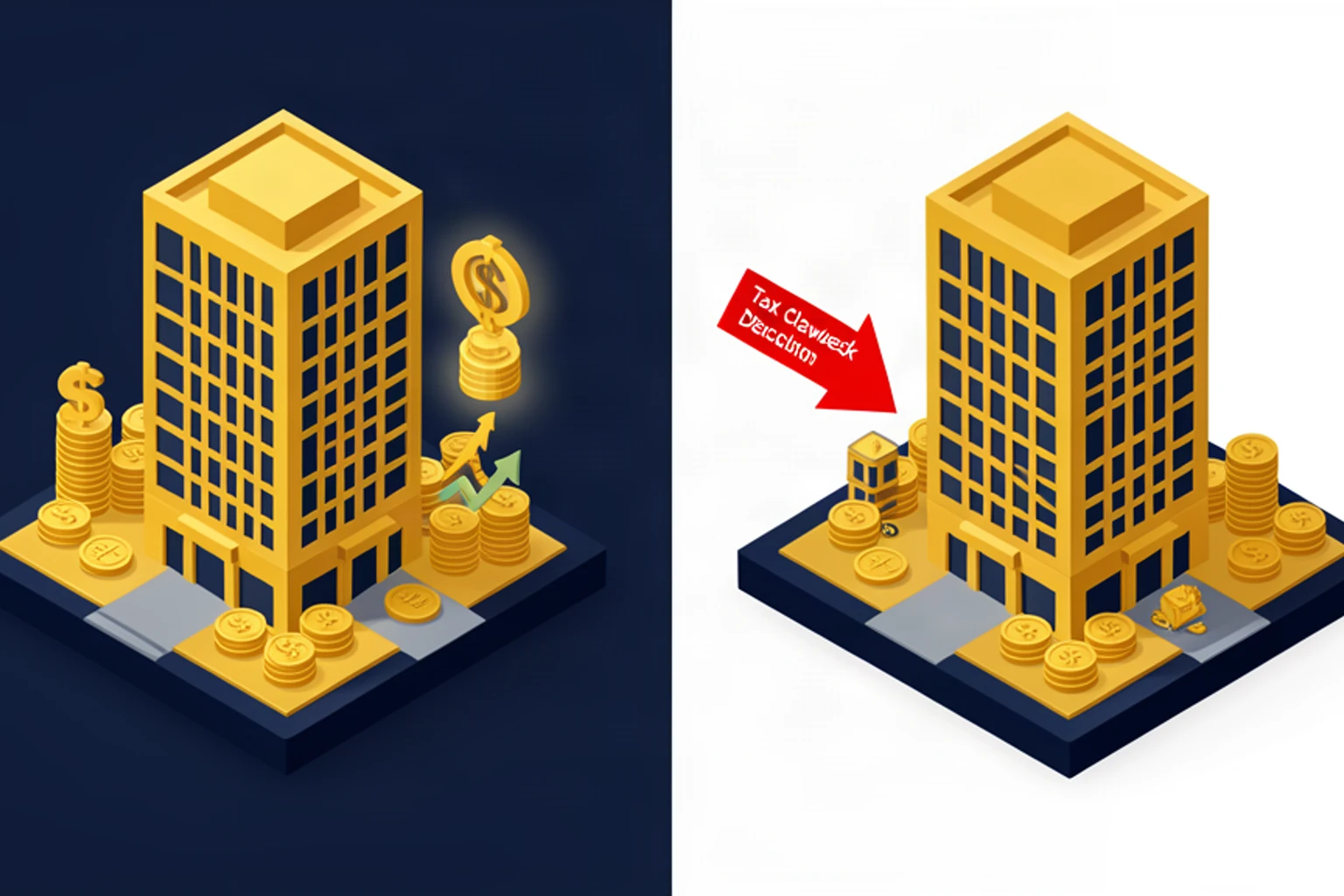
Here’s the short version: If your corporation earns more than $50,000 in passive investment income in a year, the CRA starts clawing back your small business deduction. At $150,000 of investment income, it’s gone entirely. The result? Your tax rate on the first $500,000 of active business income jumps from roughly 12% to roughly 26%. That’s an extra $70,000 in federal tax — money that could have gone to your retirement, your kids’ education, or growing your business.
But here’s the good news: this isn’t a tax bill you have to accept. Once you understand how the rules work, you can structure your affairs to stay under the threshold — or neutralize the impact entirely. Let me show you how.

What Exactly Is the Small Business Deduction — and Why Does the CRA Care About My Investments?
The Small Business Deduction (SBD) is the single most valuable tax break available to Canadian-controlled private corporations (CCPCs). It reduces the federal tax rate on your first $500,000 of active business income from 15% (the general rate reduction) to 9%. With provincial tax, the combined rate drops from roughly 26% to roughly 12% — depending on your province.
That 14-percentage-point difference is worth $70,000 a year to a business earning $500,000 of active income. For a business earning $250,000, it’s still $35,000. Over a decade, that’s $350,000 to $700,000 in tax savings.
It’s an incredible policy — designed to help small businesses reinvest their earnings and grow. And for decades, that’s exactly what happened.
But in 2019, the federal government introduced rules that started tying the SBD to how much passive investment income your corporation earns. The logic: if you have enough retained earnings to generate significant investment income, you’re not really a “small business” anymore — you’re a business that’s already succeeded. And the government doesn’t think you need the deduction as much.
Whether you agree with that logic or not, the rules are real. And they’re costing Canadian business owners tens of thousands of dollars every year.
How the Grind Works: The $50,000 Line in the Sand
The mechanism is called the “grind” of the SBD, and here’s exactly how it works:
Step 1: The CRA looks at your corporation’s adjusted aggregate investment income (AAII). This includes interest, dividends (other than dividends from connected corporations), rental income from real property, and taxable capital gains from selling assets like stocks or real estate. It does not include dividends from other corporations you control, or income from an active business.
Step 2: If your AAII exceeds $50,000, your SBD starts to shrink. The formula is:
SBD reduction = (AAII − $50,000) ÷ 5
But the reduction is capped at one-fifth of your total SBD limit. In practical terms: the SBD is fully eliminated once your AAII hits $150,000 or more.
Step 3: As your SBD shrinks, more of your active business income gets taxed at the higher general rate. The effect is a marginal rate increase of roughly 13 to 14 percentage points on your first $500,000 of active income.
Let me give you a real example.
Real-World Example: Dr. Sarah’s Clinic
Dr. Sarah runs an incorporated medical clinic in Ontario. She earns $400,000 in professional income through her CCPC. She also has $300,000 in retained earnings sitting in a corporate GIC earning 5% — that’s $15,000 in interest income.
Her AAII is $15,000. Since it’s under $50,000, her SBD is untouched. She pays ~12.2% on her $400,000 of active income.
But what if she sold an investment property and realized a $120,000 capital gain inside the corporation? Her AAII jumps to $135,000. The SBD grind kicks in. Her rate on the first $500,000 of active income climbs toward 26%. That’s roughly an extra $55,000 in tax — money that came straight out of her pocket.
The Three Ways Business Owners Get Hit (Even When They Don’t Realize It)
Most business owners I meet don’t actively try to earn passive investment income in their corporation. It just happens — and that’s what makes this rule so insidious. Here are the three most common scenarios I see:
1. The “My Retained Earnings Are Just Sitting There” Trap
You’ve been profitable. You’ve left money in the company. It’s earning 2% or 3% in a corporate savings account or GIC. That interest counts as AAII. If your retained earnings are $1.5 million earning 3.5%, that’s $52,500 in AAII — and you’ve already triggered the grind. Most business owners with over $1 million in retained earnings are unknowingly losing SBD room.
2. The “I Invested in Real Estate Inside My Corp” Trap
Rental income from real estate held in the corporation counts as AAII. So do capital gains from selling that real estate. If you buy a commercial condo or an investment property inside your company, every dollar of net rental income pushes you closer to — or past — the $50,000 threshold.
3. The “I Sold a Business Asset” Trap
Selling a major piece of equipment, a building, a customer list, or goodwill — even selling shares of another company — generates capital gains inside the corporation. The taxable portion of those gains counts as AAII. A single six-figure gain can trigger the full grind for that year. And if it happens in a “bump year,” it can cost you $70,000 in lost SBD benefit on your active income.
What You Can Do About It (Without Ditching Your Corporation)
Here’s what I want you to take away from this: the rules are real, but they’re not a death sentence. There are legitimate strategies to manage your AAII and preserve your SBD. Let me walk through the most effective ones.
Strategy 1: Keep Passive Assets Below the Threshold
The simplest fix: keep your AAII under $50,000. If your corporation has $1 million in retained earnings earning 4%, that’s $40,000 in interest — you’re fine. At $1.3 million, you brush up against $52,000 — and you need a strategy. Consider paying yourself a dividend or bonus to reduce retained earnings below the danger zone (but watch your personal tax situation), or moving some assets to non-registered accounts personally.
Strategy 2: Convert Passive Income to Active Business Income
Here’s a clever one that most accountants don’t suggest because it takes a little extra planning: reinvest your retained earnings directly into your active business. Buying new equipment, hiring a key employee, developing a new product line, expanding your facility — these are all uses of cash that produce active business income, not passive income. The return on investment is often higher than GICs anyway, and it keeps your AAII low.
Strategy 3: The Capital Dividend Account (The Accountant’s Favorite)
When your corporation realizes capital gains, 50% of the gain is taxable. The other 50% — the non-taxable portion — goes into the Capital Dividend Account (CDA). You can pay that out to yourself as a tax-free capital dividend. This removes the cash from the corporation (so it stops generating AAII) and puts it in your hands tax-free. It’s one of the most powerful tools in Canadian corporate tax planning.
Strategy 4: Use Life Insurance as a Corporate Investment Vehicle
This is a deeper strategy, but worth understanding: life insurance policies owned by the corporation (corporate-owned life insurance) accumulate cash value on a tax-sheltered basis. The growth inside the policy doesn’t count as AAII. And when you do a corporate-to-shareholder loan or a tax-sheltered withdrawal, the money comes out with significant tax advantages. It’s not for everyone, but for a business owner with $1–2 million in retained earnings, it can be a game-changer.
Strategy 5: Multiple Corporations (The “Dividend Received” Loophole)
Dividends from a connected corporation (one you control) are excluded from AAII. This means you can structure multiple operating corporations that pay dividends to a parent holding company — as long as they meet the connectedness test — and those dividends don’t count as passive income. This requires professional structuring and annual legal costs, but for businesses with multiple revenue streams, it can preserve the SBD across all of them.

The 90-Day Warning: Why You Need to Act Before Year-End
Here’s something most advisors don’t emphasize enough: the SBD grind is calculated on the previous year’s AAII in some cases (for the first year), and then in real-time on a go-forward basis. But more importantly, once your AAII hits $50,000 in a given year, you can’t reverse it retroactively. You need to be looking at your retained earnings, your investment income, and your projected capital gains before December 31 — not after.
If you’re sitting on retained earnings that might push you over the threshold, October and November are the months to act. Paying a dividend, buying business equipment, or restructuring your corporate holdings all take time to execute properly. Waiting until February tax season is too late.
The Bottom Line
The $50,000 passive income threshold is one of the most expensive surprises in Canadian business taxation. It’s not new — the rules have been in place since 2019 — but I’m still meeting business owners every month who are blindsided by it when their accountant hands them the tax bill.
You don’t have to be one of them.
The formula is simple: understand your AAII, plan your retained earnings, and structure your corporate investments to stay under the threshold — or take advantage of strategies like the CDA, business reinvestment, and corporate-owned insurance that work with the rules, not against them.
If you’re not sure where you stand, the first step is to get a clear picture of your current year’s AAII. Your accountant can run that number in minutes. Then you can decide whether you need to take action — or whether you’re already safe.
This is part of the Grow and Protect pillars of your Financial House — you’re growing your wealth inside your corporation, and you’re protecting it from unnecessary tax leakage that serves nobody but the government.
Not sure where you stand? Take the 2-minute Financial House Assessment and get your personalized report — free.
Want to go deeper? Check out Essentials of Money ($50), The Wake Up Call ($50), or book a free discovery call.