

What if the retirement safety net you’ve spent 40 years building is actually a trap designed to keep you stagnant? Most Canadians are waiting on the new cpp and oas payments scheduled for 2026 with a sense of quiet desperation, hoping the numbers will finally catch up to the skyrocketing price of groceries and gas. You know deep down that relying solely on a government baseline is a gamble you can’t afford to lose. It’s frustrating to feel like you’re losing control of your financial destiny while the CRA prepares to claw back the wealth you’ve rightfully earned.
I’m here to give you the hard truth and the exact 2026 payment increases you need to master your cash flow. You’ll discover how to transform these basic entitlements into a core pillar of a Financially Indestructible legacy. We’ll break down the phase two enhancement schedule and the specific strategies you must implement today to stop the CRA from raiding your retirement fund. It’s time to stop guessing and start leading your financial future with purpose.
Key Takeaways
- Stop guessing about your future and get the exact breakdown of the new cpp and oas payments scheduled to hit Canadian bank accounts in 2026.
- Understand why government “indexing” is often a losing game against real-world inflation and how to protect your family’s purchasing power from being eroded.
- Identify the specific income thresholds that trigger the OAS clawback to ensure the government doesn’t strip away your hard-earned retirement legacy.
- Master the strategic deferral math to unlock up to an 8.4% annual increase, transforming a baseline government check into a high-performance asset.
- Learn the “Financially Indestructible” framework to move beyond government dependence and take absolute mastery over your own banking and wealth.
The 2026 CPP and OAS Payment Schedule: What Is Actually Hitting Your Account?
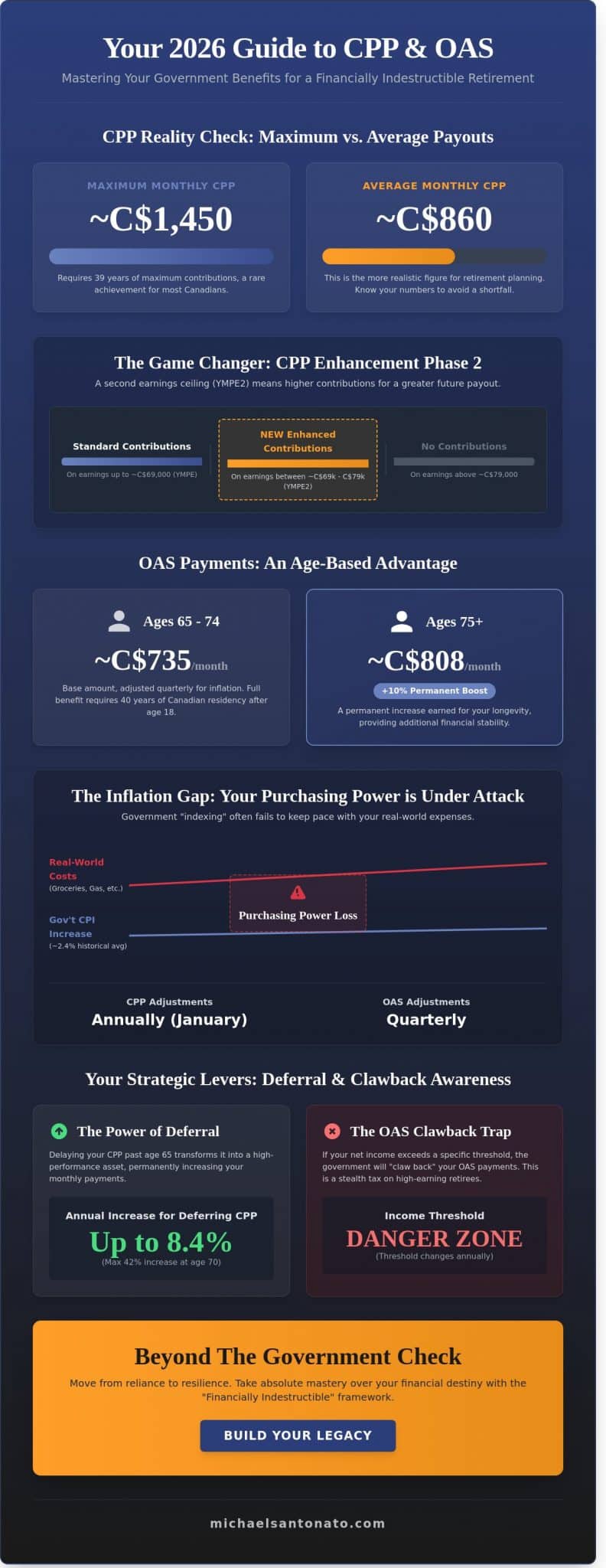
Your retirement isn’t a passive event. It’s a high-stakes performance that requires precision. For 2026, the new cpp and oas payments are shifting, and if you aren’t tracking the data, you’re losing ground. The maximum monthly CPP payout for new beneficiaries starting at age 65 is projected to reach approximately C$1,450. But here is the cold truth: the average payment is usually closer to C$860. Why the gap? The maximum requires 39 years of maximum contributions. Most Canadians simply don’t hit that mark. You must understand your specific numbers to avoid a shortfall.
Service Canada follows a strict disbursement schedule. Mark these dates in your calendar now. Your money hits the account on January 28, February 25, March 27, April 28, May 27, June 26, July 29, August 27, September 28, October 28, November 26, and December 22. These aren’t suggestions; they are the fixed points for your cash flow. The Canada Pension Plan (CPP) is the foundation of your financial security. You need to master how it works to scale your lifestyle in retirement. Stop guessing and start planning with the actual dates your capital becomes available.
CPP Increases and the Enhancement Phase
The second earnings ceiling, known as YMPE2, is the real game changer in 2026. This additional tier targets earnings between approximately C$69,000 and C$79,000, which forces a higher contribution for a higher future reward. The CPP Enhancement Phase is the multi-year transition to higher replacement rates. Your personal increase depends on how many years you contribute under these new rules. If you’ve been a high earner since 2019, your breakthrough is coming. You’re building a legacy through disciplined contributions, and 2026 is a pivotal year for that growth.
OAS Adjustments for Seniors 75 and Over
If you’re 75 or older in 2026, you’ve earned a permanent 10% boost to your base OAS. For those aged 65 to 74, the monthly base sits near C$735, but that number moves every quarter. The government uses the Consumer Price Index (CPI) to adjust for inflation. If the cost of living spikes, your payment follows. To get the full amount, you need 40 years of Canadian residency after age 18. No shortcuts. Visit True Financial Education to see how these new cpp and oas payments fit into a larger wealth strategy. Mastery of these government pillars is the first step toward financial dominance in your senior years.
Decoding the 2026 Adjustments: How Inflation Dictates Your Income
The Canadian government uses the Consumer Price Index (CPI) to calculate your new cpp and oas payments, but don’t let the technical jargon fool you. This is about your survival. The CPI measures a basket of goods, yet it often lags behind the actual prices you pay at the pump or the checkout counter. In 2026, your CPP will adjust once in January, while OAS payments undergo quarterly reviews in January, April, July, and October. This math is cold and calculated. If the CPI doesn’t move, your check doesn’t move. It’s a system built on averages, not your individual reality.
Comparing the 2026 increases to the historical 10-year average of roughly 2.4% reveals a hard truth. We’ve moved into a period of higher volatility. If your pension increase is 2.5% but the cost of home heating in Ontario or British Columbia jumps 12%, you’re falling behind. You aren’t just standing still; you’re losing ground. Mastery of your retirement requires understanding that these government adjustments are a baseline, not a breakthrough strategy for wealth.
The CPI vs. Real World Inflation Gap
Your purchasing power is under attack. The psychological trap of relying on government cost-of-living adjustments (COLA) is dangerous because it creates a false sense of security. While the government claims inflation is “under control,” your daily expenses tell a different story. You cannot index your way to a legacy. You must be proactive. Hedging against this gap means looking beyond the mailbox for your income. Consider diversifying into assets that traditionally outpace the CPI, such as dividend-growth stocks or inflation-protected securities. You need a plan that creates an impact, regardless of what the Bank of Canada decides. Take ownership of your financial trajectory by exploring True Financial Education to build a strategy that doesn’t rely on government crumbs.
Guaranteed Income Supplement (GIS) Thresholds 2026
The GIS acts as a critical safety net, but it’s a net with very specific holes. For 2026, the estimated income limits for single seniors are projected to hover around C$21,700. For married couples, that combined limit moves toward C$28,600 depending on the pension status of the spouse. These aren’t just numbers; they’re hard boundaries. If you earn a single dollar over the threshold, your benefits start to disappear. This is why your 2026 tax filing is non-negotiable. If you miss the April 30 deadline, the government will pause your GIS payments in July. They don’t care about your excuses; they care about the data. Ensure your filing is precise to protect every cent of your new cpp and oas payments and the supplemental GIS you deserve.
The Stealth Wealth Killer: Navigating OAS Clawbacks and the Tax Trap
You worked decades to build your legacy. You paid into the system with the expectation of a secure future. Now, the government promises new cpp and oas payments to help you keep up with the rising cost of living. But there is a catch they won’t highlight in the brochure. It is called the OAS Recovery Tax. I call it the stealth wealth killer. If your income climbs too high, the CRA starts clawing back your pension. It is a 15% penalty on your success. Don’t let a lack of planning turn your golden years into a tax nightmare. You need to understand the mechanics of this trap before it snaps shut on your cash flow.
The danger is real. These higher payments can accidentally push you into a higher tax bracket or trigger a clawback you didn’t see coming. It is a classic case of the government giving with one hand and taking with the other. If you aren’t managing your total income with precision, you are leaving money on the table. Stop being a spectator in your own financial life. You must master the math of retirement income to protect what is yours.
2026 Clawback Thresholds and Math
For the 2026 tax year, current economic projections suggest the OAS clawback threshold will sit near C$95,800. This is the line in the sand. Once your net world income crosses this mark, the 15% reduction rule takes effect. The math is brutal and direct. For every dollar earned over the threshold, 15 cents of OAS is lost. If your income reaches the projected upper limit of approximately C$156,000 for those under age 75, your OAS vanishes entirely. That is thousands of dollars in lost benefits simply because you didn’t structure your withdrawals correctly. This hits high achievers and disciplined savers the hardest. It is a tax on those who prepared well but planned poorly for the distribution phase.
Tax Optimization Strategies for Retirees
Your RRSP is often the primary trigger for this loss. Every dollar you pull out of that account is treated as taxable income. It is a tax time bomb. You thought you were saving money for years, but you were actually deferring a massive liability that now threatens your pension. You need a breakthrough strategy to bypass this. The TFSA is your greatest weapon in this fight. Income generated within a TFSA is tax-free and, more importantly, invisible to the CRA when they calculate your OAS eligibility. By shifting your focus to Tax-Free Wealth Planning, you can maintain a high-performance lifestyle without triggering a single cent in clawbacks.
- Withdrawal Sequencing: Take from taxable accounts first to keep your lifetime tax bill low.
- Pension Splitting: Use your spouse’s lower tax bracket to keep your individual income below the C$95,800 mark.
- TFSA Maximization: Use these funds for large purchases instead of spiking your income with an RRSP withdrawal.
The new cpp and oas payments won’t save you if you are losing 15% to 50% of your income to taxes and clawbacks. Efficiency is the name of the game. Take control of your numbers now. Build a strategy that prioritizes impact and protects your hard-earned pension from the tax man’s reach.
To Defer or Not to Defer? Maximizing Your Government Benefits Strategy
Are you making a legacy play or a fear-based retreat? Most Canadians grab their benefits the second they’re eligible because they’re afraid the well will run dry. That’s a mistake. You need to look at the hard numbers for the new cpp and oas payments and decide based on math, not anxiety. Stop acting like a victim of the system and start acting like the CEO of your retirement. The government rewards patience with massive, guaranteed increases that no traditional market investment can match with the same level of security.
The math is simple but the impact is profound. For every year you delay CPP past age 65, your benefit increases by 8.4%. Wait until age 70, and you’ve secured a 42% permanent raise. OAS follows a similar path, offering a 7.2% annual bump for deferral. These are inflation-indexed returns. Can your current portfolio guarantee an 8.4% return every single year regardless of market volatility? If the answer is no, you’re leaving money on the table.
The Math of Deferral: 2026 Edition
In 2026, the gap between starting at age 60 and age 70 is a chasm. Taking CPP at 60 results in a 36% permanent reduction in your monthly check. If you’re healthy and your family history suggests longevity, the break-even point usually hits around age 82. Once you cross that threshold, every extra dollar is pure profit. If you continue to work while deferring, your new cpp and oas payments will stack even higher due to additional contributions. Mastery of your timeline is the ultimate leverage.
When Taking it Early Makes Sense
Cash flow is king. If you’re facing immediate liquidity needs or your health status is compromised, taking the money early is a pragmatic survival tactic. It’s not about winning a math game if you can’t pay your bills today. You also have to consider the opportunity cost. If you’re a sophisticated investor who can deploy that capital into high-growth assets immediately, the deferral bonus might look less attractive.
This is where your strategy needs to get aggressive. Understanding Infinite Banking Canada changes the deferral math entirely. It allows you to create your own pool of capital, potentially outperforming the government’s fixed increases while maintaining total control. Don’t just settle for what the government gives you; build a structure that makes you indestructible.
Stop guessing about your financial future and start building a breakthrough strategy. Visit True Financial Education to master your cash flow today.
Beyond the Government Check: Building Your Financially Indestructible Legacy
Relying on the new cpp and oas payments as your primary retirement plan is the single biggest risk to your financial freedom. These government checks are a safety net, not a wealth strategy. If you want a lifestyle defined by choice rather than compromise, you must achieve mastery over your own banking. The “Financially Indestructible” framework isn’t about chasing market returns; it’s about control. You need to integrate these government payments into a broader private wealth strategy that protects you from inflation, taxes, and market volatility.
True financial power comes from building a private reserve. High-cash value life insurance allows you to create a tax-free retirement “bank” that grows regardless of what happens in Ottawa. This isn’t just about saving money. It’s about positioning your capital so it does two things at once. You want your money to grow while you still have the liquidity to use it. That is how you build a legacy that lasts for generations.
The Infinite Banking Concept for Seniors
Most Canadians spend their lives paying interest to third-party lenders. You’ve paid the big banks for your mortgage, your cars, and your credit cards. By implementing the Infinite Banking Concept, you start recapturing that interest for yourself. This strategy allows you to become your own source of financing. It creates a pool of capital that the CRA cannot claw back, unlike your OAS payments which might be reduced if your income exceeds specific thresholds. In 2026, the OAS clawback begins for individuals with an income over approximately C$90,000. Don’t let your hard-earned wealth be penalized. You can book a strategy session today to see if you qualify for the Indestructible Program and start keeping what is yours.
Your Next Steps for 2026
The landscape of Canadian retirement is shifting. You need to be proactive. Start by auditing your 2026 income sources now to prepare for the upcoming tax season. Understand exactly how the new cpp and oas payments will impact your tax bracket. A professional financial coach can help you optimize your drawdown strategy to minimize taxes and maximize impact.
- Review your cash flow: Identify where you are losing money to interest and taxes.
- Consult a mentor: Stop taking advice from people who haven’t achieved the results you want.
- Execute the plan: Knowledge without action is a waste of time.
Stop waiting for the government to save you. They won’t. The math doesn’t work. Your future is your responsibility. Start building your own bank today and secure a legacy that is truly indestructible.
Stop Renting Your Retirement and Start Owning Your Legacy
The hard truth is that the new cpp and oas payments hitting your bank account in 2026 won’t be enough to fund a world-class lifestyle. Relying solely on government schedules leaves you vulnerable to the 15% OAS recovery tax and the eroding power of inflation. You’ve seen the numbers; waiting until age 70 can boost your CPP by 42%, but even that is just one piece of a much larger puzzle. Real wealth isn’t about surviving on a government check; it’s about building a fortress that taxes and market volatility can’t touch. You need a strategy that works as hard as you do.
It’s time to stop playing defense with your future. My Financially Indestructible Framework is designed to move you beyond basic survival into true financial mastery. As an Infinite Banking Specialist and expert Canadian wealth coach, I help you reclaim control of your cash flow so you aren’t at the mercy of shifting federal policies. Don’t let your hard-earned success be a casualty of poor planning or stealth taxes. You’ve worked too hard to settle for a “standard” retirement when a breakthrough is within reach.
Master your wealth and become Financially Indestructible, Book Your Strategy Session Now
The life you’ve imagined is waiting for you to take the lead. Let’s build something that lasts.
Frequently Asked Questions
What are the CPP payment dates for 2026?
The federal government schedules CPP payments for the third to last business day of every month. In 2026, you can expect your funds on January 28, February 25, and March 27. Mark these dates in your calendar now. Consistency is the backbone of financial mastery, and knowing exactly when your capital arrives allows you to manage your cash flow with professional precision.
How much will OAS increase in 2026 for Canadians?
Old Age Security increases are tied to the Consumer Price Index and adjusted every quarter in January, April, July, and October. While the exact 2026 percentage depends on inflation data, historical trends suggest an annual lift between 2% and 3%. These new cpp and oas payments provide a vital floor for your retirement, but don’t just rely on government adjustments. Use this baseline to fuel your broader wealth strategy.
Can I receive both CPP and OAS at the same time?
You can absolutely collect both CPP and OAS simultaneously to maximize your monthly revenue. Most Canadians trigger both benefits at age 65 to create a stable foundation for their post-career life. Why settle for less? Combining these streams is a calculated move that ensures you’re leveraging every available resource to maintain your lifestyle and protect your legacy.
Is the C$2400 OAS payment real for 2026?
The rumored C$2,400 monthly OAS payment is a myth not supported by current 2026 government projections. As of late 2024, the maximum monthly OAS for seniors aged 65 to 74 is approximately C$718.33. Stop chasing social media headlines and focus on the real numbers. High performance requires making decisions based on verified data, not internet rumors that distract you from your goals.
What is the maximum CPP payment for a 65-year-old in 2026?
The maximum CPP payment for a 65-year-old in 2026 is projected to reach approximately C$1,450 per month. This figure depends on the Year’s Maximum Pensionable Earnings (YMPE) and requires you to have contributed the maximum amount for at least 39 years. Are you tracking your contribution history? You can’t achieve a breakthrough in your retirement planning if you don’t know your starting point.
How do I avoid the OAS clawback in 2026?
You avoid the OAS clawback by keeping your 2026 net world income below the estimated recovery tax threshold of C$91,000. If your income exceeds this limit, the government takes back 15 cents for every extra dollar you earn. Use your TFSA for withdrawals to keep your reported income low. This is about tactical efficiency. Don’t let the CRA penalize your success because of a poor withdrawal strategy.
What happens to my CPP and OAS if I move outside of Canada?
Your CPP payments stay with you regardless of where you live because you earned that capital through years of direct contributions. For OAS, you must have lived in Canada for at least 20 years after the age of 18 to continue receiving payments while living abroad. Your vision shouldn’t be limited by geography. If you’ve put in the work, your benefits should support your lifestyle anywhere on the globe.
Is CPP and OAS considered taxable income?
Yes, the CRA treats both CPP and OAS as taxable income that you must report on your annual tax return. You’ll receive a T4A(P) and T4A(OAS) slip every year to document these new cpp and oas payments. Don’t be blindsided by a tax bill in April. Plan your withholdings now and treat your retirement income with the same professional scrutiny you applied to your business earnings.