
Most Canadians are unknowingly handing the keys to their financial legacy over to the CRA while they call it retirement planning. You’ve likely spent years dutifully contributing to your rsp, believing you were securing your freedom. It’s a common trap. Statistics Canada reported that Canadians held over C$1.5 trillion in registered assets in 2022, yet most people are playing a game where the rules are written against them. You want control, not a government-mandated tax bill waiting to explode when you finally stop working.
I’m going to strip away the jargon and show you exactly why your current strategy might be a tax trap designed to limit your growth. You deserve a plan that offers more mastery over your capital than a standard bank account ever will. We are going to decode the terminology, expose the hidden risks to your wealth, and build a strategy that protects your hard-earned capital from future tax increases. It’s time to stop guessing and start leading your financial future with absolute certainty.
Key Takeaways
- Stop the confusion by decoding the critical difference between a general rsp and the government-regulated RRSP contract.
- Unmask the “Refund Illusion” to see why that April tax check is a strategic trap designed to benefit the CRA, not your long-term growth.
- Confront the “Tax Time Bomb” and learn how mandatory RRIF liquidations at age 71 can derail your wealth-building momentum.
- Apply the “Financially Indestructible” litmus test to your current portfolio to see if you truly own your money or just manage it for the state.
- Discover how the Infinite Banking Concept creates a private, tax-free vault that prioritizes your liquidity and long-term legacy.
RSP vs RRSP: Is There a Real Difference?
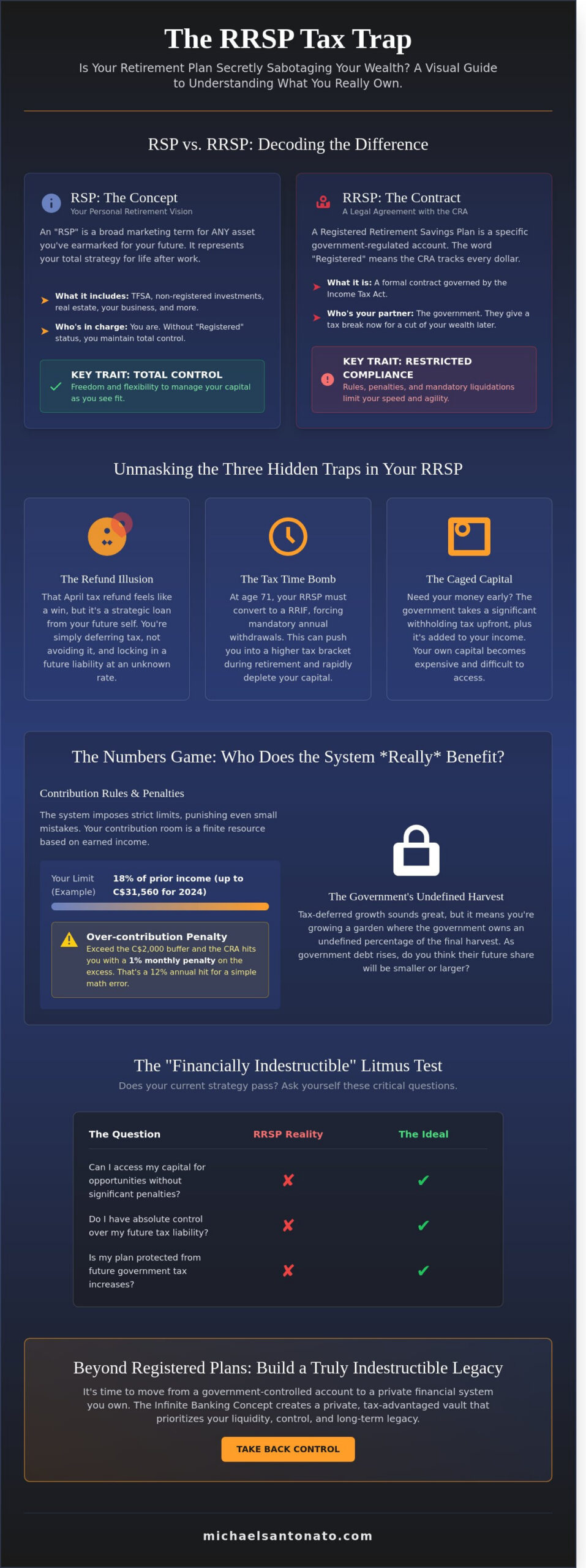
Stop letting the banks play word games with your money. You see these terms splashed across billboards every February, but most people can’t tell them apart. Here is the cold, hard truth: the difference determines who controls your wealth. An rsp is a destination, while an RRSP is a specific vehicle the government lets you drive to get there. One represents your vision for life after work; the other is a legal contract with the Canada Revenue Agency (CRA).
Financial institutions often use these terms interchangeably to keep things simple for the masses. I don’t want you to be the masses. I want you to be a master of your own capital. When a bank salesperson talks about an rsp, they’re usually selling a product. When you talk about your retirement savings plan, you’re talking about your legacy. Knowing the technical boundary between these two isn’t just semantics; it’s about protecting your performance and your profit.
The Umbrella Term: What Qualifies as an RSP?
Think of an RSP as a broad category. It covers any asset or account you’ve earmarked for your future. This includes your Tax-Free Savings Account (TFSA), your non-registered investment accounts, and even your real estate holdings. If you own a rental property in Toronto or a small business you plan to sell, that’s part of your retirement savings plan. It’s a marketing term used by banks to cast a wide net and capture your attention.
Without the “Registered” status, you maintain total control. You don’t have to report every move to the CRA, and you don’t face the same rigid withdrawal penalties. However, you also miss out on the immediate tax deduction. You’re trading a tax break today for freedom and flexibility tomorrow. Is that a trade you’re willing to make? Most people haven’t even thought about the long-term impact of that decision.
The Registered Reality: What the CRA Requires
The Registered Retirement Savings Plan (RRSP) is a different beast entirely. This was introduced back in 1957 to help Canadians save, but it comes with strings attached. The word “Registered” means the government tracks every single C$1 you deposit and every C$1 you take out. It’s a formal agreement governed by the Income Tax Act that dictates exactly how you can interact with your own money.
When you use an RRSP, you’re effectively making the government your business partner. They give you a tax break now, but they’re just deferring their cut. They’re waiting in the wings to tax you when you’re older and potentially more vulnerable. Do you really want the CRA at the table when you’re trying to enjoy your legacy? You need to understand the rules of this contract before you sign your life away. Registration means compliance, and compliance often limits your speed and agility in the market.
How the Registered System Works (and Who it Really Benefits)
The Canadian government markets the rsp as the ultimate tool for retirement, but you need to look past the brochure. The mechanics are simple. You can contribute 18% of your earned income from the previous year, up to a hard cap of C$31,560 for 2024. If you hit that limit, you stop. If you go over by more than C$2,000, the CRA hits you with a 1% monthly penalty on the excess. That is a 12% annual hit to your capital just for a math error. Does that sound like a system designed for your benefit or theirs?
Most Canadians fall for the Refund Illusion every April. You get a tax check and feel like you won the lottery. You didn’t. That money isn’t a gift. It is a calculated delay. By taking the deduction today, you are making a massive bet that your tax bracket will be lower 30 years from now. You are handing over control of your future tax liability to a government that is currently C$1.2 trillion in debt. Tax-deferred growth sounds sophisticated, but “deferred” really means “delayed and unknown.” You are growing a garden where the government owns an undefined percentage of the harvest.
The Mechanics of Contribution Room
Your contribution room is a finite resource. It is based on your earned income, not your total wealth. This creates a trap for high-achievers who focus solely on the current year. Many people use their room blindly as soon as they get it. This is a mistake. If you expect your income to jump from C$80,000 to C$160,000 in the next few years, burning your room now at a lower tax bracket is tactical suicide. You want to master your financial strategy by saving that room for your peak earning years when the deduction actually moves the needle on your legacy.
Withdrawal Rules: The High Cost of Accessing Your Capital
The moment you try to touch your money, the “registered” part of the rsp becomes a cage. Outside of specific programs, early withdrawals trigger immediate withholding taxes. In most provinces, the bank takes 10% on amounts up to C$5,000, 20% up to C$15,000, and a staggering 30% on anything over C$15,000. This happens before you even see the cash.
- Home Buyers’ Plan (HBP): Allows you to “borrow” up to C$60,000 for a first home.
- Lifelong Learning Plan (LLP): Allows C$10,000 per year for education.
- The Catch: You must pay it back on their schedule, or it counts as taxable income.
Forcing yourself to repay your own capital with after-tax dollars just to avoid a penalty is a circular trap that kills your opportunity cost. You are effectively becoming your own high-interest debt collector while the government dictates the terms of your liquidity.
The Tax Time Bomb: Why Your RSP Might Be a Liability
You’ve been sold a dream that might actually be a financial nightmare. Most people view their rsp as a fortress of wealth. In reality, it’s a growing tax lien held by the government. You’re building a balance, but you don’t own all of it. You’re simply acting as an unpaid money manager for the CRA. Every dollar of growth in that account is a future tax liability waiting to explode. Are you prepared for the fallout? Stop playing defense with your future and look at the math.
Betting Against the Future: The Tax Rate Gamble
The entire premise of the traditional retirement plan relies on a single, dangerous assumption. You’re betting that you’ll be in a lower tax bracket when you retire. Why would you strive for a life of “less” after decades of hard work? If you’re committed to mastery and growth, your income should be higher in retirement, not lower. With Canada’s federal debt sitting at approximately C$1.2 trillion as of early 2024, tax hikes are a mathematical certainty. You’re deferring taxes at today’s known rates to pay them at tomorrow’s unknown, likely higher rates. Why would you defer a 30% tax bill today to pay 50% later? It’s a losing bet that compromises your legacy.
Mandatory Meltdown: The RRIF Reality
At age 71, the government stops asking and starts demanding. You’re forced to convert your savings into a Registered Retirement Income Fund (RRIF). This isn’t a suggestion. It’s a mandatory liquidation of your assets. You must take minimum withdrawals every year, regardless of whether you need the cash or if the stock market is crashing. This loss of control is the ultimate blow to your financial freedom. These forced payments can easily catapult you into the highest tax bracket, stripping away the very wealth you spent a lifetime accumulating. You aren’t in the driver’s seat anymore; the government is. This rsp transition is designed to benefit the tax collector, not the retiree.
The collateral damage extends to your hard-earned benefits. This artificial income spike triggers the Old Age Security (OAS) recovery tax. For the 2024 tax year, if your income exceeds C$90,997, the government begins clawing back your pension. You’re being penalized for your own success. Finally, consider the “Succession Trap.” Upon your death, the remaining balance is often taxed as income in a single year. Your heirs could see 50% or more of their inheritance vanish instantly. Is that the impact you want to leave behind? It’s time to rethink the strategy before the bomb detonates.
Evaluating Your Strategy: Is Your Money Truly Yours?
Ownership is an illusion if you can’t access your capital when you need it most. True mastery over your wealth requires three non-negotiable elements: liquidity, use, and control. If your money is locked behind a wall of government regulations and bank-imposed restrictions, it isn’t truly yours. You are merely a custodian for a future tax bill. To build a legacy, you must apply the Financially Indestructible litmus test to every vehicle in your portfolio. Does this account serve your growth, or does it serve the institution holding it?
The Three Pillars of Wealth Protection
Stop settling for “someday” money. To protect your impact, evaluate your current rsp against these three pillars. First, liquidity. Can you pull C$100,000 for a business opportunity today without paying a massive tax penalty? If the answer is no, you don’t have liquidity; you have a locked box. Second, control. Who dictates the rules? With registered plans, the CRA decides when and how much you must withdraw. Finally, certainty. Do you know your exact tax liability? If you’re deferring taxes to a future date when rates will likely be higher, you’re not planning. You’re gambling.
Breaking the Institutional Cycle
Why do banks push the RRSP so aggressively every February? It’s simple. They want your deposits locked up for decades. It provides them with cheap, stable capital while you take all the market risk. There is a massive difference between being a “saver” and being a “wealth creator.” Savers follow the herd and hope for the best. Wealth creators utilize private strategies that offer tax-free growth and immediate access to capital for reinvestment.
The breakthrough moment happens when you realize you don’t need the CRA’s permission to grow your wealth or access your own hard-earned Canadian dollars. You don’t have to wait until you’re 71 to start living on your own terms. Private wealth strategies allow you to bypass the traditional gatekeepers entirely. This isn’t about avoiding taxes; it’s about mastering the mechanics of how money actually moves. Why play a game where the rules are stacked against you? It is time to stop being a spectator in your own financial life and start playing to win.
Stop letting the banks dictate your financial future and start mastering your capital today.
Beyond Registered Plans: The Financially Indestructible Legacy
You’ve spent years contributing to your rsp. You’ve played by the rules. But what if the rules were designed to benefit the government more than you? It’s time to stop thinking like a consumer and start thinking like a bank. The standard Canadian retirement path is built on a foundation of “someday.” You save today, lose control of your capital, and hope the tax rates are lower in thirty years. That isn’t a strategy; it’s a gamble. To achieve true financial indestructibility, you must move beyond the limitations of registered plans and build a private system that works for you 24/7.
The solution lies in a specialized life insurance structure known as a “Private Vault.” This isn’t the basic coverage your local agent sold you. This is a high-cash-value vehicle designed for maximum growth and tax-free accumulation. It provides a sanctuary for your capital where your money is shielded from creditors and the prying eyes of the CRA. The magic happens through the power of uninterrupted compounding. In a traditional rsp, when you take money out, the growth stops. In a Private Vault, your dollar never stops growing. Even when you leverage your cash for other opportunities, the full balance continues to compound as if you never touched it.
Infinite Banking: Becoming Your Own Banker
Traditional plans create a “lock-up” mentality. Your cash is trapped behind a wall of penalties and tax triggers. The Infinite Banking Concept (IBC) flips this script entirely. It creates a “flow” of capital. You use your system to fund major purchases like a C$60,000 vehicle or a C$150,000 business expansion while your original capital remains undisturbed, earning dividends. You’re effectively recapturing the interest you’d otherwise pay to a commercial bank. You aren’t just saving for a distant retirement; you’re building a liquid engine for wealth creation. For a comprehensive breakdown of how to implement this in the Canadian market, read the Infinite Banking Canada guide.
Your Next Move: Mastery Over Theory
Knowledge without execution is just a distraction. Don’t settle for a default financial life because it’s what everyone else is doing. Most Canadians are sitting on a “Tax Time Bomb” because they’ve over-funded their registered accounts without a clear exit strategy. You need a blueprint that prioritizes control, liquidity, and legacy. It’s time to graduate from basic saving to high-level wealth mastery. You deserve a strategy that scales with your ambition and protects your family for generations. Stop guessing and start building. Book your Private Wealth Coaching session today and let’s restructure your portfolio for maximum impact.
Take Control of Your Wealth and Kill the Tax Liability
You’ve seen the truth behind the curtain. Whether you call it an rsp or an RRSP, the reality remains that the Canadian government is your silent partner. In provinces like Ontario, the top marginal tax rate hits 53.53%, meaning the CRA could effectively own more than half of your registered savings when you go to withdraw. This isn’t just a naming convention; it’s a structural tax trap that threatens to liquidate your hard-earned capital the moment you need it most. You didn’t build your business to hand over the keys to the government during your legacy years.
Stop playing by a set of rules designed to keep you average. I’ve spent over 12 years as a high-performance financial coach, helping Canadian business owners navigate these specific pitfalls. As the founder of the Financially Indestructible framework and a specialist in the Infinite Banking Concept, I help you move beyond simple deferral into total asset mastery. You deserve a strategy that ensures your money is actually yours. Master your wealth and stop the tax leak—Join the Financially Indestructible Program. You have the ambition to lead; now it’s time to build a financial foundation that’s as powerful as your vision.
Frequently Asked Questions
Is an RSP the same as an RRSP for tax purposes?
Yes, for most Canadians, an RSP and an RRSP are functionally identical for tax purposes. Banks often use the term Retirement Savings Plan (RSP) as a marketing label for the Registered Retirement Savings Plan (RRSP) defined under the Income Tax Act. Every dollar you contribute to a registered rsp reduces your taxable income for that year. Don’t get tripped up by the labels. Focus on the tax deduction and the long term growth.
Can I have both an RSP and an RRSP at the same time?
You can hold multiple accounts, but your total contribution limit remains the same across all of them. The CRA sets your 2024 limit at 18 percent of your previous year’s earned income, up to a maximum of C$31,560. Opening more accounts doesn’t give you more room. It just adds complexity. Consolidate your assets to maintain clarity and control over your wealth. Mastery requires simplicity, not a scattered portfolio.
What happens to my RSP if I move out of Canada?
You can keep your account, but you’ll face a non-resident withholding tax of 25 percent on any withdrawals you make. Some tax treaties might lower this to 15 percent depending on your new country. You lose the ability to contribute new funds once you’re no longer a resident. Stop letting your money sit idle. Plan your exit strategy before the CRA takes a massive bite of your legacy.
Is it better to contribute to a TFSA or an RRSP first?
High earners making over C$106,717 in 2024 should prioritize the RRSP to maximize tax bracket arbitrage. If you’re in a lower bracket, the TFSA is your best friend because it offers tax-free growth without the future tax liability. Don’t follow generic advice. Look at your current tax rate versus your expected retirement rate. Make the move that protects your bottom line today and builds impact for tomorrow.
Can I use my RSP to pay off my mortgage early?
You can withdraw funds at any time, but you’ll pay immediate withholding taxes and lose that contribution room forever. A C$50,000 withdrawal could trigger a 30 percent immediate tax hit in provinces like Ontario. Unless you’re using the Home Buyers’ Plan to withdraw up to C$60,000 for a first home, this move kills your compounding. It’s a high-cost way to clear debt. Protect your capital at all costs.
What is the maximum I can contribute to my RRSP in 2026?
The projected maximum contribution limit for 2026 is C$33,810. This follows the 2025 limit of C$32,490. You’re still capped at 18 percent of your 2025 earned income. Don’t wait until the March deadline to figure this out. Maximize your room early in the year to let that capital work for you. Performance is about precision. Get your numbers right and execute with speed.
How do I know if my retirement plan is a “tax time bomb”?
Your plan is a bomb if 90 percent of your wealth is locked in tax-deferred accounts. You aren’t saving taxes; you’re just delaying them until you’re in a potentially higher bracket or face OAS clawbacks. If your projected RRIF withdrawals at age 72 push you over the C$90,997 income threshold, the government starts taking back your benefits. Diversify your tax buckets now to ensure a breakthrough in your net worth.
Can business owners use a private banking system instead of an RRSP?
Successful business owners are increasingly using high cash value dividend-paying life insurance to build a private reserve. This system allows you to access capital for business growth while your money continues to grow tax-deferred. It bypasses the restrictive rules of a traditional rsp and provides a liquid alternative. Stop being a spectator in your own financial life. Take control of the banking function in your business today.