
Why Your Neighbour’s New Truck Is Costing You More Than You Think
You drive past that new truck in their driveway. The one with the chrome rims and the pristine black paint. Your neighbour waves as you go by, and you smile back. But something gnaws at you. They’re the same age as you. They’ve got the same kind of business. How did they afford that? What are they doing that you’re not?
That feeling — that quiet, persistent comparison — is one of the most dangerous forces in personal finance. It doesn’t feel dangerous. It feels like ambition. It feels like keeping score. But left unchecked, it’s one of the 7 Destroyers of Wealth, and it has quietly sabotaged more financial plans than market crashes, bad investments, or even overt spending addiction.
If you’re a Canadian business owner, you’re especially vulnerable. You don’t have a boss setting your salary. You don’t have a pension contribution deducted automatically. Your income fluctuates, your peers are other entrepreneurs, and the line between “keeping up” and “smart business spending” blurs every single day.
Let me show you how the comparison trap works, why it’s costing you real money, and — most importantly — how to get out of it.
The Comparison Trap: The 7th Destroyer of Wealth
Most people know the six obvious destroyers: debt, poor cash flow, lack of protection, bad investments, taxes without planning, and not saving for retirement. But the seventh — the one that fuels all the others — is comparison-driven decision making.
It starts innocently enough. A friend tells you about a crypto trade that tripled. A colleague buys a vacation property. Your cousin’s business just landed a six-figure contract. And suddenly, the path you’re on — the slow, steady, boring path — feels inadequate.
So you make a move. You chase a hot stock. You upgrade your office before your cash flow justifies it. You take on debt for a lifestyle that looks like success but doesn’t feel like freedom.
None of these decisions look like mistakes in the moment. They look like ambition. But they’re reactions — not strategy. And reacting to someone else’s highlight reel is a terrible way to build your own wealth.
Why Business Owners Are Especially Vulnerable
Entrepreneurs live in a world of constant comparison. It’s built into the job. You go to networking events where everyone’s talking about their wins. You scroll LinkedIn and see peers celebrating milestones. You hear about other businesses in your niche raising capital, expanding offices, hiring teams.
And because your income isn’t fixed, there’s no natural guardrail. An employee who overspends hits their credit card limit. A business owner who overspends just… keeps spending. There’s always another revenue stream to chase, another line of credit to tap, another “investment” that might pay off.
This is where the Financial House framework matters most. Your Financial House has four rooms: Earn, Save, Grow, and Protect. Comparison-driven decisions tend to skip straight from Earn to Grow — and they ignore Save and Protect entirely.
You see someone making money in crypto, so you skip building your emergency fund and jump into a volatile asset. You see a competitor buying new equipment, so you finance a purchase before you have the cash reserves to back it up. You’re trying to grow a house that doesn’t have a foundation.
The Real Cost of Keeping Up
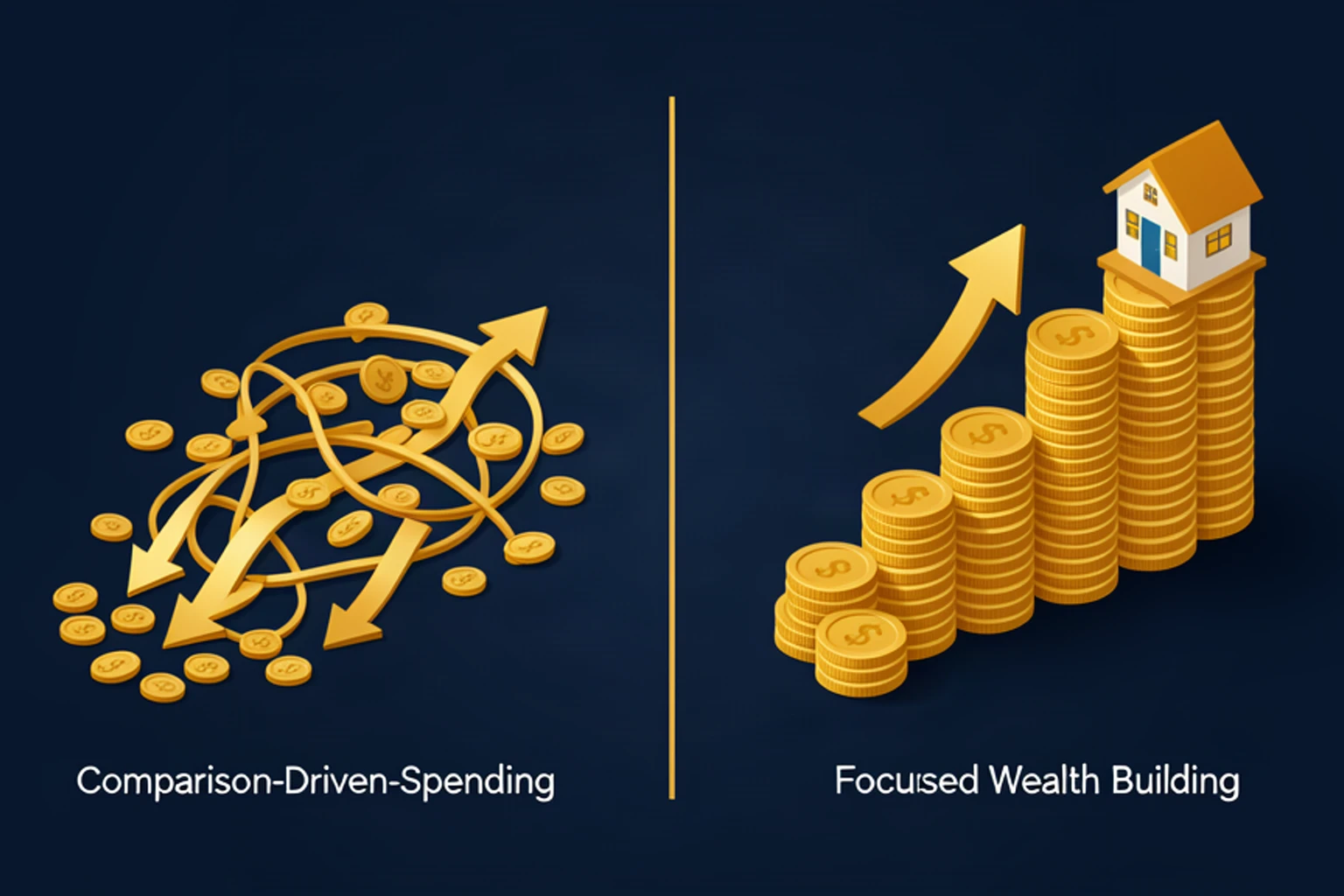
The financial cost of comparison is easy to measure. Every dollar spent to impress someone else — the nicer car, the bigger office, the fancier dinner — is a dollar that could be working for you inside your Financial House. But the hidden cost is worse: the stress, the anxiety, the feeling that you’re always behind.
Here’s what I’ve seen in my years working with Canadian business owners: the ones who build lasting wealth are rarely the ones who look the most successful. They’re the ones who don’t care how their wealth looks from the outside. They care about what it does on the inside.
They’re the ones who drive a five-year-old car and have a $500,000 investment portfolio. They’re the ones who skip the flashy office renovation and quietly buy their second rental property. They understand that wealth is what you don’t see.
As I wrote in a recent post about fear and greed in financial decisions, your emotions are the biggest threat to your financial plan — and comparison feeds both fear and greed equally.
Comparison tells you you’re behind (fear). Then it tells you to catch up fast (greed). Neither emotion leads to good decisions.

How to Rewire Your Brain: Practical Steps to Stop Comparing
Breaking the comparison trap isn’t about willpower. It’s about systems — and that’s good news for business owners, because you already know how to build systems.
1. Define Your Own Finish Line
Comparison thrives in a vacuum. When you don’t know what “enough” looks like for you, every external milestone looks like the target. Sit down and get specific:
- What does financial independence actually mean for your family? (Not your neighbour’s family, not your mentor’s family — yours.)
- What number, invested and yielding, would let you sleep through any market crash?
- What lifestyle do you actually want — not the lifestyle you think you should want?
Write it down. Put it somewhere you can see. Every time you feel that twinge of comparison, go back to your number. Does their win change your finish line? No. It doesn’t.
2. Build the Save Room First
The Financial House starts with Earn (your income) and Save (your reserves). Not Grow. You don’t get to invest aggressively until you’ve built a foundation. That means:
- 3-6 months of personal and business operating expenses in cash
- A dedicated tax account (so CRA surprises don’t derail your plan)
- An emergency fund that’s truly separate from your investment capital
When you have that buffer, comparison loses its power. You’re not chasing the next score because you’re scared of running out. You’re playing from a position of financial stability, not financial anxiety.
I covered this system in detail in my article on separating business and personal finances — because the first step to building a Save room that works is keeping your buckets straight.
3. Run Your Own Race
Here’s a question I ask every client who feels behind: “If nobody else could see your bank account, your house, or your car — if social media didn’t exist and no one at your networking group knew what you drive — what would you change about your financial plan?”
The answer is usually “nothing” or “very little.” Most of the pressure we feel is external. Strip it away, and the right path becomes obvious.
Run your race. Not theirs. Your business, your family, your goals — they’re unique. The financial strategies that work for the guy with the truck might not work for you. And that’s not just okay. That’s the point.
The Financial House Framework: Your Blueprint, Not Theirs
The Financial House isn’t just a metaphor — it’s a practical framework for making decisions that serve you, not the people around you.
Every financial decision you make should answer one question: Which room of my house does this serve?
- Buying a new vehicle? Does that serve Save? (Unlikely.) Does it serve Grow? (Only if it generates income.) Does it serve Protect? (Not really.) Where does it fit?
- Investing in a course or certification? If it helps you Earn more, great — that’s the Earn room. But if it’s just because you saw someone else do it, that’s comparison, not strategy.
- Hiring a new team member? If it genuinely grows your business capacity, that’s Earn and Grow. If it’s because your competitor has a bigger team, that’s comparison.
The framework removes the emotion. It gives you a checklist instead of a feeling. And when you operate on a checklist instead of a feeling, you stop making expensive decisions based on what everyone else is doing.
If you want a deeper dive into how the Financial House works alongside the 5 Methods of building wealth, check out my previous post on why financial goals fail — it walks through the exact system that replaced comparison with clarity for dozens of my clients.

Comparison Is the Enemy of Enough
Here’s the truth that took me years to learn: there will always be someone richer, faster, or more successful than you. Always. If you build your financial plan around catching up to the person ahead of you, you will never, ever feel wealthy — no matter how much you accumulate.
Wealth isn’t a ranking. It’s not a leaderboard. It’s knowing that you have enough for what matters to you. It’s a paid-off house, a growing investment portfolio, a business that serves your life instead of consuming it, and the peace of mind that comes from knowing you’re on your path.
The comparison trap isn’t a character flaw. It’s a wiring issue — and like every other aspect of your finances, it can be rewired with the right system.
You don’t need their truck. You don’t need their timeline. You need your Financial House, in order, built for your life.
Not sure where you stand? Take the 2-minute Financial House Assessment and get your personalized report — free.
Want to go deeper? Check out Essentials of Money ($50), The Wake Up Call ($50), or book a free discovery call.